
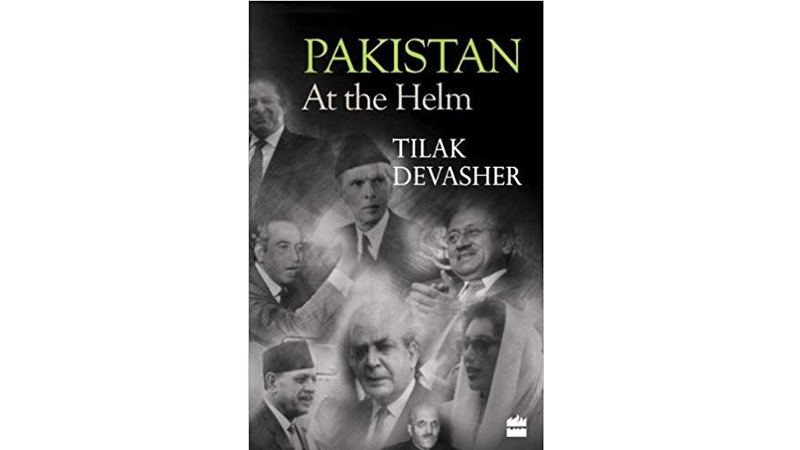
Tilak Devasher has written an evaluation of all the major leaders, beginning with Jinnah and concluding with Musharraf. Some Pakistanis may approach the book, Pakistan: At the Helm with apprehension since the author was a cabinet secretary in India. They will be pleased to find out that his assessment contains no rancor or ill will.
Devasher is not the first analyst to note that Pakistan has been poorly served by its leaders. Most of them have proven to be selfish, authoritarian, corrupt and incompetent, regardless of whether or not they wore a uniform.
They have led Pakistan down a primrose path of promises that were never fulfilled for the common person. And they have been fueled by a hatred of India, a country with which Pakistan has fought over and over again, with increasingly negative results. Air Marshal Asghar Khan made the same point in his 2005 book, “We’ve learnt nothing from history.”
The book, “neither a conventional history of Pakistan nor a biographical one,” seeks to derive lessons from history.
Its major conclusion is that Pakistan’s leaders governed as if they were emperors in the Mughal tradition when “the entire empire was the personal estate of the ruler; the bureaucracy functioned at his whims and fancies.” Thus, “instead of the rule of law there was the law of the ruler; all power and authority flowed from the ruler — political, military, administrative and judicial.”
While this attitude was to be expected during periods of military rule, it remained visible even under civilian rule. A thrice-elected prime minister, ruling “like a king, Nawaz ignored parliament, the rest bastion of his strength, rarely consulted his cabinet and considered himself above accountability. Civil servants were at his beck and call as if they were servants rather than employees of the state. Thus, capricious exercise of power has become the prevailing form of governance replacing institutions and democratic functioning….Institutions have been eroded to such an extent that instead of being protectors of the democratic system, they have become complicit in the erosion of the system.”
With that assessment, Devasher may have put his finger on the widespread popular support that brought victory to Imran Khan in the recent elections, and for the repeated bouts of military rule that the country has endured.
Ayub was so disenchanted by the War of September 1965 that he told his cabinet that he would never again risk the future of the 100 million people of Pakistan for the sake of five million Kashmiris. He was also disenchanted with the US for cutting off arms supplies and reached out to China for arms.
Premier Zhou told him China would be happy to provide arms provided Pakistan was prepared to fight a long war and even risk lose a few cities. Ayub demurred. His army, trained in the British military tradition, was unwilling to fight a people’s war. Zhou believed that a country without a viable military-industrial network and facing a bigger enemy would have to fight a guerilla war. Even then, China provided arms and they came via Indonesia since Ayub did not want the US to know.
Further embarrassment occurred when Pakistani generals failed to recognise the ranks held by Chinese generals and asked one of them to carry their bags. They dismissed Zhou’s acumen, not knowing that he had fought in countless wars and was once the PLA’s chief of general staff.
Zia, who wanted to Islamise everything, failed to change Pakistan’s Independence Day from the 14th of August to the 27th of Ramzan and to insert Arabic inscriptions in the national flag. But he replaced Khuda Hafiz with Allah Hafiz, a practice that continues to this day
ZA Bhutto’s arrogance was legendary and his ultimate undoing. NAP’s Wali Khan told him to change his behaviour or else he would not return to Larkana on his own two feet. When the High Court sentenced him to death by hanging, an editor recalled that Bhutto had told him a while back that “the courts did not figure” in his book.
When Gen. Yahya took over from Field Marshal Ayub, he said: “I did not force Ayub to relinquish power in my favour…but welcomed the chance to take power away from him.” Ironically, Ayub had noted, “When the commander in chief of the army gets it in his head to seize power, no one except God can prevent him from doing so.”
Yahya was disturbed that even after he held the national elections, he was being called a dictator. He asked Henry Kissinger when he visited Pakistan if he was a dictator. With others present, Kissinger, the consummate diplomat replied that “for a dictator, you hold one helluva bad election.”
Yahya had topped his class at the Indian Military Academy in Dehradun and was regarded in the Pakistani army as “a solid field commander and staff officer.” Yet he blundered into war with India and lost half the country.
Sir Morrice James spent nine years in Pakistan representing the British Crown from 1952 to 1966. When Civil War broke out in 1971, he told his superiors in London that the atmosphere in East Pakistan now “resembled that of a colony on the brink of achieving its independence.”
Zia, who wanted to Islamize everything, failed to change Pakistan’s Independence Day from the 14th of August to the 27th of Ramzan and to insert Arabic inscriptions in the national flag. But he replaced Khuda Hafiz with Allah Hafiz, a practice that continues to this day.
When Zia visited the US, Reagan had to deal with an uproarfor hosting a dictator. Reagan said Zia was not a dictator, since he is “the only foreign leader I have seen visiting the White House, who even shook hands with the marine guards, with the waiters and with practically everyone in sight. If he was so good to people, he can’t be all that bad.”
In the book, no one escapes scrutiny, not Benazir Bhutto, nor Nawaz Sharif, nor Pervez Musharraf. The lineup of Pakistan’s leaders comes across as a rogue’s gallery.
Devasher’s mastery of the subject matter is evident. Wisely leaving political theory and philosophy to the academics, he has laid outa riveting narrative based simply on the facts.
I only have two quibbles with the book. It does not analyze why Pakistanis have tolerated authoritarianism and incompetence for so long. They are not a docile people
Nor does it discuss why Pakistan has been afflicted with bouts of military rule while India has not. Surely, it could be not be that Pakistanis are wild, as a retired brigadier once told me.
I doubt that a Pakistani author could write such a penetrating book about India’s leaders. But I do Devasher will write a similar book about India’s leaders who he must have seen up-close.
Published in Daily Times, September 9th 2018.