
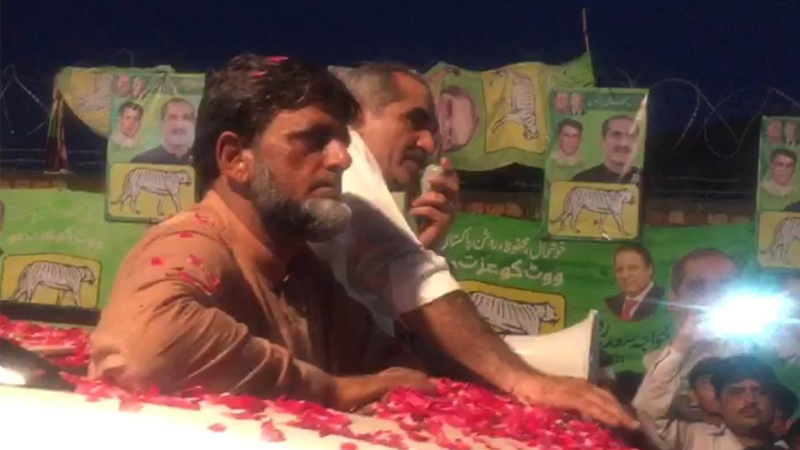
 On a wet evening last week, Saad Rafique emerged from the roof of a large white car with two other men and a giant microphone in hand. Speaking into the microphone, Rafique started his speech in the most heartwarming Punjabi. Greetings, puns, and statements followed in the language he never uses in the National Assembly or his countless public appearances. Khawaja Saad Rafique, the former railways minister, was on the campaign trail in the Charar Pind in Cantt area, now a new smaller constituency –NA 131.
He was greeted with chants of “shair aya! shair aya!” One of the most popular slogans of Pakistan Muslim League Nawaz (PML-N) which basically means the “lion has arrived.” He made a coherent argument for himself and then started a well-planned attack on Imran Khan. “Tussi meinu jaande hu?” (Do you know me? ) he asked. “Tussi eis bande nu jaande hu?” (Do you know this man?) he asked this, while pointing to a banner of Khan.
Once amidst their electorate, most candidates resort to the language closest to their voter’s heart, usually a regional language like Punjabi.
Whereas on television, in assemblies, and during international appearances, these parliamentarians stick to either Urdu or sometimes English. Mushtaq Soofi is a Punjabi writer, poet and the president of the Pakistani Punjabi Abadi Board. “When politicians speak to their voters in villages they utilise Punjabi but once in cities and towns, they resort to using Urdu again.” He said Punjabis need to incorporate their mother language into their identity.
It is about time Imran Khan returned the favour to the land that served as his family home for six centuries. Maybe start with saving Punjabi language itself?
“Can you imagine a Frenchman, an Englishman or even a Pushtun who doesn’t speak his own language?” asked Soofi. “Imran Khan doesn’t speak Pushto and therefore many Pushtuns call him a Punjabi. Language is the identity of an ethnic group but Punjabis have been brainwashed by centuries of colonialism to disown their own language. “
Khan, who is now the unofficial prime minister elect of Pakistan and is likely to make a government in Punjab as well, is a Pushtun whose family settled in Jalandhar six centuries ago. An article in India and Khan’s own previous interviews reinforce this fact. It is high time that Khan returned the favour to the land that served as his family home for six centuries. May be start with saving the language itself. By the way, Khan himself speaks reasonable Punjabi and has given speeches in the language. Pakistan Tehrik-e-Insaaf’s (PTI) leading man in Punjab, Ejaz Chaudhary, who is also the former mayor of Lahore, has participated in the International Mother Language Day rallies previously. Perhaps he will remember the commitment he made to the Punjabi language activists back then.
The former chief minister of Punjab, Mian Shahbaz Sharif, is said to be fluent in German, Arabic and of course English.
For the last one decade, Punjab has been a PMLN stronghold. They have made a government in Punjab three times.
And the party has added to its gross domestic product (GDP) growth, infrastructure and human development index to varying degrees. Both the Sharif brothers take pride in the China and Turkey backed development they brought to Pakistan’s most populated province. But they have displayed little or no regard for the main language spoken there despite it being critically endangered.
Ramesh Singh Arora was a member of the Punjab Assembly from 2013 to 2018. He had the honour of being the first Sikh to make it to the Punjab Assembly and helped passed important legislation like the Sikh Marriage Act and declaring Guru Nanak’s birthday a public holiday in Punjab.
However, he says that legislation on Punjabi was not possible because of reservations by some party member who wanted to focus on other more “urgent” issues.
“The Punjabi departments of various universities have been developed to impart higher education and professional degrees in Punjabi language and literature,” he added. “This includes departments in Punjab University, Lahore College for Women University and Government College University.”
The Sharif brothers, their families, cabinets, and assemblies did nothing for saving Punjabi as a language, which they have been said to speak in their family gatherings and high-level party meetings. PML-N’s party songs are sung by the likes of Arif Lohar in Punjabi. Many of them are copies from mainstream Punjabi songs that become popular – like “Bismillah karan” and “Mein laung tey tu Laachi.”
Basically, picking up the issue of Punjabi language is perceived to be as an opposition of Urdu, the language adopted as Pakistan’s lingua franca after partition.
Saad Rafique started his speech in the most heartwarming Punjabi. Greetings, puns, and statements followed in the language he never uses in the assembly
Urdu, Pakistan’s national language is deliberately given preference over Punjabi when it comes to teaching both the languages in school. Punjab government has repeatedly shied away from implementing Punjabi as a compulsory language at the school level.
Anwar Masood, the renowned Punjabi poet, and humourist believes that primary education should be in Punjabi.
“When the child goes to school, it leaves two things. One is the lap of the mother and the other is the mother language.” He also adds that the education should begin in Punjabi or any regional language and Urdu or English should follow in the later years. “These folks do not adopt Punjabi because they think it is not functional. This is like not letting your son buy a cycle because he may fall down.”
This policy could not just teach Punjabi children how to read and write their own mother language but also open up the Punjabi publishing industry which has gone downhill due to lack of a readership. Just a handful of Punjabi publishers exist in Lahore today and the readership is dwindling. Only one Punjabi newspaper is published in the province, compared to several in Sindhi and Pushto. All this can be changed if people learn to read and write Punjabi at the school level.
Punjabi has the highest number of speakers (48%) in Pakistan. Implementing it as compulsory in schools can bring a cultural renaissance in Lahore.
The question often raised by politicians and policy-makers alike is: if Punjab won’t give preference to Urdu- who will? However, Punjabi activists ask the same question. If Punjabi children won’t learn to read and write their own mother language- who will?
The census done in Pakistan last year recorded an increase in Punjab’s population and a sharp decline in the number of those who described themselves as Punjabi speakers despite being ethnically Punjabi. They described themselves as Urdu speakers instead.
 Mian Imran Masood is a member of the Pakistan Muslim League-Quaid (PML-Q) and has been the education minister of Punjab from 2002 to 2008. He usually joins the protest for implementing Punjabi as a compulsory subject in schools but says there were serious problems with the policy change when he was in office.
“We believed that children learn Punjabi at home but not Urdu, therefore it is imperative to teach them the national language at school.” Masood also said that this policy needed a lot of groundwork to be implemented. “To make the language compulsory or even optional in schools we needed hundreds of teachers that were unavailable so we started Punjabi in the higher education system to train those teachers.” He added that the Punjab Institute of Language, Arts, and Culture was established during his tenure and is doing some significant work even today. His party, the PMLQ’s manifesto includes developing, empowering and establishing regional languages. His party won eight seats in the Punjab Assembly out of the 371 total.
Mushtaq Soofi is pessimistic that politicians will do “anything to promote Punjabi.” Ramesh Singh Arora said that once elected the PMLN will struggle for the Punjabi language. Nevertheless, once in office, politicians and political parties have other priorities.
Saad Rafique has won a seat in the Punjab Assembly on a PMLN ticket and he might be the leader of the opposition in the house. Hopefully, some Punjabis will approach him to save the very language he used during his campaign trail from extinction. During that rally in Charar Pind, it had started to drizzle and Rafique went back into his car. The music that followed him on loudspeakers was in Punjabi again, “Mian dey nearly wajne hee wajne ney” (Mian’s chant will fill the air again) and his supporters once again responded with chants of “shair aya, shair aya!”
The writer is based in Lahore and tweets as @ammarawrites. Her work is available onwww.ammaraahmad.com
Published in Daily Times, July 31st 2018.