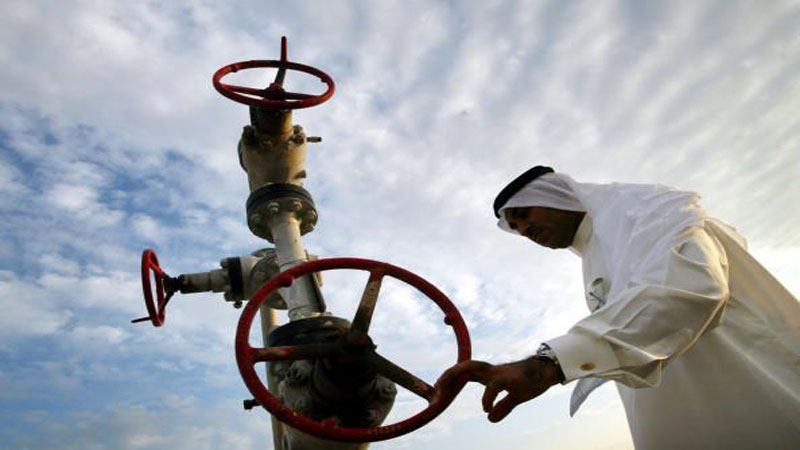
 A new, massive oil discovery in Bahrain could help the island kingdom dramatically improve its economic and fiscal strength, according to analysts at Moody’s credit ratings agency.
In early April, Bahrain’s Oil Minister Sheikh Mohammed bin Khalifa Al Khalifa announced its biggest discovery of hydrocarbon deposits in decades, estimated to be at least 80 billion barrels of tight oil and between 10 and 20 trillion cubic feet of deep natural gas.
Found off Bahrain’s west coast , if it is verified by an international oil consortium as being technically and economically recoverable it could be a boon for the nation’s economy .
Bahrain’s budget deficit was as high as 17.8 percent of gross domestic product (GDP) in 2016 and the International Monetary Fund (IMF) predicted there would be a deficit of 11.9 percent of GDP in 2018. But, while improving, Bahrain’s debt factor continues to be a concern for both ratings agencies and the IMF.
As such, a new oil discovery could be just the thing Bahrain needs to boost its recovery.
“The find… could stimulate private investment in the country’s energy sector in the near-term, and in the medium-term could increase government oil and gas related revenue, and reduce the country’s fiscal and current account deficit,” Moody’s analysts Alexander Perjessy, Matt Robinson and Marie Diron said in a note Wednesday.
Like other Gulf nations, Bahrain is keen to diversify its economy away from oil, but revenues from oil exports still make up the bulk of government income. Hydrocarbon-related revenue accounted for 75 percent of government revenue in 2017, down from 87 percent in 2013.
Although Bahrain is one of the smallest oil exporters in the region, it is the Gulf Cooperation Council’s (GCC) oldest oil producer, while remaining its littlest, having started production in the 1930s. Bahrain’s hydrocarbon endowment is relatively small, Moody’s noted, with an output of around 198,000 barrels per day (bpd) of which around 150,000 bpd comes from an offshore field that it shares with Saudi Arabia. By contrast, Saudi Arabia produces 12.3 million bpd .
Bahrain’s onshore oil reserves are estimated to be around 125 million barrels which, at the current rate of production, would last less than seven years, the analysts noted, making the new discovery of as much as 80 billion barrels very important. “A significant oil and gas discovery could improve Bahrain’s economic and fiscal strength by allowing the kingdom to boost its rate of hydrocarbon production (and hence gross domestic product) and/or to extend its current rate of production for a number of additional years,” Moody’s said.
Welcome boost
If the latest discovery of oil proves viable and leads to a large increase in Bahrain’s oil production, and associated fiscal revenue, it could therefore materially reduce the kingdom’s budget deficit and improve its balance of trade.
Moody’s downgraded Bahrain’s credit rating last year to B1 with a negative outlook. It said the downgrade was driven by its view that the credit profile of the Bahraini government would “continue to weaken materially in the coming years, predominantly because, despite some fiscal reform efforts, there is a lack of a clear and comprehensive consolidation strategy.”
The agency also expected Bahrain’s government debt burden and debt affordability to deteriorate significantly over the coming two to three years. There is hope that a recent recovery in oil prices will also help the economy, with Reuters reporting the central bank governor as saying in February that he hoped growth would be spurred by this — although he warned about the budget deficit. Brent crude is currently trading around $73.12 and WTI around $67, a big improvement from 2014 when prices dipped below $30 a barrel causing the Bahrain economy to struggle more than its richer neighbors.
Bahrain reportedly asked a number of its Gulf allies for financial aid last year. The aid was said to have been required to avert a currency devaluation as the central bank struggled to keep the currency, the Bahraini dinar, pegged to the dollar. The central bank said in December that it was committed to the peg, which means it has to maintain a fixed exchange rate to the dollar by buying or selling its currency. The IMF warned in August that Bahrain “urgently needed” to take more steps to stabilize state finances and support the dinar’s peg to the dollar, Reuters reported.
Moody’s analysts said that pressure on the peg now was higher than ever, explaining the current state of Bahrain’s finances.
“Oil exports accounted for 55 percent of total goods exports in 2017. When oil prices declined after mid-2014, the dollar value of Bahrain’s oil exports dropped significantly and the country’s current account swung from surpluses averaging 8 percent of GDP in 2012-13, to deficits averaging 3.7 percent of GDP in 2015-17,” the analysts said. “The reserves have since recovered somewhat on the back of large sovereign external bond issuances, including $3 billion in international bonds in September 2017 and $1 billion in international sukuk (Islamic bonds) in April 2018. But with foreign reserves of $2.8 billion at the end of November covering only 1.4 months of imports of goods and services and less than 10 percent of Bahrain’s short-term external debt, pressure on Bahrain’s pegged exchange rate regime is now at its highest since the formal peg of the rial to the dollar was introduced in 2001.”
Published in Daily Times, May 9th 2018.