
 In grade school, I came to know of heroes and gods who fought in an ancient land known for its grapes and olives, of Helen whose uncommon beauty had launched a thousand ships, and of the mysterious Trojan horse whose arrival had doomed Troy.
In middle school, I came to learn that these tales were written by a blind poet, Homer, in the 7th or 8th century BC. In high school, I came to know that there was some debate about whether Homer even existed. When I entered the University of Karachi, I also came to learn the Greek alphabet not in any of my literature classes but in my mathematics and econometric classes.
So it was that on one fine October day, in search of Homer’s Greece, we landed in Athens, capital of the Hellenic Republic which lies in the southern part of the Balkan Peninsula.
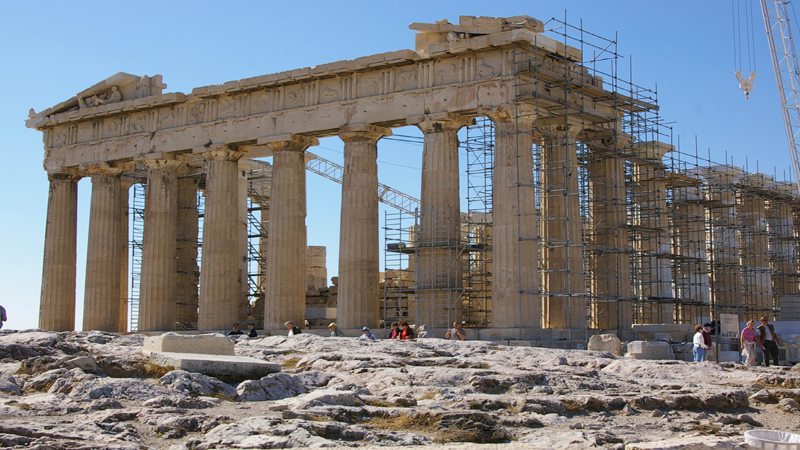
The first place we toured was the famed Acropolis. Words cannot do justice to the magnificent ruins that sit atop the ancient plateau overlooking the city. The most prominent building is unquestionably The Parthenon which is lit up at night and shines like a jewel in the sky. With its exquisite columns and pediments, it is arguably the world’s most photographed building. Over the centuries, it has inspired replicas in virtually every major city around the globe. Close by is a smaller structure in which there are depicted seven maidens. We were told that every evening, the setting sun transforms them into goddesses. Further off, there is an ancient theatre where plays are still staged in the summer, continuing a tradition that goes back millennia.
As we entered the Homerian world, I felt goosebumps developing all over my body. Here Agamemnon had reigned once and it was from here that he had set off to free Helen, who was married to his brother, the king of Sparta. Afflicted with a dull marriage, she had eloped with the handsome Paris, son of Priam, king of Troy
On the other side of the Acropolis is the ancient Agora (marketplace), where the philosopher Socrates pioneered the artful use of dialogue. Not too far away, Plato had set up his academy where he lectured on what it meant for a country to be a republic. And in the vicinity was Aristotle’s Lyceum, where the foundations of modern logic, ethics and politics may have been said to have been laid.
Further down the road was the grand library built by the Roman emperor Hadrian and the Tower of the Winds built by Julius Caesar. A short walk brought us to the exotic shopping and eating district of Plaka. We entered a café and ordered coffee. When it came, it resembled the coffee we had had in Turkey two years prior. I asked the waiter if it was Turkish coffee. He smiled, and said: “Please don’t call it that.”
 A site marked the place where Lord Byron had once stayed. Looking at the colorful pottery in the stores, we were affected by the same muse that had visited John Keats when he penned, “Ode on a Grecian Urn,” and wrote “Beauty is truth, truth beauty.”
The realisation dawned on us that that Greek was the only ancient language still in active use. The traffic signs reminded me of algebraic operations that I longed to forget on this holiday. The contributions that the Greeks had made to literature, philosophy, science, medicine and sports were all around us.
Duly inspired, one day we sped off toward the northern Peloponnese with George, a Greek native who had lived for 19 years in Australia and the US. He proved to be the perfect tour guide. Our first stop was in ancient Corinth, a place associated with much lewdness and one where St. Paul spent much of his time, preaching. Atop a hill was perched a Turkish fortress, a silent testimonial to the four centuries of Ottoman occupation.
After a zesty lunch, we drove off to Mycenae. As we entered the Homerian world, I felt goosebumps developing all over my body. Here Agamemnon had reigned once and it was from here that he had set off to free Helen, who was married to his brother, the king of Sparta. Afflicted with a dull marriage, she had eloped with the handsome Paris, son of Priam, king of Troy.
We entered the ruins through the famed lion gate and came across a remarkable circular cemetery. After a steep climb, we entered the citadel which afforded a commanding view of the valley. Toward the horizon was a crystal blue sea and it was from there that Agamemnon had sailed toward Troy. Just a little further away was the treasury which according to legend housed the tomb of Agamemnon. We stepped inside and I felt the hair on the back of my neck standing on end. This is where a German archaeologist had uncovered a gold mask in the 19th century and remarked, “Today, I have gazed at the face of Agamemnon.” I wonder how the hair on the back of his neck must have felt.
In Homer’s tale, Agamemnon returned home victorious from the ten-year battle with Tory only to be murdered in his bath by his wife who had taken another lover. No wonder if something really tragic happens today, it is called a Greek tragedy. George asked us to look at the mountains beyond and to let our imagination soar. After a few hints, we saw an apparition. It was Agamemnon, lying asleep on the horizon.
On another day, we drove to check out Delphi, site of the famous Oracles. The modern scenario-building approach that involves repetitive expert consultations is named after it. As we approached the site, we got a glimpse of Mt. Parnassus, Greece’s second-highest mountain.
Delphi was perched on the side of a mountain beneath, which lay a valley whose pristine grandeur evoked the granite cliffs of California’s Yosemite National Park. But right in front of us was the Temple of Apollo. Nearby was the stream in which the baby Achilles had been dipped upside down, giving him a weakness that would prove fatal in combat with in the battle of Troy with Paris who shot an arrow at his heels. Down below was a track where athletes trained for the Olympics.
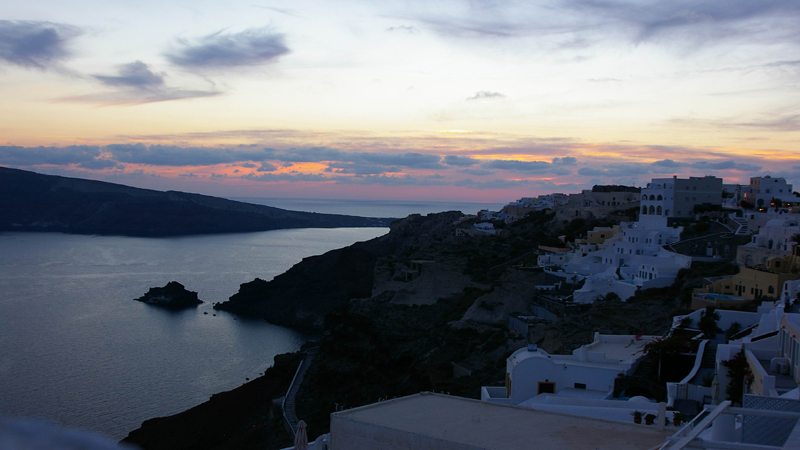 Then we flew off to the island of Santorini for a few days. It is the site of an ancient volcano whose major eruption took place 35 centuries ago. The noise of the blast was so intense that scientists believe it was heard as far away as Sweden. Pieces of Santorini have been found in Greenland. We stayed in a hotel that was dug into the steep cliffs. It provided jaw-dropping views of the crater and the blue sea. Along the hillside were houses with blue domed roofs and white adobe walls which are featured on more than one postcard. We took a boat ride to the caldera. The hike to the top afforded panoramic views and brought us up-close to hot lava rocks that were emitting pungent sulfur fumes.
The last leg of our trip, oddly enough, took us to the British Museum in London, where the beautiful friezes that were once installed all around the upper walls of the Parthenon are housed. Depicting scenes from ancient battles, they are still at the centre of a modern battle for control between the Greek and British governments.
The writer has traveled to 36 countries. He can be reached at [email protected]
Published in Daily Times, February 28th 2018.