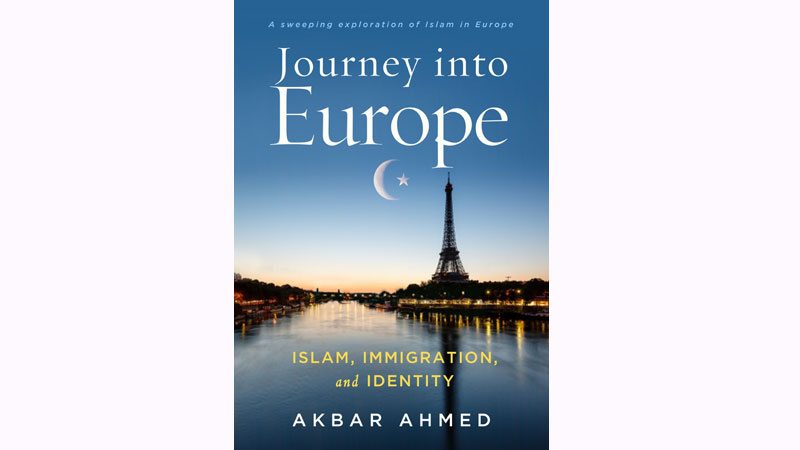
 In a silent and quite grainy black and white film clip showing members of the extended British royal family lined up for a photograph, one is struck by the overpowering dazzle and opulence of the jewels worn by the women. The scene is from the early part of the last century and the jewels are undoubtedly the spoils of empire. Another scene, one that Anthropologists and popular-culture buffs alike are familiar with, and one that is illustrative of why Akbar Ahmed’s Journey into Europe is an absolute must-read, appears in chapter one of his book: “Decked out in khaki shorts, knee socks, and solar topees, clutching binoculars, notebooks, and tape recorders, and suitably inoculated against deadly tropical diseases, they (Anthropologists of the colonial era) disembarked on the Pacific Islands or headed into the Amazon rainforest or the African hinterland. We, too, ventured forth to do our fieldwork; only our destination was Europe itself.”
As Noam Chomsky has noted, Ahmed’s study, which takes into account things such as Europe’s ‘primordial tribal identity’ as well as the deep-rooted effects of Western imperialism, in addition to the flux of immigrants from former colonies- in order to study contemporary dynamics between communities of Muslims and the European countries they call home, reverses the traditional paradigm in the social sciences (“in this case, not Europeans studying African and Asian societies but an Asian author examining Europe”). This, in my view, provides the long-awaited necessary corrective, the radical shift in connotations derived from Imperialist attitudes and agendas, coining, finally, a language without which neither academic discourse nor artistic representation can be fair or go far, one that may finally make it possible to have balanced, nuanced perspectives on subjects relevant to Islam and the West.
Journey into Europe, the latest in the series of books by Dr. Akbar Ahmed and his team, employs roughly the same fieldwork methodology as the previous studies Journey into Islam, Journey into America and The Thistle and the Drone
Ahmed, who is the former Pakistani High Commissioner to the UK has had personal ties with Europe since his student days and even farther back (being the grandson of Sir Hashmatullah Khan who was honored with a knighthood for his services), led a team of four, each with a European aspect (educational/familial) to their background, for the Journey into Europe film/book project. The candid, intimate conversations resulting from the interviews conducted in the fieldwork were possible due to the team’s relative ease with the local cultures as they brought up controversial and emotionally charged topics related to Muslims. Dr Ahmed’s team, including Frankie Martin, Harrison Akins, Dr. Amineh Hoti, along with Dr. Ahmed’s wife Zeenat Ahmed, devoted themselves entirely to the completion of this project which demanded a tough fieldwork-schedule and was subject to day-to-day changes in social scenarios, perceptions, and levels of anxiety based on current political events.
Dr. Amineh Hoti, Ahmed’s daughter (academic/author/founder of the Society for Dialogue and Action at Lucy Cavendish College, University of Cambridge) played a pivotal role in engaging female subjects in discussions about the challenges of living in the West in the present climate of extremist violence, hostility from fellow-citizens and institutions, incongruences within their own faith-communities and discriminatory government policies. The book, despite its heft as an academic work, comes across as accessible and makes a fascinating read.
Journey into Europe, the latest in the series of books by Dr. Akbar Ahmed and his team, employs roughly the same fieldwork methodology as the previous studies Journey into Islam, Journey into America and The Thistleand the Drone. The three previous studies in the quartet inform the current project on Muslims in Europe. Muslim immigrants in the West, both the first and the succeeding generations, could be broadly identified as falling into three overlapping but essentially opposed categories, as discussed in Journey into Islam and Journey into America: literalist Muslims, modernist Muslims, and mystic Muslims. With the caveat that these categories are neither watertight not permanent, we identified and interviewed individuals in each category… we divided Muslims in Europe into three categories: immigrants, indigenous Muslims and converts.” Even though the backgrounds, experiences and identities of each of these sub-groups is vastly different, the results yielded that members of each category have faced discrimination or hostility in recent years: “Whatever their persuasion, literalist, modernist or mystic-Muslims faced racial and religious prejudice. They were seen in terms of stereotypes as immigrants.”
From the book’s analysis of perceptions based on current events, there emerges some distinguishing aspects setting apart those who are bitter, exclusivist or pessimistic and those who are hopeful and are actively building bridges (a sizeable number of Jewish and Christian faith-leaders among others). The latter are likely to recognise the apparent ‘clash between Islam and the West’ not as a ‘clash of civilization’ but as a by-product of the tectonic shifts in the global Economy and politics of the post-colonial world. One of the primary differences between the two groups is the degree/depth of awareness of the Islamic faith and the long shared history of Muslims in Europe.
Akbar Ahmed offers invaluable insights by drawing our attention not only to great thinkers of Europe and their contributions but to the details of the ‘missing millennium’, a transformative but brutally erased chapter of European history when Europe’s Muslims initiated a legacy of convivencia or ‘peaceful coexistence’ enabling Western civilisation to be lifted out of “the dark ages.” Al-Andalus (711-1492), while absent from Spain’s history (“history books begin with 1492” as a Spanish Muslim states in an interview), is remembered as a golden age by those who have studied history beyond school texts.
Having done research on the period of al-Andalus since my own college years while writing Baker of Tarifa, I realise that even the convivenica has been taken out of its historical context and rendered contentious. Despite the common dismissals and erasures, there still exist works that testify to this rare chapter of interfaith tolerance and intellectual accomplishment in world history, European history, Muslim and Abrahamic history; a time of spiritual, intellectual and creative collaboration that we would all benefit to learn from in the prevalence of bigotry and anti-intellectualism. Ahmed generously devotes space in this book to the topic of al-Andalus, how it shaped civilisation in parts of Spain and Italy, summing up beautifully: “There is a direct, causal relationship between the ilm ethos and convivencia; one could not exist without the other.” In other words, ilm or seeking knowledge, an Islamic value of central importance, necessitates a purge from prejudice, resulting in a genuine understanding and respect for the other: the hallmark of the Andalusi convivencia. This significant, ‘civilising’ influence of European Muslims of centuries ago ought to be better understood, honored and applied. Muslim communities would do well to dispel their anxieties and narrow-mindedness and take a keener interest in their own intellectual history; there is inspiration to be found here: “The celebrated European Universities, including Oxford, Cambridge, and the Sorbonne, were also influenced by Islamic Universities. Islamic Universities were the first to grant degrees (ijazah), and scholars have argued that the baccalaureate or bachelor’s degrees, is derived from the Arabic bi-haqq al-riwayah, meaning ‘the right to tech on the authority of another’, a phrase used in Ijaazah degree certificates for six centuries. A university’s faculty is a direct translation of Arabic quwwah, which refers to “the power inherent in an organ”. Even the concept of a university chair comes from the Islamic practice of the teacher sitting on an elevated chair (kursi in Arabic) so he could be seen and heard by the students.” Reminding readers literally of the origins of the language to which Western academia owes so much, Ahmed reveals a debt of civilisation not only unrecognised but also falsified. He challenges the Orientalist perceptions that persist in academia and mass culture alike, and by doing so, he demonstrates why the language describing Muslims in the West is faulty in design, how it makes further distortions possible and how those distortions have, in part, led to massive political ramifications.
The greatest gift of this work, as I say in my earlier remarks on the book, is that it teaches us the art of bridge-building across differences as it reinvigorates not only the historical ties that have been mutually beneficial to Muslims and the West in the past but also challenges the divide set thus far by the ‘vertical’ approach of Anthropological research – rejecting the hierarchical standards established by Western imperialism, establishing a new lexicon for the discipline, and cultivating a multi-faith, multi-ethnic, international community of bridge-builders.
Published in Daily Times, February 15th 2018.