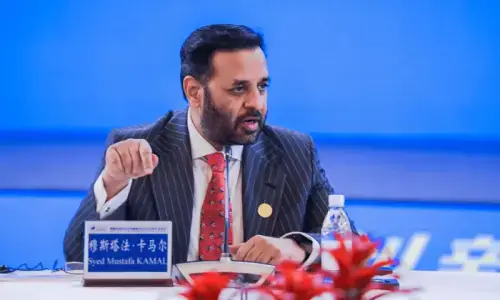
Pakistan and China have signed 22 investment agreements worth approximately $629.5 million during the Pakistan-China Pharmaceutical & Healthcare B2B Investment Conference, marking a major step towards strengthening bilateral cooperation in the healthcare and pharmaceutical sectors.
Read More: Islamabad opens two-day Pakistan, China health care investment
Addressing a press conference in Islamabad, Federal Minister for National Health Services Syed Mustafa Kamal said the agreements were finalised during the two-day conference held on July 17-18. The deals cover key areas including vaccine production, active pharmaceutical ingredients (APIs), medical devices, clinical trials, and pharmaceutical manufacturing.
The minister also revealed that 84 memorandums of understanding (MoUs) valued at around $800 million were signed during the event. He expressed optimism that many of these MoUs would eventually be converted into formal commercial investment agreements.
According to Kamal, the conference brought together 240 Chinese delegates representing 140 pharmaceutical companies and 430 Pakistani participants from 210 local firms, making it one of the largest Pakistan-China business engagements dedicated exclusively to the pharmaceutical industry.
He said the initiative reflects the government’s strategy to attract foreign investment, promote technology transfer, expand domestic pharmaceutical production and increase exports.
Highlighting recent policy reforms, Kamal said Pakistan has approved its National Local Vaccine Production Policy for the first time, providing a framework to establish domestic vaccine manufacturing. He noted that all 13 vaccines currently used under Pakistan’s national immunisation programme are imported, and the new policy aims to strengthen health security by reducing reliance on foreign supplies.
The minister said the signed agreements include eight projects in vaccine production, two in API manufacturing, two in clinical trials, two in injectable generic formulations and eight in medical devices.
Read More: Kamal eyes more investment after Pak–China B2B
While Pakistan manufactures around 85 per cent of its medicines locally, Kamal noted that the country still imports approximately 95 per cent of the active pharmaceutical ingredients required for production.
He added that the government’s priority is to transform investment commitments into legally binding agreements that generate employment, support industrial growth and strengthen Pakistan’s pharmaceutical sector.