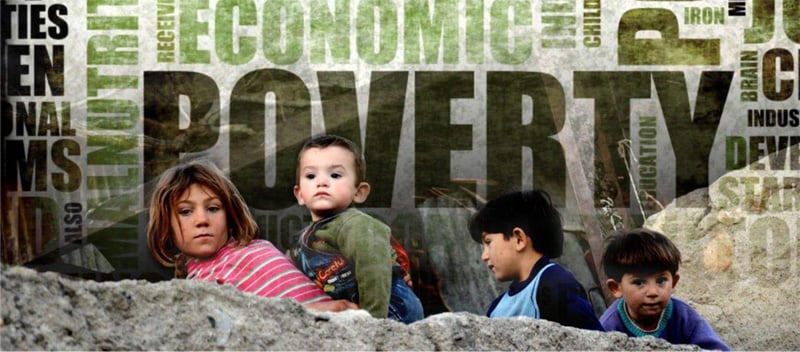
 Pakistan’s federal budget for FY2025-26 allocates over Rs. 593 billion for social protection, with Rs. 455 billion alone earmarked for the Benazir Income Support Programme, BISP. Yet 39.4% of Pakistanis still live below the national poverty line, according to the World Bank’s 2024 update. The math does not add up.
Every year, the budget promises “pro-poor” relief. Every year, inflation erodes that relief within months. The core question is not about intent. It is about design, delivery, and distortion. Why do welfare allocations fail to move the needle on poverty? And what structural reforms are needed to ensure the next budget does not repeat the same cycle?
1. Why Relief and Welfare Allocations Fail to Eradicate Poverty
There are four structural reasons.
First: Relief is reactive, not transformative.
Most budget allocations treat poverty as a cash-flow problem. BISP, utility subsidies, and Ramzan packages provide temporary consumption support. They do not change a household’s earning capacity. In economics, this is the difference between “social protection” and “social development.” Pakistan spends 90% of its social budget on the former. Without parallel investment in skills, health, and jobs, beneficiaries fall back into poverty the moment the stipend stops.
Second: Inflation outpaces allocations
BISP’s quarterly stipend was Rs. 7,000 in 2021. It is Rs. 10,500 in 2025. That is a 50% increase over 4 years. But food inflation in the same period averaged 22% annually. A family that received relief worth 30 days of food in 2021 now gets barely 18 days. The budget increases in nominal terms, but loses in real terms.
Third: Fiscal space is crowded out by debt and defense.
In FY2025-26, debt servicing consumes Rs. 8.2 trillion, nearly 45% of total expenditure. Development and social spending are the first items cut when IMF targets are missed. As a result, welfare becomes a residual item, not a priority item.

Fourth: Leaky delivery systems.
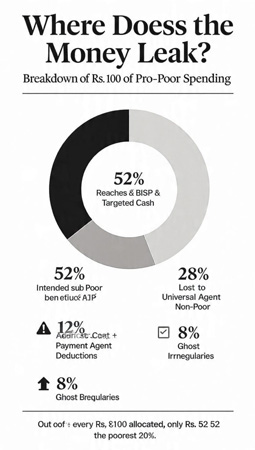
Pakistan’s poverty data is outdated. The last comprehensive survey was in 2018-19. Targeting is done through the National Socio-Economic Registry, NSER, which misses millions of newly poor families post-floods and post-COVID. Meanwhile, ghost beneficiaries and middlemen absorb a share of the funds before they reach the poor.

2. How Subsidies and BISP Fail to Provide Real Relief
Subsidies and BISP were designed to cushion the poor. In practice, they create three problems.
A. Poor Targeting, High Leakage
Universal subsidies on fuel, electricity, and wheat benefit the rich more than the poor. A 2023 PIDE study found that 62% of electricity subsidy went to households in the top 40% income bracket because they consume more units. The poor, who use deceased persons, and beneficiaries above the poverty score threshold due to outdated NSER data.
B. Cash Without Conditions Creates Dependency
BISP gives unconditional cash. That prevents starvation, but it does not build assets. Countries like Brazil and Mexico moved to “conditional cash transfers” tied to school attendance and health checkups. Pakistan’s BISP has a Taleemi Wazaif education component, but it covers less than 20% of BISP families due to funding and capacity gaps.
C. Subsidies Distort Markets
Wheat and sugar subsidies encourage hoarding and smuggling. The government buys at a support price, sells at a subsidized price, and the difference is paid by the budget. The result: fiscal loss, market distortion, and little price relief for the end consumer because the supply chain captures the margin
3. Flaws in BISP: Corruption, Governance, and Audit Gaps
BISP is Pakistan’s largest social safety net and has improved a lot since 2008. But four flaws keep undermining it.

1. Data and Inclusion Errors
The NSER survey is not dynamic. A family that became poor after the 2022 floods is still not in the system. At the same time, AGP audits have repeatedly flagged “ineligible beneficiaries” who scored above the poverty threshold but were included due to political pressure at local levels.
2. Payment Frauds and Middlemen
Despite biometric verification, cases of agents charging Rs. 500-1000 per withdrawal persist in remote areas. AGP’s 2023 report noted “weak internal controls” in payment disbursement through partner banks. Beneficiaries, especially women, often do not know the full amount they are entitled to.
3. Lack of Outcome Auditing
Audits focus on financial compliance: “Was the money paid?” They rarely ask: “Did poverty reduce?” There is no built-in impact evaluation linking BISP payments to nutrition, school enrollment, or asset creation. Without that feedback loop, the program cannot selfcorrect.
4. Political Interference
During election years, BISP enrollment spikes. New districts are added without budget backing. This turns a technical program into a political tool, diluting its credibility and fiscal sustainability
4. Budget Reforms Needed to Fill the Gaps
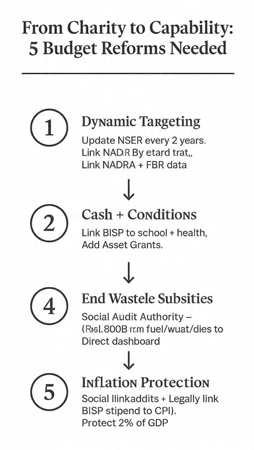
To move from “relief” to “eradication,” Pakistan’s budget needs 5 structural reforms
1. Shift from Subsidies to Targeted Cash + Services
Phase out untargeted energy and commodity subsidies. Redirect that Rs. 800 billion annual saving into an expanded, inflation-indexed BISP and into health and education vouchers. Use the existing banking and mobile wallet infrastructure to deliver money directly, with zero human contact.
2. Dynamic Targeting and Data Integration
Update NSER every 2 years, not every 5. Integrate NADRA, FBR, BISP, and Ehsaas data to create a live poverty registry. Use AI to flag anomalies and remove ghost entries. This alone could save Rs. 30-40 billion annually.
3. Make BISP Conditional and Asset-Building
Expand Taleemi Wazaif to 100% coverage. Add a health and nutrition condition for mothers and children under 5. Launch a “BISP Asset Grant” of Rs. 100,000 for 10% of graduating families to start a small business or livestock. Move from stipends to ladders.
4. Independent Social Audit
Create a statutory “Social Protection Audit Authority” separate from AGP. Its mandate: annual impact audits, not just financial audits. Publish beneficiary data, payment data, and impact data on an open portal. Transparency is the best anti-corruption tool.
5. Protect the Social Budget
Legislate a “Social Protection Floor” that cannot be cut below 2% of GDP, even under IMF programs. Link BISP stipend to inflation automatically, like pensions. This prevents real value erosion every year.
5. The Way Forward: From Charity to Capability
Eradicating poverty requires moving beyond the charity model. The way forward rests on three pillars.
Pillar 1: Invest in Human Capital
BISP money should be paired with free primary healthcare, school meals, and technical training. A mother receiving Rs. 10,500 is less poor. A mother receiving Rs. 10,500 + vocational training + health insurance is on a path out of poverty.
Pillar 2: Create Jobs, Not Just Grants
No welfare program can beat job creation. The budget must prioritize labor-intensive sectors: construction, agriculture value chain, and IT freelancing. Use BISP data to identify and train beneficiaries for these jobs.
Pillar 3: End the Leakage Economy
Digitize everything. Biometric payment, grievance redressal via 0800 helpline, and public dashboards. Prosecute officials involved in fraud publicly. When the poor see that the system is fair, trust and compliance rise
Conclusion: The Cost of Inaction
Pakistan spends billions on poverty and still has 130 million poor people. The problem is not the size of the budget. It is the architecture. Curent subsidies and BISP allocations act like a bandage on a fracture. They stop the bleeding for a day, but do not set the bone. Without reforms in targeting, conditionality, and audit, the 2026 budget will read the same as the 2025 budget: more money, same results.
The choice is clear. Pakistan can continue to fund poverty management, or it can start funding poverty exit. That requires political will to cut wasteful subsidies, technical will to fix data, and moral will to put the poor, not the middleman, at the center of the budget.
Until then, every “pro-poor” budget will remain a paradox: the more we spend, the more we stay the same.