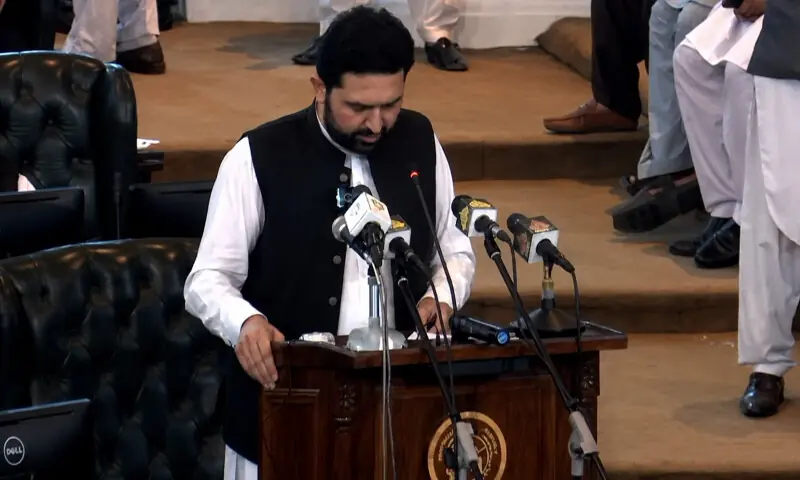
PESHAWAR: The Khyber Pakhtunkhwa (KP) government on Thursday presented its 2026–27 budget with a total outlay of Rs2.17 trillion, focusing heavily on welfare, security and infrastructure development while projecting a modest Rs48 billion deficit.
The budget was tabled in the provincial assembly by Chief Minister Sohail Afridi, who said the shortfall would be managed through the province’s own resources rather than new borrowing.
Of the total allocation, Rs1,645.7 billion has been set aside for current expenditure, while Rs524.3 billion is reserved for development under the Annual Development Programme.
On the revenue side, Khyber Pakhtunkhwa expects Rs1,240.7 billion from its share of federal taxes, while its own-source revenue target has been significantly increased to Rs182.4 billion. Net hydel profits are projected at Rs116.8 billion, reflecting the province’s continued reliance on hydro-based income.
A large portion of the budget has been directed towards social sectors. The health sector receives major funding, including Rs50.4 billion for Sehat Card Plus, Rs80 billion for Medical Teaching Institutions, and Rs14.26 billion for medicines in public hospitals.
In education, Rs5 billion has been allocated for out-of-school children, Rs8.5 billion for free textbooks, and Rs11.85 billion for public universities. The government also announced new initiatives such as interest-free student loans, an Insaf Female & Orphan Education Card, and a Women Economic Empowerment Endowment Fund.
Security spending has also increased, with Rs191.39 billion allocated to police reforms, modern equipment and safe city projects.
For infrastructure, Rs52.9 billion will go to road development and Rs12.7 billion to clean drinking water schemes.
A major allocation of Rs272.8 billion has been reserved for merged districts, covering both operational costs and development projects.
The budget also introduces reforms aimed at improving financial transparency, digitalising revenue systems, and expanding public-private partnerships, alongside the creation of a Disaster Risk Management Fund and a provincial takaful insurance company.