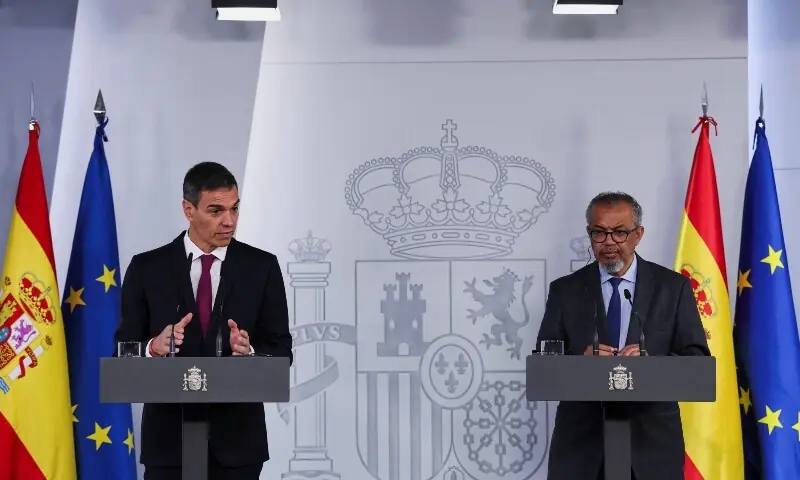
World Health Organisation chief Tedros Adhanom Ghebreyesus has said efforts to contain a hantavirus outbreak linked to a cruise ship are still ongoing, despite the successful evacuation of passengers and crew.
Speaking at a joint press conference in Madrid alongside Spanish Prime Minister Pedro Sanchez, Tedros said the situation remains under close monitoring and warned that the response is not yet complete.
Read More: WHO chief to oversee hantavirus evacuation
“Our work is not over,” Tedros said, referring to containment efforts following an outbreak aboard the cruise ship MV Hondius, where three passengers died after contracting the rare virus.
The incident triggered international concern after the vessel became the focus of a complex health and logistical operation involving multiple countries.
WHO Technical note for the disembarkation and onward management of passengers and crew in the context of an Andes virus-associated cluster MV Hondius cruise ship. Read here: https://t.co/YB7jgI3t1x
+
Management of contacts of Andes virus (ANDV) cases from the MV Hondius cruise…— World Health Organization (WHO) (@WHO) May 10, 2026
LIVE from Madrid: Media briefing on #hantavirus response with Prime Minister @sanchezcastejon and @DrTedros https://t.co/LI9go7QfTj
— World Health Organization (WHO) (@WHO) May 12, 2026
More than 120 passengers and crew members were evacuated from Spain’s Canary Islands on Sunday and Monday after the ship was allowed to anchor near the archipelago for disembarkation.
Health officials have stressed that the global public health risk remains low and said there is currently no indication of a wider outbreak.
Tedros rejected comparisons to the early stages of the Covid-19 pandemic, saying there is no evidence suggesting the beginning of a major global health emergency.
However, he cautioned that hantavirus has a long incubation period, meaning additional cases could still emerge in the coming weeks.
The WHO has recommended a 42-day quarantine period and close monitoring for high-risk contacts. Most countries have reportedly adopted these guidelines for returning passengers.
In contrast, US health officials indicated American evacuees may not automatically be placed under quarantine, prompting Tedros to encourage countries to follow WHO recommendations.
Read More: WHO says hantavirus risk remains low
The handling of the MV Hondius also created diplomatic complications. Cape Verde declined to receive the ship while it remained offshore near Praia, resulting in Spain eventually allowing the vessel temporary access near the Canary Islands for evacuation purposes.
Spanish Prime Minister Pedro Sanchez defended the decision, saying global crises require cooperation rather than fear-driven responses.
Hantavirus is a rare disease typically transmitted through contact with infected rodents or their droppings. There is currently no approved vaccine or virus-specific treatment available. Investigations into the source of the outbreak remain ongoing.