
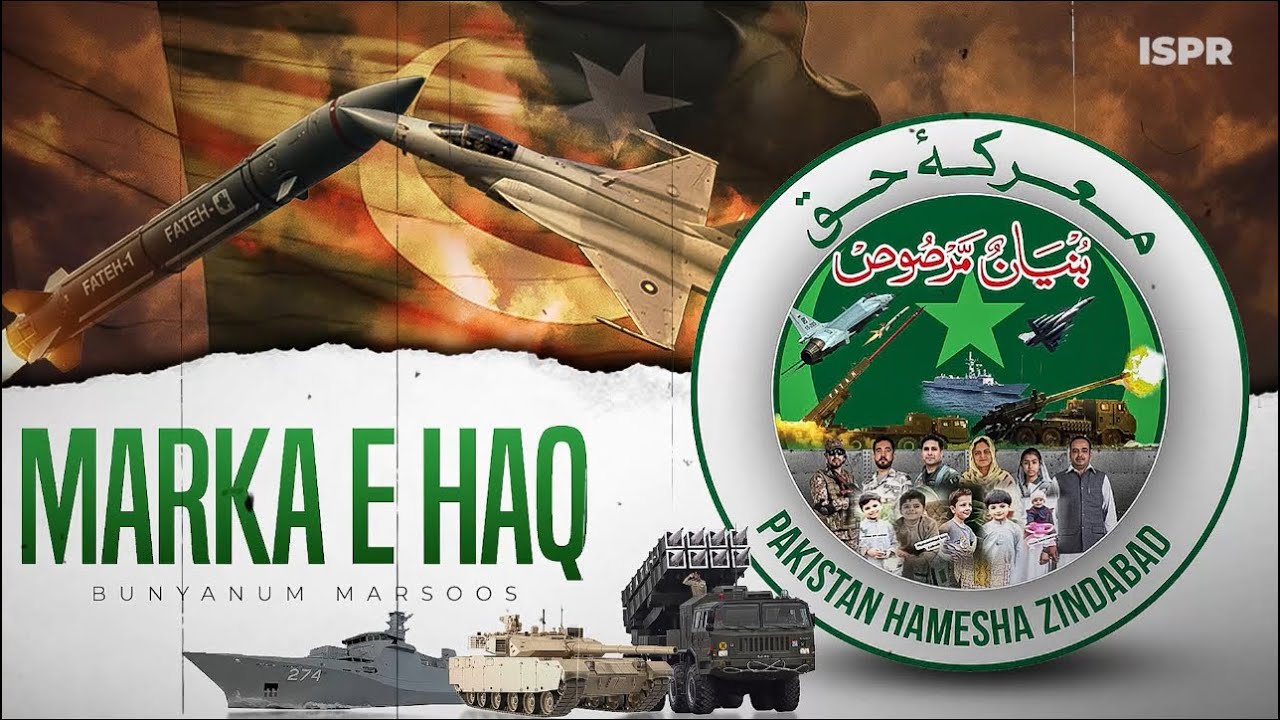
By the time the smoke of May 2025 began to settle, South Asia had already witnessed one of the most decisive and defining military confrontations of the modern era. What India proudly initiated under the banner of “Operation Sindoor” was answered by Pakistan with a response that history will remember as Marka-e-Haq,
A battle not merely of weapons, but of resolve, professionalism, faith, and national unity.
For years, India attempted to project itself as an untouchable regional hegemon, armed with advanced Western technology, supported by massive propaganda machinery, and driven by an increasingly aggressive strategic doctrine. Yet in those critical days of May 2025, Pakistan shattered that illusion with extraordinary calm, precision, and strength.
India believed it could intimidate Pakistan through missile strikes, air superiority, psychological warfare, and diplomatic pressure. Instead, it discovered that nations built upon sacrifice, resilience, and unwavering belief do not surrender to coercion.
Pakistan’s response under Operation
“Bunyanun Marsoos” became a textbook example of modern integrated warfare. It was not merely a military reaction; it was a demonstration of strategic maturity. The Pakistan Armed Forces exhibited remarkable coordination among the Army, Air Force, Navy, cyber units, intelligence formations, and electronic warfare capabilities. Military academies and strategic institutions across the world will study this conflict for years as a case study in multi-domain warfare.
What distinguished Pakistan was not numerical superiority or economic might. It was preparation, professionalism, indigenous capability, and clarity of purpose.
As sequel to false flag operation, India suspended Indus Water Treaty unilaterally, and entered the conflict with French Rafales, Russian systems, Israeli drones, and massive international backing. Yet
Pakistan’s defensive and offensive operations neutralized much of that technological edge. Sophisticated aerial platforms were challenged, missile systems were disrupted, electronic spectrums were jammed, and enemy operational coordination suffered visible setbacks.
The world saw something unprecedented: a smaller but determined state effectively countering multiple layers of imported military technologies through superior operational planning, electronic warfare, cyber capability, precision targeting, and real-time coordination.
Pakistan’s response also exposed another uncomfortable truth for New Delhi: wars are not won through media studios and hyper-nationalist rhetoric.
While sections of Indian media attempted to manufacture victory through disinformation campaigns, Pakistan’s media, cyber volunteers, youth, and strategic communicators stood united like a wall of steel. Facts defeated fiction. Discipline defeated hysteria. Professionalism defeated propaganda.
One of the most remarkable dimensions of the conflict was the role played by Pakistani youth. Thousands became cyber and information warriors, defending the national narrative across digital battlefields. In modern warfare, perception management is no less important than battlefield success and Pakistan demonstrated mastery in both domains.
The conflict also reaffirmed the importance of national unity. Political leadership, military command, scientists, engineers, diplomats, media professionals, and ordinary citizens stood together in defense of the motherland. Such moments remind nations that true strength emerges not from slogans, but from collective resolve.
Yet while celebrating victory, mature nations also reflect upon responsibility.
The real tribute to the martyrs of Marka-e-Haq lies not only in commemorations but in building a stronger, more prosperous Pakistan. Military success must translate into national confidence, economic revival, institutional harmony, technological advancement, and social justice.
Pakistan today stands at a critical crossroads. The same spirit that defended the country’s sovereignty must now be directed toward defeating inflation, unemployment, corruption, hopelessness, and political polarization.
External victories lose meaning if internal wounds continue to deepen.
History teaches us that no power remains invincible forever. Empires rise and collapse. Arrogance eventually meets accountability. Nations that survive are those capable of balancing strength with wisdom.
Pakistan demonstrated strength in May 2025. The challenge now is to demonstrate wisdom in the years ahead.
As a nation, we must also remember that durable peace in South Asia cannot emerge through aggression, coercion, or hegemonic ambitions. Stability will only come when regional powers abandon expansionist fantasies and accept sovereign equality.
Pakistan’s response decisively established that any violation of its territorial integrity will invite a comprehensive and calculated reply.
The events of May 2025 buried the dangerous illusion that Pakistan could be isolated, intimidated, or strategically cornered. Instead, the conflict restored Pakistan’s relevance in regional and global strategic calculations.
Above all, Marka-e-Haq reminded the nation of an eternal truth: faith, unity, sacrifice, and courage remain the greatest force multipliers in history.
The Pakistani nation stood shoulder to shoulder with its Armed Forces. Mothers sent prayers, youth fought information battles, soldiers guarded every inch of the homeland, and martyrs wrote a new chapter of national honor with their blood.
And perhaps that is why the message delivered to the enemy echoed far beyond the battlefield:
“We do not seek war, but if war is imposed upon us, we know how to defend our homeland with dignity, precision, and unbreakable resolve.”
Pakistan emerged from Marka-e-Haq not merely with military success, but with renewed confidence, restored deterrence, and a reaffirmed national spirit.
Pakistan Zindabad.
Afwaj-e-Pakistan Paindabad.