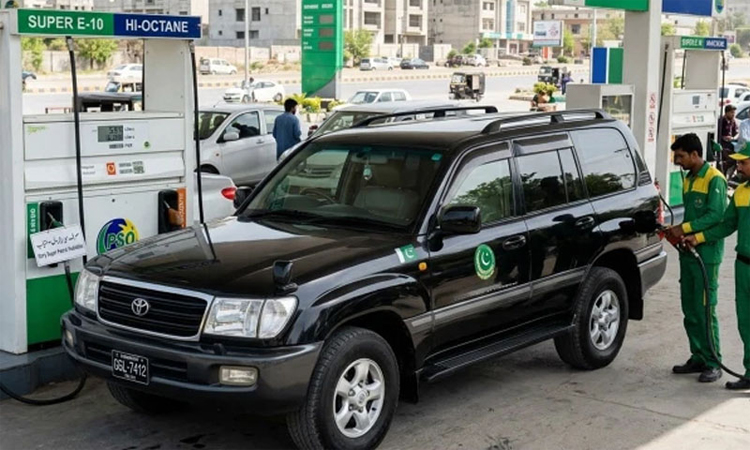
 Prime Minister Shehbaz Sharif on Monday imposed an immediate ban on the use of high-octane fuel in government vehicles.
The decision comes in continuation of the recent increase in petroleum levy on high-octane fuel and is aimed at reducing unnecessary government expenditures.
According to the directive, all federal ministries, departments, authorities and subordinate institutions have been instructed to implement the decision immediately and ensure full compliance.
The prime minister stated that if the use of high-octane fuel becomes unavoidable for any official vehicle, the concerned officer or user will have to bear the expense personally, as the use of high-octane at government expense has been strictly prohibited.
The move is part of a broader cost-cutting policy already in force, under which fuel consumption for government vehicles has been reduced by 50 percent, while nearly 60 percent of official vehicles have already been grounded.
The government said savings generated through these measures are being utilized to provide relief to the public and support the availability of cheaper fuel.
Prime Minister Shehbaz Sharif emphasized that strict adherence to austerity measures and reduction in avoidable expenditures is essential under current economic conditions. He also directed relevant authorities to establish an effective monitoring mechanism to ensure implementation of the order and warned that strict action would be taken against any violation.
Separately, President Asif Ali Zardari on Monday directed the government to prioritise public relief, minimise the burden of petroleum prices and ease economic pressure on citizens during a high-level meeting at Bhutto House, according to the press release.
The meeting was attended by Interior Minister Mohsin Naqvi, Finance Minister Muhammad Aurangzeb and Petroleum Minister Ali Pervaiz Malik, along with PPP Chairman Bilawal Bhutto Zardari, Sindh Chief Minister Murad Ali Shah, Faryal Talpur and Sindh Local Government Minister Nasir Hussain Shah.
According to officials, the participants reviewed the overall law and order situation, the country’s economic outlook, and developments in the energy sector, including petroleum product pricing.
The interior minister briefed the president on ongoing counterterrorism operations and border security. The meeting also discussed tensions between Pakistan and Afghanistan, as well as a detailed overview of broader regional security challenges.
The finance and petroleum ministers apprised the president of key economic indicators, the state of the energy sector and steps being taken by the government regarding prices of petroleum products.
President Zardari emphasised that economic policies must focus on providing relief to the public, directing authorities to ensure that rising fuel costs do not disproportionately impact the common man.