
 Pakistan will have a seat at the table this week as the United States convenes a high-stakes summit on critical minerals. This development calls the bluff of earlier Indian claims that Islamabad was left out. Officials confirmed on Tuesday that Federal Minister for Energy (Petroleum Division), Ali Pervaiz Malik, will attend the inaugural Critical Minerals Ministerial in Washington, joining delegates from more than 50 countries to discuss securing supply chains for the resources that fuel modern technologies and defence. The two-day conference, hosted by the US State Department, comes amid intensifying global competition for rare earths, copper, lithium and other strategic materials.
The earlier news cycle saw Indian media outlets hastily painting Pakistan’s absence as a foregone conclusion, touting it as a diplomatic snub even after Islamabad’s much-publicised overtures to Washington on minerals. Citing former Pakistani envoy Abdul Basit, a Times of India report, for instance, claimed Pakistan’s “shrinking strategic space” was laid bare when it “was not invited to the Global Minerals Conference”. New Delhi’s foreign minister S Jaishankar’s confirmed presence was simultaneously being held up as proof that India had seized the initiative instead.
That narrative has rapidly unravelled. A source in Islamabad’s diplomatic circles had first indicated Pakistan would indeed send a minister. The Foreign Office later made it official, announcing that Minister Ali Pervaiz Malik will represent Pakistan at Secretary of State Marco Rubio’s summit.
Pakistan’s participation in this forum marks a subtle yet significant diplomatic victory at a time when perceptions matter. The invite list reflects a broad coalition of mineral-rich and industrial nations from the G7 to the Global South, and Pakistan’s inclusion means it will not be watching from the sidelines as decisions on critical supply chains are made. ”
The contrast is stark,” the earlier Indian commentary had crowed, arguing Islamabad offered only symbolism while New Delhi brought policy depth. Now, by securing its seat and putting real projects on the table, Pakistan is directly challenging that claim.
The high-profile Washington meeting underscores how much the geopolitical calculus has shifted in Pakistan’s favour over the past year. Former US critics are re-engaging, drawn less by old security paradigms and more by Pakistan’s untapped veins of wealth beneath its soil. President Donald Trump’s administration, once openly critical of Islamabad, has pivoted to pragmatism. Analysts say Pakistan’s promise of critical minerals became a key catalyst for this turnaround. Washington is eager to find new sources of rare earths and other minerals essential for industry and clean energy. Pakistan, though an untested partner in this arena, has put itself forward as a willing supplier.
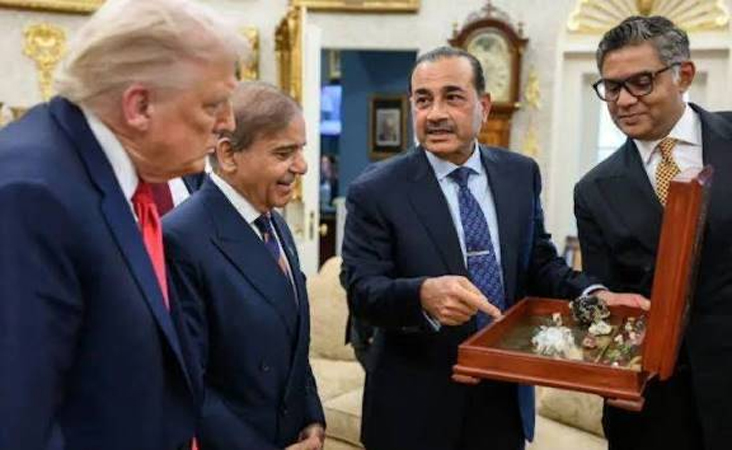
That courtship has already yielded tangible results. Last September, Islamabad signed memoranda of understanding worth $500 million with American company US Strategic Metals (USSM) to develop and export minerals. The deal, hailed as a “strategic handshake” by officials, saw Pakistan’s then-Prime Minister Shehbaz Sharif sharing a stage with generals and US executives in a rare show of civil-military unity. Trump publicly thanked Pakistan for its cooperation and even slashed tariffs on Pakistani goods to 19%. In another first, Pakistan’s army chief was welcomed at the White House amid this minerals diplomacy.
The Critical Minerals Ministerial hosted by Rubio reflects Washington’s urgency to reduce its dependence on Beijing’s supply chain chokehold. Pakistan’s presence alongside allies like Australia and Japan suggests the US is hedging its bets by engaging all potential partners with mineral deposits or market heft.