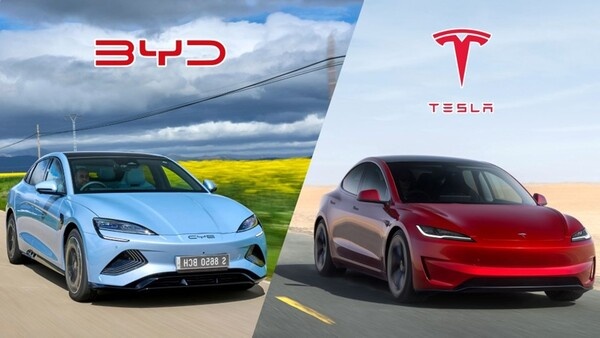
China’s BYD has overtaken Tesla to become the world’s top electric vehicle maker, as the US automaker recorded a second consecutive year of declining annual sales. Intensifying competition, the expiration of US tax incentives, and pressure on Tesla’s brand weighed on demand.
Global electric vehicle sales rose about 28% last year, creating room for rivals to gain ground. BYD capitalised on this growth by expanding rapidly outside China, particularly in Europe, where it widened its lead over Tesla.
Read More: BYD set to overtake Tesla in global EV sales
Tesla delivered around 1.64 million vehicles in 2025, down from 1.79 million the previous year. The decline followed a strong third quarter driven by buyers rushing to secure US tax credits before they expired at the end of September.
Demand softened sharply in the final quarter after the $7,500 federal EV incentive ended. Tesla delivered 418,227 vehicles between October and December, missing market expectations and marking a year-on-year drop of more than 15%.
Analysts say Tesla faced mounting challenges in North America and Europe during 2025. Growing competition from Chinese manufacturers and established European brands such as Volkswagen and BMW eroded its market share.
Brand-related headwinds also played a role, with criticism of CEO Elon Musk’s political statements affecting consumer sentiment in key markets. Despite weaker deliveries, Tesla’s shares edged higher, supported by investor focus on future technologies.
Market participants remain closely focused on Tesla’s ambitions in self-driving vehicles and robotaxis. Analysts say expectations around these projects continue to influence the company’s valuation more than short-term delivery figures.
Read More: BYD smashes EV sales record in 2025
BYD, meanwhile, reported record overseas sales of about one million vehicles in 2025, a sharp increase from the previous year. The company has indicated plans to further accelerate its international expansion in 2026.
To defend volumes, Tesla introduced lower-priced versions of its Model 3 and Model Y, particularly targeting Europe. While the move helped broaden appeal, it fell short of investor hopes for a major new mass-market vehicle.
The shift in leadership highlights how competitive the global EV market has become, as price pressures, policy changes, and consumer preferences reshape the industry.