
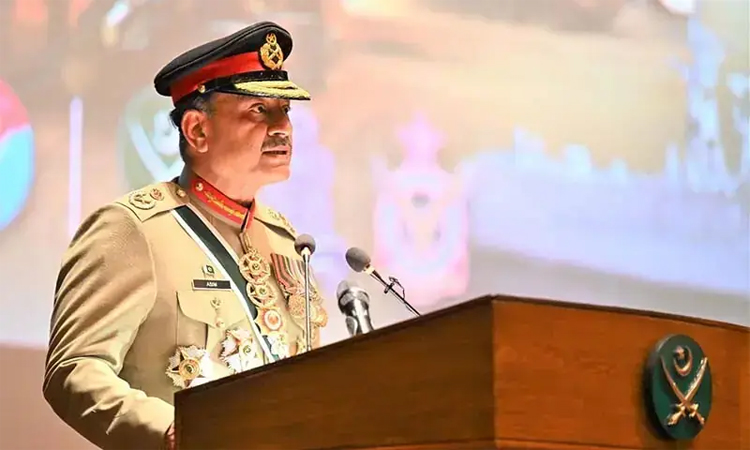
 Pakistan on Thursday rejected media reports claiming that Chief of Defence Forces Field Marshal Syed Asim Munir was planning an imminent visit to the United States, saying no such trip had been agreed or scheduled.
Foreign Office spokesman Tahir Andrabi, responding to questions at a regular press briefing, categorically denied a Reuters report that Field Marshal Munir was expected to travel to Washington for talks with US officials. “I am contradicting the fact that a visit has been agreed or planned,” Andrabi said, adding that no official delegation to the United States was currently on the books.
The spokesman stressed that high-level visits are announced through formal diplomatic channels and that no such announcement had been made. “I have seen the reports, but I have no information to share,” he said, reiterating that no plan had been finalised.
The clarification came on the heels of a Reuters report, which cited unnamed sources while claiming that Pakistan’s army chief was expected to meet US President Donald Trump in the coming weeks to discuss a proposed international stabilisation force for Gaza. The said visit would have marked Field Marshal Munir’s third trip to Washington in six months.
US officials also moved to dispel the report, reinforcing Islamabad’s denial of any planned visit.
Field Marshal Munir has met President Trump twice this year. In June, he attended a private lunch at the White House, and in September, he accompanied Prime Minister Shehbaz Sharif during an official visit to Washington. Pakistani officials note that both visits were publicly announced in advance, underlining that senior-level engagements are not conducted discreetly.
Responding to another query, Andrabi, said discussions on ISF for Gaza were ongoing in “certain capitals,” but Pakistan had neither committed to participate nor received any specific request.
Separately, diplomatic sources in Islamabad said routine contacts between Pakistan’s military leadership and their US counterparts remain ongoing, including telephone-level communication on regional developments. The sources stressed that such exchanges should not be confused with a formal visit or negotiations on troop deployment.
Pakistan’s leadership has repeatedly outlined its position on the Gaza conflict, calling for an immediate ceasefire and a UN-led political process. Prime Minister Sharif and Foreign Minister Ishaq Dar have publicly rejected ad hoc military deployments, with Dar stating last month that “disarming Hamas is not our job.”
Islamabad has also raised the issue at international forums. At the United Nations Security Council, Pakistan called for a time-bound political process grounded in UN resolutions aimed at establishing a sovereign Palestinian state.
Analysts say participation in a foreign-led stabilisation force would be politically sensitive at home. Several Muslim-majority countries have raised reservations against proposals outlined by Washington, and local analysts warn that any troop deployment under an external framework could trigger domestic backlash.
For now, officials insist there is no change in policy. The Foreign Office’s denial and the White House’s clarification leave little room for speculation about an imminent visit. Until an official announcement is made, Islamabad says reports of a secret Washington trip or discussions on troop deployment remain unfounded.