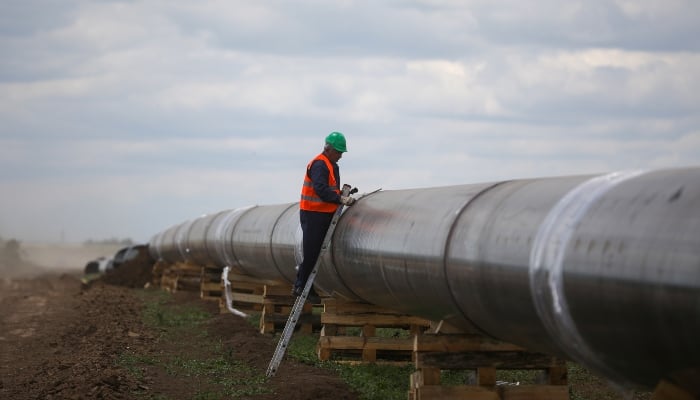
ISLAMABAD: Pakistan’s national gas transmission network has entered a critical phase once again after nearly two months of stability, with system pressure surpassing the danger level of five billion cubic feet (BCF), The News reported on Thursday.
Official figures for October 29, 2025, reveal that the line pack — which measures gas volume and pressure — reached 5.177 BCF, exceeding the safe operating limit. The Sui Northern Gas Pipelines Limited (SNGPL) attributed the alarming pressure build-up to a sharp decline in power sector gas consumption.
Currently, power plants are consuming just 293 million cubic feet (MMcf) of re-gasified liquefied natural gas (RLNG), even though Pakistan has binding take-or-pay LNG contracts with QatarEnergy and ENI, ensuring steady fuel supply for four major RLNG-based plants in Punjab.
Read More: $18b penalty if Pakistan terminates Iran gas pipeline agreement
Despite rising pressure, ENI has continued diverting one LNG cargo per month to the international market since February 2025, a trend expected to continue until the end of the year due to lower domestic demand.
To manage the excess gas, authorities have curtailed local production by 300 MMcf, a decision that has frustrated exploration and production (E&P) companies. Industry experts caution that forced shutdowns of gas wells could damage reservoirs and cause permanent production losses, with past restoration efforts costing over $1 million per well.
In related developments, gas supply from the Bettani field was suspended on October 18 following a sabotage attack on an eight-inch pipeline, while the Dakhni plant remains closed for a 21-day annual maintenance.
Read More: Gas pipeline targeted again in Lakki Marwat explosion
Energy officials explained that RLNG-based power plants are operated according to the economic merit order (EMO) to keep electricity prices low, prioritizing cheaper local-fuel power generation.
However, experts warn that if the system pressure continues unchecked, any rupture in the main gas trunk line could cripple the nation’s energy infrastructure, halting industrial operations, power generation, and household gas supply across Pakistan.