 Three more ministers from the Azad Jammu and Kashmir (AJK) cabinet on Friday announced their resignation, with two of them calling upon Prime Minister Chaudhry Anwarul Haq to step down for what they described as his “failure to safeguard the constitutional rights of Kashmiri refugees”.
Earlier this week, AJK Information Minister Pir Mazhar Saeed announced that he had resigned from his position, citing “some unavoidable reasons”. However, a senior official at the AJK prime minister’s office told that the resignation had been “received but not yet accepted”.
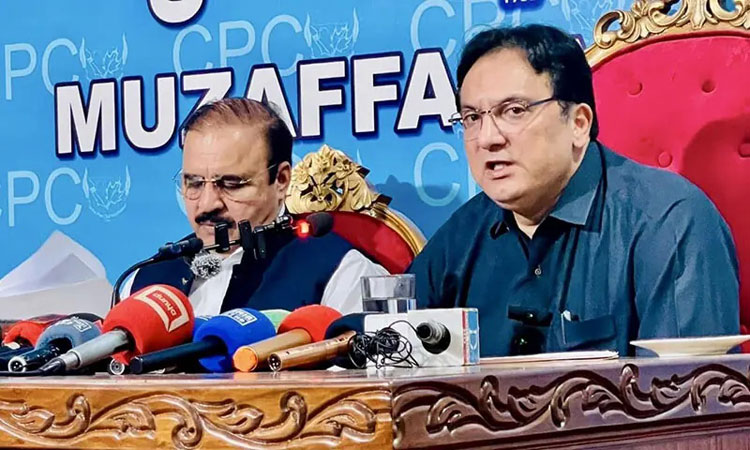
AJK Finance Minister Abdul Majid Khan and Food Minister Chaudhry Akbar Ibrahim announced they would step down at a joint press conference at the Muzaffarabad Press Club, while Sports, Youth and Culture Minister Asim Sharif Butt sent his resignation directly to the prime minister, opting to stay away from media interaction.
All three were elected on PTI tickets in the 2021 general elections from LA-45 (Valley-VI), LA-38 (Jammu-V) and LA-42 (Valley-III) – constituencies reserved for Kashmiri refugees who migrated to Pakistan after 1947. However, the trio had later joined the faction of PTI defectors led by PM Haq in 2023.
Their resignations came in protest against the agreement recently signed by a seven-member federal government committee and the Joint Awami Action Committee (JAAC), which, among other matters, addressed the contentious issue of the 12 legislative assembly seats reserved for Kashmiri refugees settled across Pakistan.
Calling the JAAC an “unelected, baton-wielding group”, Khan and Ibrahim said the accord had effectively legitimised an “unconstitutional and morally indefensible demand, reached under pressure and without wider consultation”.
They alleged that the deal violated the fundamental rights of thousands of Kashmiri refugees and struck at the heart of AJK’s constitutional and political framework.
They maintained that the campaign against the refugee seats was a malicious move by a small group of traders and self-styled representatives pursuing narrow interests “under the guise of reforms”.
The real target, they asserted, was not the government but the identity, representation and political recognition of the refugee community that had made immense sacrifices for Pakistan and the cause of Kashmir’s accession.
Both ministers argued that these seats were not a privilege but a historic and conscious constitutional decision, which was part of AJK’s political setup since 1947. The reserved seats, they said, symbolised the constitutional acknowledgment of the sacrifices and long displacement endured by those who lost everything for the cause of Pakistan.
They termed the JAAC’s questioning of these seats’ existence a denial of the pain, identity and political significance of an entire generation exiled for its struggle for accession to Pakistan.
They said they had brought this issue to the notice of the president and prime minister of Pakistan in black and white, and added that they would “knock on all doors to frustrate the designs of the elements hellbent upon creating a wedge between local and migrant Kashmiris and thus damaging the Kashmir cause”.