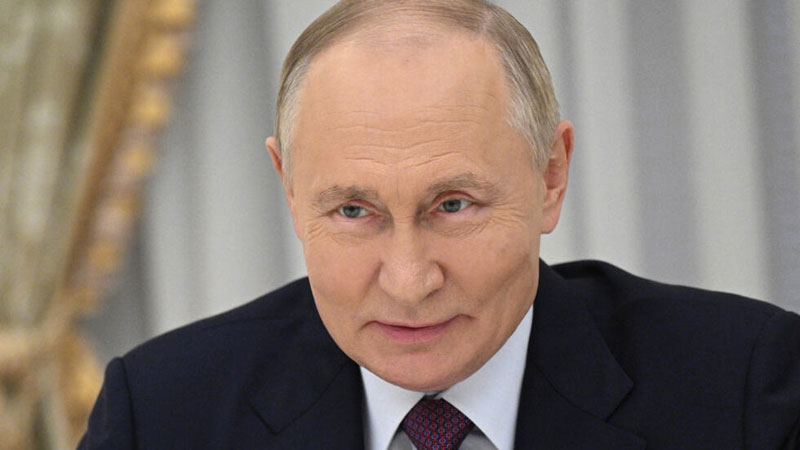
 President Vladimir Putin made a chilling declaration this week when he proposed changes to Russia’s nuclear war policies. One of the most concerning was the possibility of mobilising the country’s nuclear arsenal if another nuclear power supports a non-nuclear state’s attack on Russia. The comments marked a clear escalation in Moscow’s rhetoric, but some experts say there is a world of difference between Putin’s declarations and the hidden rules of nuclear doctrine.
Is the world approaching the brink of nuclear disaster or is Putin merely bluffing when he talks about playing the nuclear card?
The significance of Putin’s September 25 statement is not easy to decipher. Ever since the start of the war in Ukraine, the Russian leader has repeatedly threatened to bring nuclear weapons into the conflict. So much so that the Bulletin of the Atomic Scientists – a journal on nuclear security and monitor of the Doomsday Clock – recently published yet another updated timeline of the many times Russia has escalated its nuclear talk. The first such threat can be traced to February 24, 2022 – the same day Russia launched its full-scale invasion of Ukraine.
Three new points
This time, however, the world seemed to pay more attention. In Britain, the BBC headlined with “Putin proposes new rules for using nuclear weapons” and US public broadcaster PBS declared that “Putin lowers nuclear response threshold”.
These reactions stemmed from the fact that Russia revised its nuclear doctrine to add three new points in conjunction with Putin’s speech, according to Ulrich Kuhn, head of the arms control and emerging technologies programme at the Institute for Peace Research and Security Policy at the University of Hamburg.
In his declaration at Russia’s Security Council, Putin said that Moscow now reserves the right to use nuclear weapons if an ally – i.e., Belarus – comes under attack.
For the first time, Putin also specified what types of attacks might trigger a Russian nuclear response, saying the scope will be widened to cover any attack that poses an “existential threat” to Russia. This means that large-scale drone attacks may join long-range ballistic missile attacks in being considered triggers.
Finally, Putin announced that any nuclear power (such as the UK, France or the United States) that is seen as supporting a non-nuclear power (such as Ukraine) in conventional attacks inside Russia will be held just as responsible as the attacker, and potentially trigger a nuclear response.
This means that the supporting country could become a target in itself, said Sarah Tzinieris, a specialist in international security and nuclear non-proliferation at King’s College in London.
“And not only would it be targeted, but it would also be potentially targeted with nuclear weapons,” she said.
This shift could quickly turn the war in Ukraine into a global conflict.
Declaration versus doctrine
But there are some important differences that separate Putin’s declarations and the actual nuclear doctrine, which stipulates exactly when, how and why Russia can use nuclear arms.
The first is that talk does not necessarily equal action.
“This doesn’t necessarily change anything strategically,” Tzinieris said. “This is very much about rhetoric.”
David Blagden, a senior lecturer in international security at Britain’s University of Exeter, agreed, noting that despite the tough language, Putin is probably not any closer to pressing the nuclear button than he was before.
“To an extent, all declaratory doctrine is just cheap talk … and in this instance, Russia making such a declaration neither increases Russian capabilities nor lessens NATO’s capability to deter,” he said.
“It remains just as true that – if Moscow responded to a NATO-backed conventional strike on Russia by escalating to nuclear use – NATO could do the same to Russia.”