

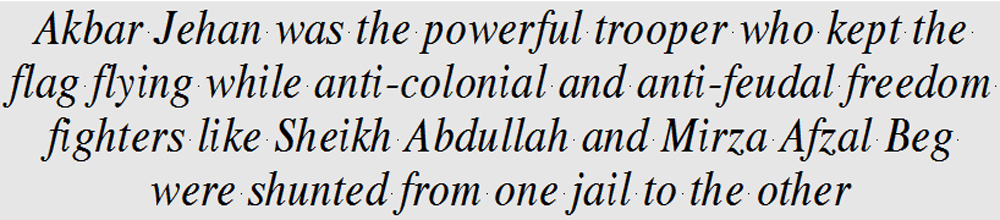
My maternal grandmother, Akbar Jehan, and her children were subjected to hardship in my maternal grandfather Sheikh Mohammad Abdullah’s long absence after his ouster from power and arrest in 1953. The family was condemned to isolation, but Akbar Jehan did not cringe. I still see vestiges of the distrust of statist versions of history and criminalisation of progressive politics in my mother, which she must have imbibed in her inclement and agitated childhood. But Akbar Jehan was the powerful trooper, the silent force that kept the flag flying while anti-colonial and anti-feudal freedom fighters like Sheikh Abdullah and Mirza Afzal Beg, and other soldiers of the Plebiscite Front were shunted from one jail to the other, from one solitary confinement to the other.
There is a historical value in revisiting and challenging narratives about political personages of pre- and post- 1947 Jammu and Kashmir and of the movement for political self-determination. I continue to employ oral testimonies, and I rely on written sources including works authored or co-authored by Sheikh Abdullah, to add layers of understanding to the tumultuous events that moulded the history of Jammu and Kashmir.
The early part of Akbar Jehan’s life with Sheikh Abdullah was constrained by hardship, uncertainty, political duplicity, and constant attempts to curb freedom. Sheikh Abdullah’s ouster on August 9, 1953, and his subsequent arrest at the behest of the Prime Minister of India, Jawaharlal Nehru, was an event that alienated the Kashmiri masses and cast Abdullah’s next of kin as personae non grata. Sheikh Abdullah’s vociferous protests against, what he perceived as, endeavours to erode the constitutional autonomy of the state and undemocratic legitimisation of its integration into the Indian Union earned him the disapprobation of some of his former allies.
For the benefit of students of politics and history, I reproduce here the speech that Sheikh Abdullah was scheduled to make at an Eid gathering in Srinagar in August 1953, but was unable to do so because of the arbitrary dismissal of his government and his incarceration:
“There is growing awareness among the people of the state that a satisfactory and lasting solution of the Kashmir problem is possible only if both India and Pakistan examine this problem from the interest of the good of the people of the state as a whole. The state of Jammu and Kashmir is so situated geographically that it depends for its economy on a free flow of trade to both countries. For ages, Kashmiri arts and crafts have found markets in India. At the same time, the rivers and roads of Kashmir stretch into Pakistan, while our only road to India remains blocked for nearly three months a year. Kashmir’s railhead used to be Rawalpindi and the traders in the Valley would use Karachi as the sea-port for overseas trade. These circumstances lend overwhelming weight to the aspirations of the people of the state to secure the goodwill of both India and Pakistan for their betterment and prosperity. They aspire that somehow the dispute should be settled in a manner as to allow them opportunities for national development based on the Indo-Pak accord. The National Conference organisation opposes pro-merger sentiments of those cultural and ethnological groups whose sympathies and loyalties run outside their own state and the only result of whose activities would be to destroy the basic structure of the state. I know of occasions when I have tried to satisfy the legitimate demands of Muslims or reassure their minds about the future, when my friends have condemned me as a communalist and a turncoat. It becomes necessary that I should satisfy them to the same extent that a non-Muslim is satisfied that his future hopes and aspirations are safe in India. Unfortunately, apart from the disastrous effects which the pro-merger agitation in Jammu produced in Kashmir amidst the present growing fears and dissatisfactions, the Muslim middle class in Kashmir has been greatly perturbed to see that while the present relationship of the state with India has opened new opportunities for their Hindu and Sikh brothers to ameliorate their lot, they have been assigned the position of a frog in the well.
“The Muslim intelligentsia in Kashmir is a definite and concrete stake in India. So the minds of the people of Kashmir have moved from fear to frustration and from frustration to near-disillusionment, which I have tried to explain in my recent speeches. While the National Conference stands committed to the support it gave to the Instrument of Accession and the Delhi Agreements, the fact remains that the present situation of suspense has primarily to be resolved: 1) Will public opinion in India, more particularly overwhelming majorities of the people of Jammu and Ladakh, accept the present relationship based on the Instrument of Accession and Delhi Agreements as final and not to be altered in due course by coercion or otherwise; 2) Would such relationship not be subject to change because of international factors; 3) Would all sections of the state’s people derive equal benefit from such a relationship, irrespective of caste or creed? 4) Would it be possible under this relationship to overcome the difficulties presented by geography or nature which stand in the way of all-round economic prosperity of the state?”
I confess that every time I read one of Sheikh Abdullah’s speeches or interviews, my eyes well up because history is a harsh judge!
The writer is the author of Fiction of Nationality in an Era of Transnationalism, Islam, Women, and Violence in Kashmir, The Life of a Kashmiri Woman, and the editor of The Parchment of Kashmir. She can be reached at [email protected]