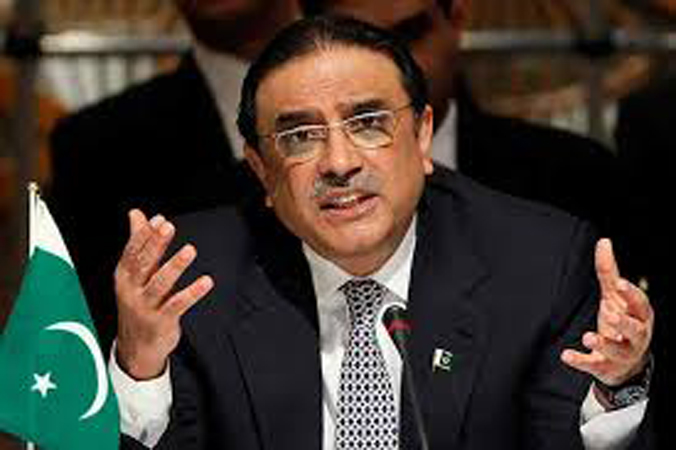
 The 69th birthday of President Asif Ali Zardari of the Islamic Republic of Pakistan is being celebrated today. This is the best opportunity to recognize his services for the stability of Pakistan, its democracy, and the well-being of its people, and to pay tribute to his historic achievements.
One of Asif Ali Zardari’s great achievements is that, after the martyrdom of Mrs. Benazir Bhutto, he worked tirelessly for the survival and continuity of the Pakistan People’s Party in very difficult circumstances. After the judicial killing of Shaheed Zulfiqar Ali Bhutto, the terrorists’ aim in martyring Ms. Benazir Bhutto was to destroy the People’s Party. The People’s Party transformed the democratic struggle of the people of Pakistan into a powerful political movement in the 1960s and continues to lead this democratic struggle. The People’s Party represents not only the unity of the people of Pakistan but also an institution of national unity. Preserving and strengthening it is undoubtedly a historic achievement for democratic and national stability.
Another major achievement of Asif Ali Zardari is the restoration of the 1973 Constitution through the 18th Constitutional Amendment, which ensures the preservation of the Federation of Pakistan. This guarantee is provided by the federal parliamentary democratic system established in the constitution. Asif Ali Zardari transferred his presidential powers to Parliament under the 18th Constitutional Amendment for the sake of the country and democracy. Now, only Parliament has the authority to form, change, and dissolve governments. The 18th Constitutional Amendment has also significantly reduced opportunities for non-political forces to seize democratic power or interfere in the political process. It has granted greater provincial autonomy, ending the sense of deprivation among smaller federal units and strengthening the Federation of Pakistan.
Another significant achievement of President Asif Ali Zardari is that he made crucial political decisions alongside the 18th Constitutional Amendment to address threats to Pakistan’s security. He gave an identity to this federal unit by renaming the North West Frontier Province (NWFP) as Khyber Pakhtunkhwa. This recognition ended the perception that the province and its adjacent tribal areas were merely a ‘buffer zone’ in the geopolitical game. Asif Ali Zardari also identified these areas as distinct units through the Gilgit-Baltistan Reforms in 2009, which helped mitigate risks for Pakistan. Additionally, he not only apologized for past violations against the people of Balochistan but also introduced the ‘Balochistan Rights Package’ to integrate them into the mainstream political framework of Pakistan.
Another great achievement of Asif Ali Zardari is his promotion of the politics of reconciliation in the country. Reconciliation is a fundamental philosophy of the Pakistan People’s Party. Shaheed Zulfiqar Ali Bhutto himself drafted the party’s ‘fundamental document’ at its establishment in 1967, with its first chapter dedicated to reconciliation. From 1970 to 2024, every election manifesto of the People’s Party has included a chapter on reconciliation. The philosophy of reconciliation advocates that instead of engaging in conflict, political forces should agree on a political and democratic program and work together to advance democracy and people’s rights.
The way Asif Ali Zardari implemented this philosophy of reconciliation is unparalleled in modern history. Through his conciliatory politics, he achieved significant milestones for democracy and people’s rights, including the unanimous approval of the 18th Constitutional Amendment. While pursuing reconciliation with political forces, he avoided confrontation with non-political forces or the establishment of Pakistan, and refrained from any kind of adventurous actions. He believed that conflicts and adventurous politics in third-world countries often damage political forces. Political and democratic evolution should not obstruct the necessary adjustments of state institutions.
Pakistan People’s Party Chairman Bilawal Bhutto Zardari is continuing this tradition of reconciliation politics, opposing the traditional politics of conflict and bitterness. It is important to reference Asif Ali Zardari’s historic speech in the National Assembly, where he stated that the era of divisive politics must end, and that we should not pass on a legacy of hate to future generations. Through his conciliatory approach, Asif Ali Zardari introduced prudence, tolerance, and politeness into politics, nurturing great traditions that will serve as a model for genuine political forces.
In the political history of Pakistan, the name of Asif Ali Zardari will remain prominent among those great politicians who endured the hardships of long imprisonment. He was imprisoned for 11 years, facing numerous false political cases and following the legal path to prove his innocence. He frequently appeared in different courts in a single day. At no stage did his determination or independence waver, nor did he compromise. He respected all state institutions, including the judiciary of Pakistan, and never claimed that, as the leader of a major political party, he was above the law. He never incited his party workers to attack institutions. Like Shaheed Bhutto, Shaheed Benazir Bhutto, and thousands of other workers and leaders of the People’s Party, he accepted court decisions. He avoided conflict with state institutions and did not drive the country into chaos. Instead, he continued his political journey with great resolve, working for the stability of Pakistan and democracy.
Another significant achievement of his is the immense patience he demonstrated during the worst propaganda and media trial against him in history. He adhered to the belief that the position and status of any political leader are defined by history, not by the opponents’ propaganda. Additionally, he advanced the main mission of the People’s Party by delivering the fruits of the democratic struggle to the people. He continued the party’s program of providing employment, housing, and other basic needs, redirecting financial resources to improve living standards and implementing plans to enhance the quality of life for the people.
What Asif Ali Zardari has done for Pakistan and its people reflects his profound political consciousness. Born into a political family, his father, Hakim Ali Zardari, was a progressive and people-friendly politician. He maintained close relationships with progressive and democratic thinkers in Pakistan and provided financial support to people-oriented and progressive organizations and individuals. Hakim Ali Zardari’s views on Pakistan’s affairs were clear and impactful.
Asif Ali Zardari inherited this political awareness, which was further refined through his association with the martyr Ms. Benazir Bhutto. His high political consciousness, prudence, integrity, and struggle have earned him the honor of serving as the President of the Islamic Republic of Pakistan for a second term-a distinction no one else has achieved. Under his leadership, the People’s Party government was established in Balochistan for the second time. Asif Ali Zardari will be remembered among those leaders whose political traditions will endure and from whom students of politics will continue to seek guidance. He is also a significant figure for political opponents, serving as a school of politics in his own right.