
Nearly half a million people of Pakistani origin call United States their home. The education and income levels in this Pakistani-American community are significantly higher than those in the US population in general.
Among them are doctors, engineers, lawyers, accountants, journalists, politicians, business executives, professional sports team managers and owners, artists, actors, entrepreneurs, salespeople, policemen, soldiers, convenience store clerks, and taxi, bus and truck drivers. US is the 5th most popular destination among Pakistan-born international migrants and the 6th largest source of remittances to Pakistan.
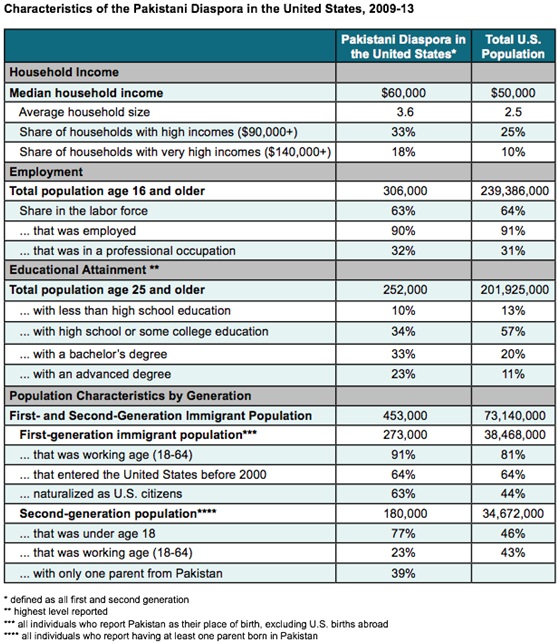
Pakistani-American population demographics: Pakistani-American population was 450,000 as of 2013, according to a report compiled by Migration Policy Institute. Of these, 273,000 were born in Pakistan and the remaining 180,000 are US-born. The Pakistani-American population has more than doubled in the last decade due to increased immigration, according to US Census data.
Pakistani-American community is the seventh largest among Asian-Americans – trailing behind Chinese-Americans (3.8 million), Filipino-Americans (3.4 million), Indian-Americans (3.2 million), Vietnamese-Americans (1.74 million), Korean-Americans (1.7 million) and Japanese-American (1.3 million), according to Asian-American Centre For Advancing Justice.
Education and income levels: Among college age population of Pakistani-Americans, 56% have at least a bachelor’s degree, much higher than 33% Americans with college degrees. Of this population segment (25 years and above), 23% have masters or Ph.D degrees.
Median annual income of Pakistani-American households is $60,000, higher than the $50,000 median household income of all Americans. 33% of Pakistani-American households earn at least $90,000, while 18% earn more than $140,000.
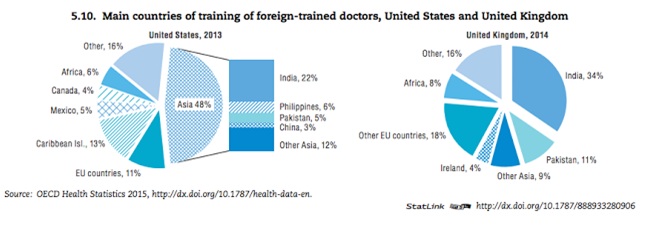
Pakistani-origin doctors in US: Pakistan is the third biggest source of foreign doctors in the US, according to OECD.
A vast majority of doctors from the American-Muslim community are of Pakistani origin. Among them is Dr Mark Humayun who was awarded top US medal for technology by President Barack Obama in 2016.
About 30% of the 800,000 doctors – 240,000 doctors – currently practicing in the US are of foreign origin, according to Catholic Health Association of the US. Predictions vary, but according to the American Association of Medical Colleges, the US will be short of about 160,000 physicians by 2025. This gap will most likely be filled by more foreign doctors.
As of 2013, there were over 12,000 Pakistani-origin doctors in the US, or about 5% of all foreign physicians and surgeons. Pakistan is the third largest source of foreign-trained doctors. India tops this list with 22% or 52,800 doctors, followed by the Philippines with 6%, or 14,400 foreign-trained doctors.
Pakistanis in Silicon Valley: Silicon Valley is home to around 12,000 to 15,000 Pakistani-American families. Thousands of them are working at leading technology companies like Apple, Cisco, Facebook, Google, Intel, Oracle, and Twitter.
In fact, Pakistani-Americans are the largest foreign-born Muslim group in San Francisco Bay Area that includes Silicon Valley, according to a 2013 study. The study was commissioned by the One Nation Bay Area Project, a civic engagement programme supported by Silicon Valley Community Foundation, The San Francisco Foundation, Marin Community Foundation and Asian Americans/Pacific Islanders in Philanthropy.
Pakistani-American entrepreneurs, advisers, mentors, venture capitalists, investment bankers, accountants and lawyers make up a growing ecosystem in Silicon Valley. Dozens of Pakistani-American founded start-ups have been funded by top venture capital firms. Many such companies have either been acquired or have gone public by offering shares for sale at major stock exchanges. Organisation of Pakistani Entrepreneurs (OPEN) has become a de facto platform for networking among Pakistani-American entrepreneurs in Silicon Valley. It holds an annual event called OPEN Forum which attracts over 500 attendees.
Pakistani-Americans in entertainment and sports: Kumail Nanjiani, a Pakistani-American actor-comedian, recently made headlines with the successful release of his feature film The Big Sick on hundreds of screens across the US. It is a cross-cultural romantic comedy based on actual events that breaks new ground by casting a Pakistani-American in a lead role. Acquired by Amazon Studios for $12 million after a bidding war at Sundance film festival, the film has already grossed over $36 million so far.
Shahid Khan, a Pakistani-American engineer who made his multi-billion dollar fortune in auto industry, became the only non-white owner of an NFL franchise team when he bought Jacksonville Jaguars for $760 million in 2011.
Major League Baseball’s Los Angeles Dodgers franchise general manager is a Pakistani-American named Farhan Zaidi, an MIT and Berkeley-educated economist.
Kamala Khan is a new Marvel comic book character created for Marvel Entertainment by Pakistani-American Sana Amanat. This was a part of the American comic giant’s efforts to reflect a growing diversity among its readers.
Academy Award winning Hollywood hits Frozen, Life of Pi and The Golden Compass have one thing in common: each used extensive computer-generated imagery (CGI) created by Pakistani-American Mir Zafar Ali who won Oscar statuettes for “Best Visual Effects” for each of these movies.
Pakistani-American Organisations: Rockefeller Foundation-Aspen Institute Diaspora (RAD) programme has identified 79 Pakistani-American organisations. Of these, five have revenues exceeding $1m while two have over $200,000 in their most recent fiscal year. The top organisations are The Citizens Foundation (TCF), the Association of Physicians of Pakistani Descent in North America (APNA) and the Organization of Pakistani Entrepreneurs (OPEN). Other large organisations are American Pakistan Foundation, Imran Khan Cancer Foundation and Human Development Foundation (HDF). These organisations help raise funds for education, health care and other development and human welfare activities in Pakistan.
Trump’s America: Like members of other ethnic and religious minorities, Pakistani-Americans may also be alarmed by the increasing bigotry in the US ever since the election of President Donald Trump. This is particularly true of places like New York’s Little Pakistan were Pakistanis were targeted after 9/11 terrorist attacks. At the height of the sweep, over 20,000 people in Brooklyn’s South Asian communities had left the US, a COPO survey found. Many sought political asylum in Canada and Australia, and some returned to Pakistan and other countries. A number of them never returned. Many had their legitimate US immigration applications pending at the time. Others had their cases in immigration courts and they were waiting for disposition by judges.
A thriving community: The aforementioned statistics show that with a few exceptions most Pakistani-Americans are thriving in their respected fields. They have significantly higher income and education levels than the general US population. Besides contributing to their respective fields, Pakistani-Americans are active in local community activities and their organisations routinely help raise funds for schools, hospitals and other civic amenities back home in Pakistan.
Published in Daily Times, August 22nd 2017.