

Getting to know one’s ideology is a work in progress. Ironically, it was in the United States — a country that prides itself on the power of it’s military-industrial complex — that I cultivated the drive to study the South Asian politico-cultural matrix. My commitment to pedagogy and scholarship has been unflinching and my faith in the critical focus that education can provide has been unrelenting.
The Kashmir conflict is driven by nationalistic and religious fervour, each side pointing to the violence and injustice of the other, as well as its own suffering and sorrow
Whether people see eye-to-eye with my stated positions or question them, anybody would be hard-pressed to deny that I have a firm conviction in my political ideology. I have spent a lot of time and energy delving into the erosion of indigenous politics in the State in my earlier work. And I have had the opportunity to immerse myself in the culture and polity of my native land, Kashmir, without which an understanding of the rich complexity of the socio-political fabric of the Kashmir Valley wouldn’t have been possible.
To enable a layman to fathom the complicated political status of Jammu and Kashmir (JK), currently, a large part of the State is administered by India and a portion by Pakistan. China annexed a section of the land in 1962, through which it has built a road that links Tibet to Xiajiang. As I underline on my monograph on Kashmir; Islam, Women, and Violence in Kashmir: Between India and Pakistan, the strategic location of Indian-administered JK underscores its importance for both India and Pakistan. The state of JK borders on China and Afghanistan.
The Kashmir conflict is driven by nationalistic and religious fervour, each side pointing to the violence and injustice of the other, as well as its own suffering and sorrow. The distrust, paranoia, and neurosis permeating the relationship between a large number of JK natives and the Indian Union have intensified the conflict. The guerrilla war in the state has gone through a series of phases since 1990 but repressive military and political force remains a brutal reality in the State, which cannot be superseded by seemingly abstract democratic aspirations. This conscious policy of the Indian State to erode autonomy, populist measures, and democratic institutions in JK has further alienated the people of the State from the Indian Union. The systemic erosion of political opposition in JK has delegitimised the voice of dissent and radicalised antagonism toward state institutions and organisations. The exposure of some democratic institutions as a brutal facade has instigated unmitigated disgruntlement and antipathy toward democratic procedures and institutions in the State.
Our peace and prosperity are inextricably bound with the peace and prosperity of the millions in India and Pakistan. In spite of the physical delineation of the boundaries, we all live in one zone. Our hopes, aspirations, fears, and dangers are the same.
We want a lasting and peaceful settlement of the Kashmir conflict, reflecting the wishes of our people. Therein lies honour, peace, and progress for all concerned.
The restoration of the autonomous status of J&K would be a viable beginning and would resuscitate rule of law and political self-determination.
Nation-states have their own interests to protect; our shared interest should be the protection of the people of Kashmir, particularly the young whose lives haven’t even begun yet.
Let’s place ourselves in the shoes of those who have suffered irreparable losses and will never know any closure. Time will not heal the wounds of such people. We need an indigenous constituency for conflict resolution.
In politics, the only viable way is forward, not a constant looking back. And policies and methods must be revisited, revised, and readjusted not just by mainstream politicians, but by separatist politicians as well in order to meet today’s needs.
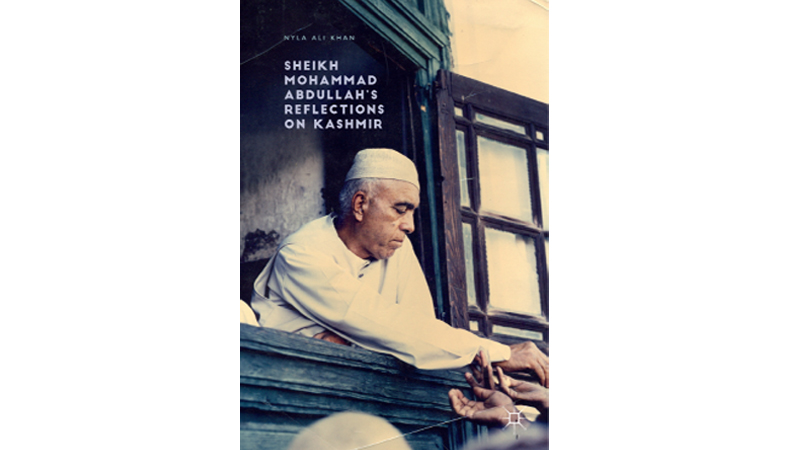
Poring over the speeches of Sheikh Mohammad Abdullah, arguably the only Kashmiri leader who enjoyed mass support in his lifetime, has enabled me to realise that instead of allowing polarising elements to disrupt nation-building, we need to cull advanced and reformist ideologies in order to build common ground. His speeches were recorded and translated by his close associates, those who fought with him in the trenches.
At the time, he and his colleagues were considered persona non grata by the Government of India, preventing them from gaining access to reputable publishing houses. So, I had to retrieve and dust the cobwebs off the documents reproduced herein, which provide tremendous insight into peace-building, democratisation, and the processes of negotiation, dialogue, and accommodation required to reach some kind of fruition.
I have been conscious of the limited representations in some other works on Kashmir which reflect the power dynamic between those who represent and those who are represented
I was further motivated to complete this project by the Kashmiri youth, college and university students, who came to see me this summer on my annual visit to my homeland. They observed that no one person and no one organisation had copyright over Sheikh Mohammad Abdullah and that a revival of the discourse of Kashmiri nationalism, which he symbolised, would repair the damaging divides and fill in the cracks in that polity.
As I underscored in The Life of a Kashmiri Woman (New York: Palgrave Macmillan, 2014), to my mind, there is a historical value in revisiting and challenging the historical narratives about the political personages of pre-and post-1947 Jammu and Kashmir and the movement for an independent Kashmir. My attempt to highlight the history of a region in a particular era, as I’ve done in The Life of a Kashmiri Woman as well, is not to localise it. As I’ve said before, I think it is important to reshape historical memory so that it includes the humanitarian and pluralistic endeavours of leaders of the movement at that critical juncture post-1948. I have been working on Sheikh Mohammad Abdullah’s Reflection on Kashmir for a while, because I am of the firm opinion that a consciousness cannot be built without a mechanism of political training, ideological education, and progressive action, which a close study of his speeches and interviews would enable. Unless a popular politics of mass mobilisation is merged with ideological guidance, not dogma, as well a grassroots social movement, it only leads to self-destruction. A serious student of South Asian politics and the politics of Kashmir in particular could analyse the ways in which experiences have been constructed historically and have changed overtime.
In the past few years, every article that I’ve written, every radio and television appearance, as well as every face book and tweet of mine have been instantiations of, as one of my reviewers puts it, “the high stakes debate on the right of the Kashmiri people to determine their own political future as an independent state.” In complementing The Life of a Kashmiri Woman, which was published in 2014, Sheikh’s Mohammad Abdullah’s Reflections on Kashmir allows me to interweave my several publications in various forums, including face book and twitter, into this compendium, bringing my work and perspective full circle.
Working on these books has enabled me to critically appraise political, cultural, and social discourses which my locations of privilege hadn’t allowed me to question previously. I have been conscious of the limited representations in some other works on Kashmir which reflect the power relations between those who represent and those who are represented. I am fully cognizant of the collision of the ideas of self-determination, identity, and unity propounded by the young members of the Reading Room Party and the Plebiscite Front with the brutal force and suppression wielded by the Indian and Pakistani nation-states. I have appraised not just the history of the Kashmiri nationalism dominated by the elite but I have carefully looked at the politics of the people and the political mobilisation engendered by such politics in my work. Popular mobilisation in J&K during the 1930s and 1940s took the form of uprisings, which was a primary locus of political action.
The primary question for me is “Who is speaking and who is being silenced?,” enabling me to recognise the legitimacy of knowledge produced from the point of view of the local subject, the conviction of the workers of political parties who maintain the vibrancy of conviction and ideology; the collision of the idea of self-determination with military oppression on the contentious site of nationalism
Hard core political analysis aside, I will never lose faith in the people of Kashmir. With every breath I pray that the younger generation of Kashmiris channelise their anger and sense of alienation, and takes the political process forward without playing into anyone’s hands. The centrist politics of both nation-states, India and Pakistan, have worked on depoliticising our society. We cannot let that happen!
The writer is a researcher associated with Strategic Vision Institute, a think tank based in Islamabad, Pakistan. She can be contacted at [email protected]
Published in Daily Times, October 3rd 2017.