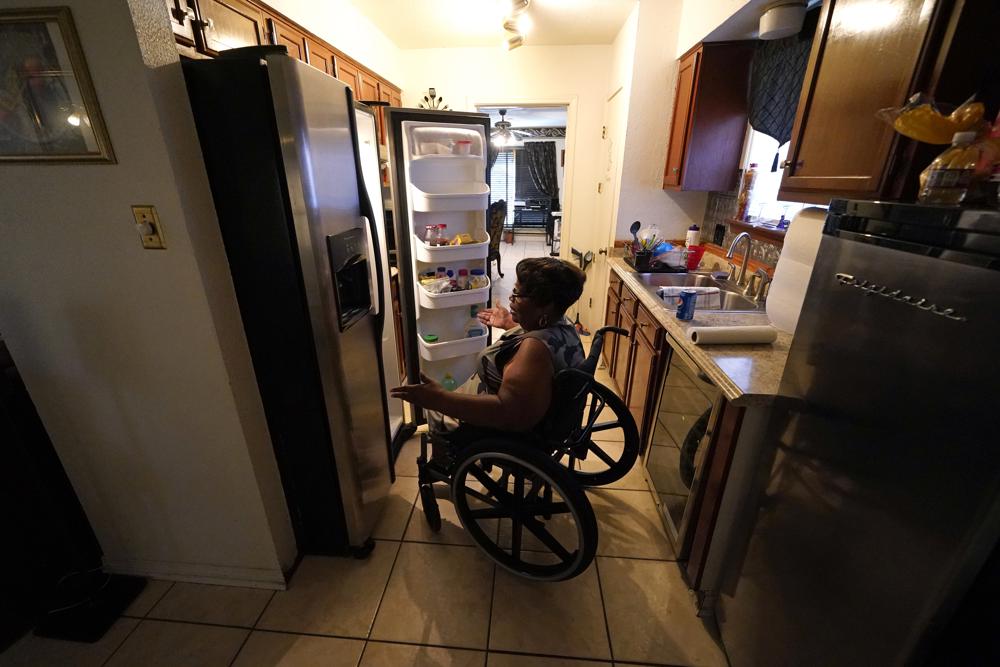
When the inevitable hurricanes threaten New Orleans, it’s hard for India Scott to figure where to go. In the city where she was born and raised, she’s stayed in hotels, relief shelters and, during Hurricane Katrina, in the famously overcrowded Superdome.
But it is always a gamble choosing where to seek refuge. A lot of places that are safe for most people aren’t safe for her because they aren’t accessible to people like her, people living with disabilities.
Scott has used a wheelchair her entire life; she was born with a disability. Even when the weather is calm in New Orleans she is reluctant to leave home to visit friends or go out to shop or eat, because places outside her house can’t guarantee that she’ll be able to maneuver even basic things like using the restroom, passing through an entryway or getting into bed.
Scott’s house in the Algiers neighborhood of New Orleans is comfortable with features that are required by code yet often missing, like widened entryways for her wheelchair. It has a bed lower to the ground that’s easier to get in and out of it. But because she lives near a levee, she leaves that comfort behind whenever a major hurricane or tropical storm is forecast because rising floodwater that would challenge anyone would surely be fatal for her.
“I try my best to make my home comfortable,” she said, “but if that water ever comes through, I’m in trouble.”
Scott said she can’t rely on the city, state or federal government when storms come, only friends. She said there is inadequate support for disabled people before, during and after disasters, from emergency management agencies at all levels of government.
“We’re on our own,” she said, through tears, to The Associated Press.
Experts and activists echoed her view, telling the AP people with disabilities are left out of emergency and disaster planning, and face hurdles that able-bodied people don’t when disasters strike.
As climate-related disasters become more common and more severe, most countries in the world are “ neglecting their obligations to respect, protect, and fulfill the rights of persons with disabilities in their responses to the climate crisis,” according to a June report from the Disability Inclusive Climate Action Research Program at McGill University and the International Disability Alliance.
The researchers found that only 32 of the 192 countries that are signatories to the United Nations Framework Convention on Climate Change’s Paris climate accords in 2015 refer to people with disabilities in their official climate plans. Forty-five countries refer to disabled people in their climate adaptation policies and no country mentions disabled people in its climate mitigation plans. Many of the world’s biggest contributors to climate change – the United States, China, Russia, Brazil, Germany, Japan and the United Kingdom – don’t figure people with disabilities into any of these plans, according to the report.
That is despite the fact that 185 countries ratified the United Nations’ Convention on the Rights of Persons with Disabilities, drafted in 2006, which says that countries will take “all necessary measures to ensure the protection and safety of persons with disabilities in …. humanitarian emergencies and the occurrence of natural disasters.” The U.S. was one of eight countries that signed the treaty but haven’t ratified it.
People who are disabled are not a small segment of the population. According to the World Health Organization, there were over a billion people in the world living with a disability in 2011, which was 15% of the global population at the time. The organization plans to release an update on disability prevalence in December.
More recently, researchers with the Disability Data Initiative estimated the percentage of people with disabilities averages 12.6% across 41 countries for which they have data, as of 2021. One of them, Sophie Mitra, said the WHO figure of one billion is likely to have grown since 2011.
“We are still failing people with disabilities, especially multiply-marginalized people, before, during and after disasters,” Marcie Roth, CEO of the World Institute on Disability, told the U.S. Congress during testimony in July. “We need your help to address urgent, immediate, lifesaving steps (government agencies) can take to serve disaster-impacted people and communities being left out and left behind.”
A clear example of this failure took place at the U.N. Climate Change Conference (COP26) in November 2021. Israeli Energy Minister Karine Elharrar, who uses a wheelchair, was prevented from entering a conference event by police officers. A day later, after the incident was publicized, conference organizers and the British government constructed a ramp so she could attend.
“What happened to the minister of energy happens to us all the time,” said Yolanda Muñoz, a professor at McGill University and co-founder of the Disability Inclusive Climate Action Research Program that co-authored the June report. “But, of course, it doesn’t make headlines.”
Another climate activist, Pauline Castres, who previously worked for the United Nations and has a disability, mourned the return to in-person climate talks that came with COP26 in Glasgow. “I’ve always found those meetings to be quite restrictive in terms of who can attend and who can take part,” she said. “We called (virtual events) one of the few good things that came out of the pandemic.”
But the problems people face go beyond access at international conferences and happen on the national, state and local level. When people can’t access climate planning talks, it’s more likely they won’t be figured into emergency management plans.
And the climate crisis isn’t only affecting people with physical disabilities, Grace Krause, policy officer for Learning Disability Wales, said in a 2019 blog post. Krause said it was “alarming” how little information on climate change was presented in an “easy read” format for people with certain cognitive disabilities. That format uses short sentences, active voice and explanation of any complex words and ideas in a separate sentence.
Font choices that make text easier to read for people with dyslexia is another way climate communications can be more accessible.
In 2019, the UN Human Rights Council adopted a resolution calling on governments to take climate action that is inclusive of people with disabilities, but there still isn’t much action from the UN’s official climate policy arm, the United Nations Framework Convention on Climate Change.
There were two disability-related events at COP26 – one on designing cities that are both climate resilient and accessible and another on mental health and climate action – but they were side events. Disability inclusion in climate action has rarely taken the main stage.
Julia Watts Belser, a Georgetown University professor who uses a wheelchair, said the inclusion of people with disabilities in climate mitigation and adaptation planning “matters deeply” to her. She leads an initiative exploring the intersection of climate change and disability at Georgetown and teaches a class called Disability, Ethics, Ecojustice.
“I think about wanting us as a society to invest in the infrastructure for our communities so that we are better able to adapt and respond,” she said, “so we aren’t leaving people behind, so we aren’t leaving people to die.”