Greatest tragedy that has hit us hard can be at best be described by Professor KK Aziz’s as murder of our history. We lost no time in engineering our history by charlatans who grabbed straight and disfigured
Jinnah Sahib’s vision to fall into the hands of usurpers who distorted and disgorged it. He refused to be called as anything but “Plain Mr Jinnah”.
Even the Quaid was not spared. Some so-called historians present him as a man on horseback, sword in hand. Though he is without a beard, he is wearing a cap with some inscription in Arabic, more or less like the Kurd crusader Salahuddin Ayubi, out there to conquer the world.
It was indeed a great honour for me to speak on Muhammad Ali Jinnah at a conference in London on his life. The conference was sponsored by the Professional Forum and the Pakistan High Commission. Despite being unwell, I accepted the invitation to speak, along with Justice (Retd) Sir Anthony Blackburn, President Pakistan Society and Barrister Sheikh Shuja, ex-Mayor of Hackney and author of ‘Jinnah’. I could have spoken on Quaid’s democratic vision of Pakistan, his views about minorities, his emphasis that in Pakistan, all citizens would be equal irrespective of caste, creed, colour or gender. And of course, how he singled out corruption as the main curse afflicting the newly-founded country.
As a journalist from a politically-charged household, I could have spoken on the dynamics of the Pakistan movement and the Quaid. Instead, I opted to make my submission anecdotal since not many Pakistanis – especially the younger generation – know what sort of man our founder was and what values he cherished the most.
Nobody would believe that except his driver, his cooks and everyone else was non-Muslim. He had no inhibitions about religion. He valued work and kept people on merit and not on the basis of religion or ethnicity
His biographer late Professor Stanley Wolpert (who died earlier in the year, rightly observes in the biography of Jinnah: “few individuals significantly alter the course of history. Fewer still modify the map of the world. Hardly anyone can be credited with creating a nation-state. Muhammad Ali Jinnah did all three”. Indeed, no man in history achieved so much in such a short time as the Quaid did.
We often hear of many people talk of their sacrifices for Pakistan. However, as far as the Quaid was concerned, his struggle for Pakistan was constitutional and democratic. He fought his battle in the Parliament using logic. Unlike Indian Congress leaders, he never went to jail, nor did he ask his followers to be violent. Nor did he have an inner voice like Mahatama Gandhi’s, (or Prime Minister Imran Khan’s to advise that he take a U-turn whenever needed. He stood upright by his words once he made a decision, and made others follow it.
A quote from Professor Wolpert, would suffice to throw light on my father’s lifelong association with the Quaid, who used to say: “All India Muslim League is nothing but Shamsul Hasan and his typewriter”.
Most of what I shared was what I had learnt from my father – late Syed Shamsul Hasan – Assistant Secretary All India Muslim League from 1913 to 1947 – perhaps one of Jinnah and Liaquat Ali Khan’s few trusted men. That my father did not bring anything with him from India except the documents the Quaid entrusted him with, shows how close they were.
My father met Mr Jinnah on his first visit to Lucknow in 1913 when he was called Ambassador of Hindu-Muslim Unity by Mrs Sarigni Naidu. My father accompanied the All-India Muslim League’s General Secretary, Sir Wazir Hasan to receive him at Kanpur station to accompany Quaid to Lucknow where a big reception was waiting for him. The entire city and drive to the venue of the meeting was decorated with huge posters and banners – welcoming ‘Maulana’ Mohammad Ali Jinnah.
Sir Wazir Hasan and my father had not met Jinnah Sahib. When the two went into his compartment, both were shocked to see a double breasted, clean shaven gentleman who greeted them as Mr Jinnah. Sir Wazir looked at my father, confused, since the Muslim League’s publicity posters had called the Quaid ‘Maulana’ Mohammad Ali Jinnah. However, the gentleman who stood before them was far from any Maulana they had ever met. Both whispered, and my father rushed to the nearby Maachli bazaar and brought some Turkish (Fez) caps. Meanwhile, Sir Wazir Hasan had shared his predicament with the Quaid and he agreed to wear one of the Fez caps. He continued to wear the cap throughout his stay in Lucknow.
Was he bigoted or discriminatory? My father used to disburse the salaries of Jinnah Sahib’s domestic servants in Delhi. Nobody would believe that except his driver, his cooks and everyone else was non-Muslim. He had no inhibitions about religion. He valued work and kept people on merit and not on the basis of religion or ethnicity. My father used to say that had his personal physician been anyone other than a Parsi doctor – Dr Mistry – who kept the secret that Jinnah Sahib was suffering from incurable Tuberculosis, Lord Mountbatten would have delayed partition and could have even waited for Jinnah sahib’s death a year later.
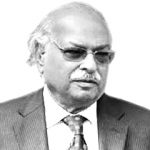
The writer is former High Commissioner of Pakistan to UK and a veteran journalist