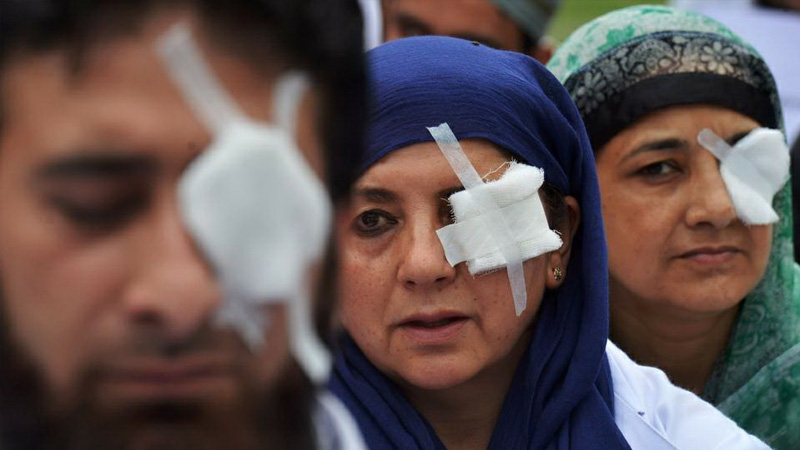
 The New York based global rights watchdog, Human Rights Watch, has said Indian authorities continue to impose harsh and discriminatory restrictions on Muslim-majority areas in Indian illegally occupied Jammu and Kashmir, one year after the revocation of its constitutional status on August 5, 2019.
The Human Rights Watch in a statement issued in New York said, “…unwarranted restraints on the rights to free speech, access to information, health care, and education have been intensified by the COVID-19 pandemic.
On August 3, 2019, the HRW said, Indian authorities imposed broad restrictions on freedom of movement, banned public meetings, shut down telecommunication services and educational institutions, and detained thousands of people with critics being threatened with arrest, while access to the internet is limited.
“Indian government claims that it was determined to improve Kashmiri lives ring hollow one year after the revocation of Jammu and Kashmir’s constitutional status,” said Meenakshi Ganguly, South Asia director at Human Rights Watch. “The authorities instead have maintained stifling restraints on Kashmiris in violation of their basic rights.”
Prominent political leaders, including three former chief ministers, were among the thousands detained to prevent protests. Police told the courts that 144 children had also been taken into custody. The HRW also mentioned allegations of new arrests, torture, and ill-treatment by Indian forces. “The government has also used harsh counterterrorism and sedition laws to clamp down on peaceful critics.” On June 29, 2020, the authorities accused Mubeen Shah, a businessman, of sedition after he criticized the government for attempting to alter the Muslim-majority demographic status of Jammu and Kashmir by lifting residency restrictions, it added.
“In April, the police opened criminal investigations against Gowher Geelani and Peerzada Ashiq, both journalists, and Masrat Zahra, a photojournalist, contending that their social media posts or reporting were “anti-national. On July 31, editor Qazi Shibli, previously held under the Public Safety Act, was questioned and detained.”
The global rights body also discussed India’s new media policy for Jammu and Kashmir that empowers the authorities to decide what is “fake news, plagiarism and unethical or anti-national activities” and to take punitive action against media outlets, journalists, and editors.
The policy contains vague and overbroad provisions that are open to abuse and could unnecessarily restrict and penalize legally protected speech. International law provides that restrictions on freedom of expression must be necessary for a legitimate purpose, such as the protection of national security, public health, or the rights of others, and strictly proportionate to achieve that end, it added.
It said, the crackdown adversely affected livelihoods, particularly in the tourism-dependent Kashmir Valley. The Kashmir Chamber of Commerce and Industries estimated that the first three months of a lockdown to prevent protests since August 2019 cost the economy over US $2.4 billion, for which no redress has been provided. Losses have nearly doubled since the government imposed further restrictions to contain Covid-19 in March.
The pandemic has made access to the internet crucial for information, communication, education, and business. However, the authorities have only barely complied with Supreme Court orders in January to treat access to the internet as a fundamental right, permitting only slow-speed 2G mobile internet services, the Human Rights Watch said.
Doctors have complained that the lack of internet was hurting the Covid-19 response. “It is a new virus – research, studies, guidelines and updates are changing every other day,” said one doctor. “The internet helps doctors to keep a tab on developments around the world, but we cannot access video lectures or other information in the absence of high-speed internet.”
Without proper internet, students are often unable to attend online classes. “The impact on education has been particularly severe. The limiting of networks to 2G has made it impossible for online classes to function adequately. Graduate students and teachers have been unable to participate in conferences or have their papers published, causing willful harm to their careers and violating the rights to education.”
The United Nations High Commissioner for Human Rights, Michelle Bachelet, has repeatedly voiced concern about human rights violations in Jammu and Kashmir.
Indian authorities should take immediate steps to protect rights by releasing political detainees; upholding the right to free speech, including by withdrawing cases against journalists and activists; restoring full internet access; and holding to account officials responsible for rights violations, Human Rights Watch said. “Even as the pandemic is forcing the world to address discrimination and inequality, the Indian government is persisting with its repression of Kashmiri Muslims,” Ganguly said. “The government should reverse its abusive policies and provide remedies for those whose rights were violated.”