
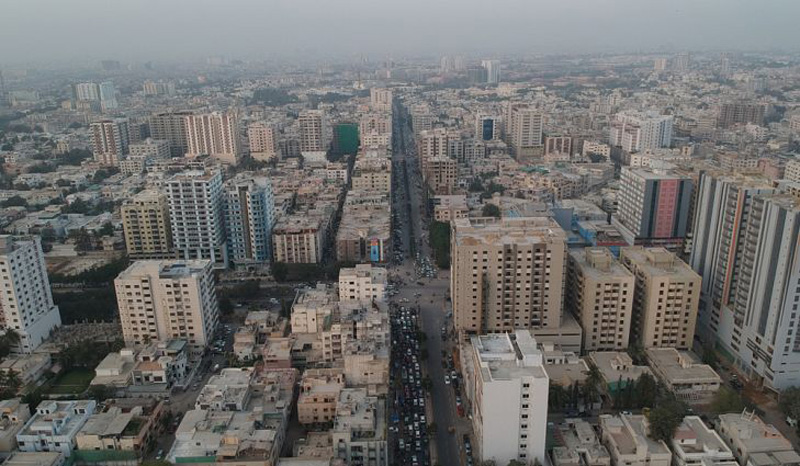
In every city and even in remote areas, there is a flood of housing societies without any control or regulation
 Pakistan is caught in a vicious cycle of over-population, housing societies and low food quality
I shifted to Pakistan in 2012 from Europe, and I was stunned to see over-crowded roads, markets, streets, mushrooming of housing societies and tasteless food. I found people rushing to big malls and shopping centres and youngsters to schools and colleges but without discipline.
Once, I took a taxi to reach a bus stand; the journey was marked with smoke, and I felt breathing difficulty until I reached the bus stand. The distance of 10 kilometres was a big challenge, which I covered in 40 minutes due to heavy traffic. I could not find any pedestrian crossing signals, and people did not seem to care where some of those signals were in place.
I travelled from Lahore to Islamabad by the G T Road. I was unable to understand where Lahore ended or Gujranwala or where Gujrat started. The GT Road was so busy, and people were in haste. I did not find any place left for lush green agriculture fields that I often saw in the past. Rather, I saw signboards of housing societies.
During my time in Europe, I often missed Pakistani food but when, on my return, I tasted it, I did not sense that taste anymore. I enquired a friend who was a graduate of agriculture sciences; he pointed out that pesticides, fertilisers and hybrid seeds have changed the taste. He told me that if we do not use pesticides, fertilisers, or genetically modified seeds, we do not have enough yield to feed our population. Housing societies have grabbed the fertile land and converted them into real estate business, which is booming. The result is a scarcity of food or compromise on the quality. It is essential to use chemicals to get high yield from the leftover land. This food is also affected by sewerage water.
In early 2000s, the debate started about the 140 million population, which turned into 220 million in 2019. In 20 years, about 60 to 80 million people were added. According to UN reports, the fertility rate (3.65 percent) is high in the region. It is projected that the population will be 310 million or higher in 2050. It is increasing without any control. The result is that we have unplanned housing societies and inadequate food.
In 2012, I started talking about population on national media. I received huge criticism. People were joking about me or did not consider population a worthwhile subject. Now we see a huge number of people, several vehicles on roads, and we can hardly find any place to live peacefully, not only in urban centres but also in remote areas. Metropolitan cities are the major victim of over-population and a high level of urbanisation.
In every city and even in remote areas, there is a flood of housing societies without any control or regulation
One agreement is that a big population could be an opportunity for Pakistan if it caters to the needs of the young population. For example, China channelised its youth and became a huge economic power of the world. China provided technical skills to the young population, and they contributed in the economic productivity. However, the Malthusian and the new Malthusian theory is that over-population of a country is a big explosion. Khurhseed Shah of the PPP termed it as ‘the nuclear explosion of population’.
In every city, and even in remote areas, there is a flood of housing societies without any control or regulation. Some of these housing societies do not even have water, sanitation and gas facilities but they are being sold to make money for their owners. Land is being expanded and occupied by housing societies. This situation prevails throughout the country. Cities and villages are not spared from the exponential growth rate of housing societies. The result is that we do not have enough quality food to provide each person. We have sub-standard food and genetic modification for our younger generations.
Pakistan is caught in a vicious cycle of over-population, housing societies and low food quality. One may argue that food is available but the distribution is not adequate for the common man. I partially agree, but it is a fact that as a result, a lot of people are without food. Food is full of effects of an excessive use of fertilisers and pesticides. In 1980s and early 1990s, we had good quality food; vegetables and fruits were without pesticides. Now the situation has changed. We have low quality and tasteless food. Consequently, the quality of life has degraded.
One of my colleagues at Quaid-e-Azam University, Islamabad, conducted a research on 22 vegetables available in Islamabad and Rawalpindi. He found that 21 vegetables had particles of arsenic and other toxic ingredients, and only one vegetable was eatable. Those 22 vegetables were not for human consumption.
Imran Khan’s government has taken a good decision to ban mushrooming of housing societies. It is the responsibility of the government to provide quality food and adequate housing societies, which needed to have a horizontal growth rather than the vertical. There is need to develop and construct apartments as we see in metropolitan cities all over the world. Housing societies should fulfil the basic needs of a common man, but they should not expand vertically. The first step should be to have an effective policy and management of the population. If the population is growing without planning, it may be a destruction of everything in itself.
The writer is a sociology lecturer at Quaid-i-Azam University, Islamabad.