
According to latest reports, the US and Taliban negotiators were expected to conclude an agreement covering two issues in their last meeting in May 2019. But the discussions stalled over Taliban’s refusal to cease hostilities and participate in an intra-Afghan peace dialogue until Washington announced a troops drawdown timetable.
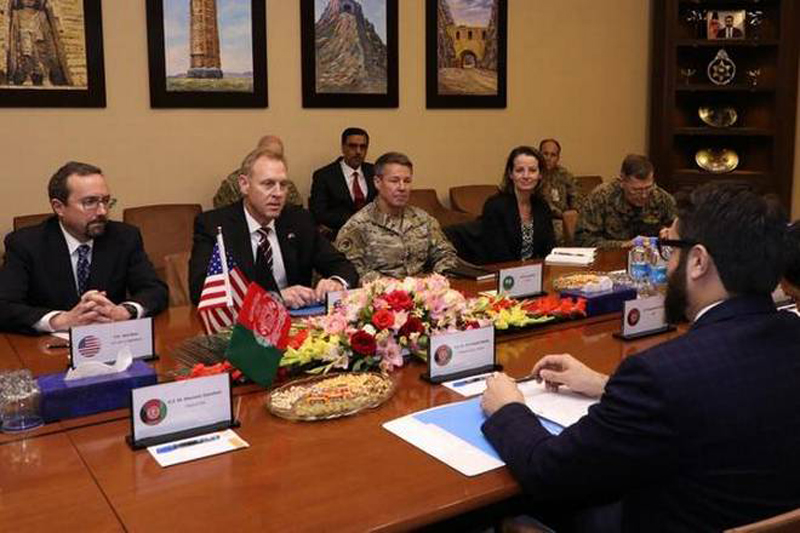 Afghan Taliban spokesperson, Sohail Shaheen, stated, “I hope that with the announcement of a timetable for withdrawal of foreign forces from Afghanistan, the process may gain momentum, paving the way for Afghans to sit together and chart a roadmap for a future Islamic system and government.” US Special envoy, Zalmay Khalilzad, in a statement ahead of the upcoming meeting with the Taliban, stated that he would “try to bring the first two parts of our peace framework to closure.” He emphasised that success would require other parties to show flexibility.
Official sources in Kabul, meanwhile, have told Voice of America that a two-day peace dialogue among Afghans, including government and Taliban representatives, is being arranged in Doha early next month. The sources said that the meeting was scheduled for July 7, 2019, and it would be an outcome of the upcoming US-Taliban negotiations.
Marine General Frank McKenzie, head of US Central Command, said earlier this week that the Islamic State was under strong military pressure in Afghanistan. American forces and their Afghan partners routinely attack IS bases in the country, while Taliban insurgents also regularly clash with loyalists of the Middle East-based terrorist group. Contradicting that, Taliban spokesman, Zabihullah Mujahid, alleged, “Their occupation is practically providing Daesh a ground in Afghanistan. They are using its name and existence as an instrument.”
It has been reported that US interlocutors, in direct talks with Taliban envoys in Qatar, have proposed to leave behind a counterterrorism force in Afghanistan to fight the IS. Taliban negotiators, however, have rejected the proposal, insisting their fighters could handle and defeat the Islamic State loyalists. Nevertheless, it reinforces the earlier fears that Donald Trump’s promise to abandon all endless wars and bring troops back home from Afghanistan under economic and political imperatives, it is not likely to be realised fully due to resistance from his own well entrenched military and intelligence establishment for whom achievement of an end state is more precious, for pursuing unstated national interests, rather than mere political expediency suiting the White House with eyes on the 2020 presidential election.
It appears that the US is backing out from the most important point agreed upon earlier regarding a complete pullout from Afghanistan. This can jeopardise the progress made so far and delay the peace process indefinitely.
Meanwhile there has been an ominous military build up in the Middle East, threatening escalation with Iran. A subtle but meaningful response to this has come through the SCO summit in Bishkek, Kyrgyzstan, underscoring the desire for peace in the region and the willingness to stand together in case of aggression by the US and its allies.
Given the context Pakistan is under great pressure.
The most enduring lesson of Vietnam and Afghanistan for the US may be that there is no good way out of a bad war except to end it
Since 1979, the USA has been in a state of war. In his 1995 memoir, In Retrospect: The Tragedy and Lessons of Vietnam, former US secretary of defence Robert McNamara wrote that the American failure in Vietnam boiled down to one important factor: America’s inability to fully grasp the complexity of its adversaries and the environment in which they operated. Little has changed in the quarter-century since McNamara’s reflection.
After 18 years of fighting in Afghanistan, the United States is diving into a peace process based on false assumptions about its primary adversary: the Afghan Taliban. US policymakers are assuming that Taliban fight simply for political power, rather than an ideology, that they operate through unified command and control, and that Taliban have come to the negotiation table as a result of war-weariness and they are willing to compromise. In fact, the Taliban are talking because, throughout, they believed that if Americans had watches, they had the time, and having been emboldened by due political recognition by important regional and extra regional countries, and with control of more than 50 per cent of the Afghan territory, they can push out the dwindling American footprint.
The biggest false assumptions fed to America by successive governments in Kabul, hand in glove with India, are that Pakistan supports Afghan Taliban and holds the magic key to bringing around the desired end state suitable for America. It then follows that application of more diplomatic, military and economic pressure by stopping any assistance and leveraging through the International Monetary Fund, World Bank, the Asian Development Bank and the Financial Action Task Force can make Pakistan cooperate. Like the unwise investing in government in Saigon in South Vietnam, America may realise too late that ignoring the UN and SIGAR reports, investing in Afghan government, and betting on India as a strategic partner to deal with China and Pakistan was an exercise in futility.
The options before the United States today are familiar ones. Washington could escalate in hopes of winning the war; it could persist just as it has so far, inviting a prolonged stalemate, or it could put an end to the failed venture that has already lasted 18 years, and whose long-term costs may run into trillions of dollars. The choice seems obvious. The United States must abandon its fixation with abstractions, such as credibility or fear of appearing weak, and act instead on the basis of common sense. The most enduring lesson of Vietnam and Afghanistan for the US may be that there is no good way out of a bad war except to end it.
The writer is a retired army officer with experience in military and intelligence diplomacy