• Skip to primary navigation
  • Skip to main content
  • Skip to primary sidebar
  • Skip to footer
Trending:
  • Kashmir
  • Elections
Saturday, June 6, 2026

Daily Times

Your right to know

  • HOME
  • Latest
  • Iran-Israel war
  • Gilgit Baltistan Election
  • Pakistan
    • Balochistan
    • Gilgit Baltistan
    • Khyber Pakhtunkhwa
    • Punjab
    • Sindh
  • World
  • Editorials & Opinions
    • Editorials
    • Op-Eds
    • Commentary / Insight
    • Perspectives
    • Cartoons
    • Letters to the Editor
    • Featured
    • Blogs
      • Pakistan
      • World
      • Lifestyle
      • Culture
      • Sports
  • Business
  • Sports
  • E-PAPER
    • Lahore
    • Islamabad
    • Karachi

Agencies

study finds Major emperor penguin breeding ground barren since 2016

Published on: April 26, 2019 10:01 PM

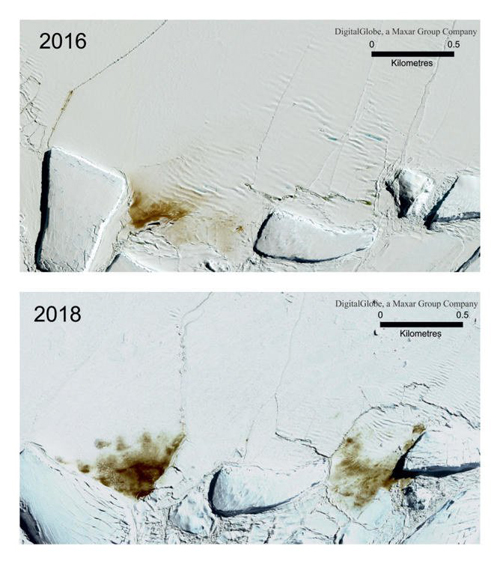
For the past three years, virtually nothing has hatched at Antarctica’s second biggest breeding grounds for emperor penguins and the start of this year is looking just as bleak, a new study found.

Usually 15,000 to 24,000 breeding pairs of emperor penguins flock yearly to a breeding site at Halley Bay, considered a safe place that should stay cold this century despite global warming. But almost none have been there since 2016, according to a study in Wednesday’s Antarctic Science.

The breeding pair population has increased significantly at a nearby breeding ground, but the study’s author said it is nowhere near the amount missing at Halley Bay.

“We’ve never seen a breeding failure on a scale like this in 60 years,” said study author Phil Trathan, head of conservation biology at the British Antarctic Survey. “It’s unusual to have a complete breeding failure in such a big colony.”

Normally about 8% of the world’s emperor penguin population breeds at Halley Bay, Trathan said.

Black-and-white with yellow ears and breasts, emperor penguins are the largest penguin species, weighing up to 88 pounds (40 kilograms) and living about 20 years. Pairs breed in the harshest winter conditions with the male incubating their egg.

Scientists blame the sharp decline on climate and weather conditions that break apart the “fast ice” — sea ice that’s connected to the land — where the emperor penguins stay to breed. They incubate their eggs and tend to their chicks — one per pair — on ice. After breeding and tending to the chicks, the penguins move to open sea.

Usually 15,000 to 24,000 breeding pairs of emperor penguins flock yearly to a breeding site at Halley Bay

In 2016 and 2017, there was no breeding in Halley Bay and last year there was just a bit, the study found.

The nearby Dawson-Lambton breeding area, which had been home to a couple thousand pairs, increased to 11,117 pairs in 2017 and 14,612 pairs in 2018, the study said.

While that’s encouraging, it doesn’t make up for all that was lost at Halley Bay, Trathan said. “Not everybody has gone to Dawson Lambton yet,” he said.

What’s troubling isn’t that part of the colony has moved to Dawson-Lambton, it is that scientists thought of Halley Bay as a climate change refuge in one of the coldest areas of the continent “where in the future you expect to always have emperors,” Trathan said.

David Ainley, a marine ecologist and penguin expert at the consulting firm H.T. Harvey & Associates, worried that some people will be more alarmed than they need to be because many of the penguins didn’t disappear, but just moved. While not as scary as it may sound initially, with climate change “long term, it’s another question as alternate breeding sites likely will become harder to find,” said Ainley, who was not part of the study.

The study makes sense, and sometimes dramatic environmental change can cause a breeding failure like this, said Stephanie Jenouvrier, a penguin expert at Woods Hole Oceanographic Institution who wasn’t part of the study.

Trathan said a super strong El Nino — a natural cyclical warming of the central Pacific that changes weather worldwide — melted sea ice more than usual and exposed the fast ice to wind and waves, making the breeding home less stable. He said it’s not possible to say yet if human-caused warming — from fossil fuel burning that creates heat-trapping gases globally — is a factor.

A 2014 study by Jenouvrier projected that because of climate change the global population of emperor penguins will likely fall by at least 19% by the year 2100.

The breeding colony failure, Trathan said, “is a warning of things that might become important in the future.”

Filed Under: Infotainment Tagged With: barren, breeding, Dawson-Lambton, Emperor, ground, major, penguin, penguin breeding, Scientists

Submit a Comment


Primary Sidebar


Latest News

Alexander Zverev eases past Jakub Mensik in French Open semifinals

Taylor to face Pili in Croke Park farewell

FIFA bans vuvuzelas from World Cup stadiums

France brush off Ivory Coast loss, call it timely World Cup reminder

Legendary boxer Muhammad Ali’s 10th death anniversary observed

Pakistan

JAAC declared proscribed party ahead of AJK polls on July 27

Fixed tax scheme for small retailers launched to raise Rs 50bn annually

Govt cuts petrol price by Rs 4 per litre, keeps diesel’s unchanged

Bilawal promises GB voters with land and job rights

Iran declares support for Hezbollah with wider peace deal in doubt

More Posts from this Category

Business

SBP’s ‘Go Cashless’ campaign saw Rs 34bn in digital transactions on Eid

Short-term inflation down by 0.56%

Saudi-Pak Business Council shows interest in infrastructure investment

‘Govt, allies united in efforts to craft people-centric budget’

Rupee records gain against US dollar

More Posts from this Category

World

CENTCOM space post signals wider US military footprint

US official delivers Trump’s “good hello” to Putin

NASA lifts ISS evacuation alert after leak

More Posts from this Category


Footer

Home
Lead Stories
Latest News
Editor’s Picks

Culture
Life & Style
Featured
Videos

Editorials
OP-EDS
Commentary
Advertise

Cartoons
Letters
Blogs
Privacy Policy

Contact
Company’s Financials
Investor Information
Terms & Conditions

Facebook
Twitter
Instagram
Youtube

© 2026 Daily Times. All rights reserved.

Manage Consent
To provide the best experiences, we use technologies like cookies to store and/or access device information. Consenting to these technologies will allow us to process data such as browsing behavior or unique IDs on this site. Not consenting or withdrawing consent, may adversely affect certain features and functions.
Functional Always active
The technical storage or access is strictly necessary for the legitimate purpose of enabling the use of a specific service explicitly requested by the subscriber or user, or for the sole purpose of carrying out the transmission of a communication over an electronic communications network.
Preferences
The technical storage or access is necessary for the legitimate purpose of storing preferences that are not requested by the subscriber or user.
Statistics
The technical storage or access that is used exclusively for statistical purposes. The technical storage or access that is used exclusively for anonymous statistical purposes. Without a subpoena, voluntary compliance on the part of your Internet Service Provider, or additional records from a third party, information stored or retrieved for this purpose alone cannot usually be used to identify you.
Marketing
The technical storage or access is required to create user profiles to send advertising, or to track the user on a website or across several websites for similar marketing purposes.
  • Manage options
  • Manage services
  • Manage {vendor_count} vendors
  • Read more about these purposes
View preferences
  • {title}
  • {title}
  • {title}
We use cookies to ensure that we give you the best experience on our website. If you continue to use this site we will assume that you are happy with it.