While visiting Beijing some 18 years ago, we had toured the Forbidden City. It was a massive palace with 9,999 and a half rooms, walled and surrounded by a moat. While the Changing of Guards ceremony was awesome, we had discovered that several of the imperial masterworks which were originally housed in the Forbidden City had been sent to the National Palace Museum in Taiwan to survive the destruction being wreaked by the civil war between China’s Nationalist and Communist armies.
That was reason enough to visit Taipei. So in December, we flew there from Hong Kong. The drive from the airport went over a really long causeway that must have been a feat of engineering when it was built.
The next day, we visited the imperial collections at the National Palace Museum. They consisted of paintings, ceramics, jades, bronzes, textiles, Ming porcelains, laquerware and fine calligraphy. The collections spanned 800 years of history encompassing the dynasties of the Han, Mongols and Manchus. Nine monarchs in particular had left their own distinct aesthetic stamp on the artworks.
The National Palace Museum was crowded with visitors, mostly from mainland China. As we toured the exhibits, it became clear that the treasures were not monumental statements. Instead, they exemplified the sophisticated taste of the emperors by emphasising craftsmanship.

For example, there was a small cup with a chicken-themed design. It had subtle polychrome decoration and was an example of Ming Dynasty porcelain, considered the apex of ceramic art produced in China.
Next on the list of places to visit was the monument to Chiang Kai-shek, the founder of the Republic of China, today’s Taiwan. He co-founded the Kuomintang or Nationalist party, was a friend of Sun Yat-sen, and a general who had been trained in Japan. On Sun Yat-sen’s demise, Chiang Kai-shek became the de facto ruler of China.
But the communists were seeking to establish the Chinese Soviet Republic. They were his nemesis and he dreamed of eradicating them. During his Fifth Campaign, Chiang Kai-shek came close to doing that. He surrounded the Chinese Red Army in 1934, forcing the communists led by Mao Zedong into a retreat. But Mao was able to turn that “Long March” to his advantage and emerge as Chairman Mao, the undisputed ruler.
Driven from the mainland, the Nationalists took refuge in Taiwan. The Republic of China was born. Chiang would rule it for the rest of his life. His memory is preserved in the Memorial Park. On the third floor is his larger-than-life statue, seated in a posture reminiscent of Abraham Lincoln in his memorial in Washington, DC.
The following day we visited the Lungshan Temple. It was originally built in the 1700s and rebuilt decades later. It honours both Taoist and Buddhist deities. As you enter the courtyard, you hear the soothing sound of running water from the waterfall on the right. The temple lies straight ahead.
The next day, we visited the imperial collections at the National Palace Museum. They consisted of paintings, ceramics, jades, bronzes, textiles, Ming porcelains, laquerware and fine calligraphy. The collections spanned 800 years of history encompassing the dynasties of the Han, Mongols
and Manchus
It is built in palatial style, with the classical three-in-one courtyard Chinese design consisting of the front hall, the main hall, the apse and the left and right guards. Worshippers were lighting red candles, burning incense and chanting prayers.
Afterwards, we went to see the tallest building in the city. It’s called Taipei 101 and features the world’s fastest elevators. But there are only two elevators and they don’t run very frequently. Thus the people have to wait in long lines and when they finally board the elevators, they are totally packed in with other visitors.
On a clear day, the visitor is able to get a 360-degree panoramic view of the city and the surrounding mountains. Unfortunately, we were deprived of any view by the thick fog that enveloped the tower.
In the afternoon, I spotted the President of Taiwan. She had been in the news lately because her party had lost the local elections. She was checking a smart city exhibit showing how Taiwan was going to use renewable energy to power its future.
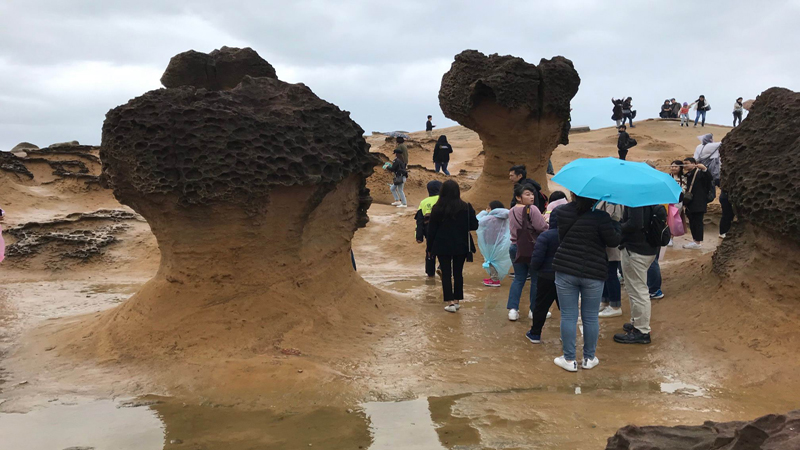
On our last day, we decided to check out the natural beauty of the areas outside the city. First on the list was Yehliu Geopark. It was located on the East China Sea. Even though nature was not cooperating with us, and the wind was splashing rain on the face, we were able to get some good views of the soft limestone formations which are its main draw. Over the centuries, wind and the waves of the sea have eroded the soft limestone rocks of the area, creating the unusual formations whose names show the power of the human imagination. The most prominent one is called Queen’s Head.
Then we drove along the coast to a volcano. The views of the sea reminded us of the views you get while driving along the California coast. Along the way, we spotted hot springs which are open year-round. But you have to take off all your clothes if you want to go into the water. We took a pass on that attraction.
The road began to climb as we approached the lower elevations of the volcano and became circuitous. At some point the view of the mountain disappeared totally, since it was enveloped by a thick fog. We concluded that nothing would be gained by continuing the journey and asked the driver to take an exit.
He had never driven to the volcano and had to rely on verbal commands to his phone to get directions via Google maps. Thankfully the phone stayed connected with the Internet and we emerged from the labyrinthine roads a half hour later.
He took us to an American village at the base of the volcano. It was a Hollywood-style replica with ranch-style homes, some of whom were flying the stars and stripes. Later, he took us to a viewpoint that had a commanding view of the Taipei skyline. The fog had lifted partially. The Tamsui River glistened in the distance.
As the plane took off for San Francisco, my mind could not resist comparing Taipei with Hong Kong. The skylines of the two cities are different. Hong Kong clearly has the greater number of high rise buildings and feels like Manhattan. Taipei has the small time charm in places.
Mandarin is spoken in Taiwan and Cantonese in Hong Kong. English is not widely spoken in Taipei while it’s widely spoken in Hong Kong.
Both share China’s glorious past and its incredible cuisine. But both have a difficult relationship with China today.
The writer can be reached at [email protected]
Published in Daily Times, January 16th 2019.