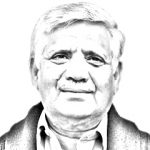
In the small hours of Sunday 14 October, comrade Javed Iqbal breathed his last at the relatively young age of 57, from stage 4 cancer in Birmingham. For forty-two of those years he had fought for the cause of revolutionary socialism.
Javed joined revolutionary politics while still at school, at the tender age of 14, after discussions with comrade Pat Wall in Manchester. (Pat Wall was later elected to the British parliament as a revolutionary Marxist.) In 1981, Javed came to Amsterdam for participation in the founding congress of Pakistani Marxist organisation. The Struggle set up by Pakistani exiles during the vicious Zia dictatorship. He remained committed to revolutionary socialism and loyal to the organisation through its most tumultuous and difficult times, and endured long years of social and personal tribulations for espousing this cause.
Javed came to Pakistan in 1986, and worked clandestinely under the brutal repression of the bigoted military regime to help lay foundations of a revolutionary organisation inside Pakistan. He suffered great hardships living in a Lahore slum. With meagre financial resources he had to use depreciated transport to visit the towns and villages of Pakistan to spread Marxist ideas and build a revolutionary nucleus. He made little complaint about this even though for him these conditions were all the more arduous, given that he was accustomed to the relatively decent infrastructure of Britain in the 1960s and ’70 (though he missed his pints of beer and the other pleasures of British life). Once other comrades arrived in 1987, the work picked up momentum and a solid nucleus of a Bolshevik organisation was created.
Javed was forced to return to Britain due to unavoidable family obligations in 1991, but his dedication to Marxism never wavered. He collected finances and organised solidarity campaigns for the struggles of youth and workers in Pakistan. Javed was elected organiser of the Pakistan Trade Union Defence Campaign (PTUDC) in Britain, and attended the British trade union conferences to participate in the British labour movement. Javed re-joined and was active in the Labour Party after the victory of left wing MP Jeremy Corbyn as Labour leader.
He organised several PTUDC public meetings for visiting Pakistani comrades and protest rallies to gather support for the class struggle in Pakistan. He accomplished this task with dedication and passion. Javed was deeply vexed by the tragedy and trauma of the Indian subcontinent’s bloodied partition of 1947. On its 70th anniversary he organised a public meeting in Birmingham in June 2017 with comrades from Pakistan and India as the main speakers. They explained in detail the concealed causes and ramifications of this Partition’s gory cleavage of this ancient civilisation and why its wounds were still festering; pulverising the region.
Javed never bragged about his dedication or sacrifices he had devoted for this struggle. He didn’t like to show off, and detested any trace of exhibitionism about one’s ideological understanding and sacrifices. He was modest but a crucial leader in the struggle for revolutionary socialism in the South Asian subcontinent and beyond
Javed regularly wrote and edited articles for the Asian Marxist Review. One of his most innovative articles was on the 1946 sailors’ revolt and the massive revolutionary upsurge in the Indian subcontinent:“The Great Royal Indian Navy Mutiny of 1946”.In 1988 he has also co-authored a booken titled Pakistan: “Socialist Revolution or a Bloody Conflagration”.
We had intense arguments and heated debates on Marxist theory, strategy and methodology. But there were always entertaining moments as we enjoyed some of the most enchanting musical classics and discussed literature, art and culture. The two languages in which Javed was well versed were English and “Pahari”, his mother tongue spoken in most areas of Pakistani-administered Kashmir. He was compassionate about the plight of the oppressed Kashmiri masses and their struggle for liberation. He was born in Kashmir and often missed his home village Boha on the banks of the Mangla Lake. After thorough discussions on the national question we developed its profound Marxist analysis and perspectives in the South Asian subcontinent. Javed wrote innumerable articles on Kashmir’s struggle against oppression.
Apart from his deep understanding of Marxism, Javed also had a passion for poetry, music and literature. Though his Urdu was modest, he took pains to read and understand the poetry of Ghalib, Faiz, Sahir and Josh Malihabadi — his favourite poets. He was enthralled by Seraiki poetry and was deeply inspired by the revolutionary message in the poetry of Mohsin Kaleem, whom he heard recite at The Struggle congresses. He also cherished classical Punjabi poetry of Waris Shah, Mian Mohammad and Baba Bulleh Shah, whose works were in Punjabi but scripted in Urdu. Javed had a treasure of books, musical records and tapes in his home library.
Javed never bragged about his dedication or sacrifices he had devoted for this struggle. He didn’t like to show off, and detested any trace of exhibitionism about one’s ideological understanding and sacrifices. He was modest but a crucial leader in the struggle for revolutionary socialism in the South Asian subcontinent and beyond. He had a remarkable tolerance for those he considered his comrades and his very few close friends. Although he sometimes appeared short-tempered, Javed often tolerated harsh verbal attacks without ever complaining about these excesses by comrades. He was always cheerful, frank and deeply sincere in the service of his cause and comrades.
Javed was also utterly dedicated to his family. He was always welcoming to guests and enjoyed the company of comrades when they visited his home in Britain or when he came over to Pakistan. His devotion to his comrades remained till the end. Just forty-eight hours before he passed away, in a phone call to a comrade and close personal friend in Lahore who was unwell himself, Javed’s concern for friends was starkly evident; in a voice that could be clearly recognised as sinking in the throes of death, he pleaded his friend to get proper treatment and admission to hospital. Such compassion is all too rare.
Javed was a silent soldier of the revolution and remained so till his last breath. His tragic demise has saddened his family, friends and comrades; but his memories will live on with them. Javed’s struggle shall not go in vain. He shall live on: not only in our memories, but will also inspire the living struggle for socialist revolution that shall be fought to the finish.
The writer is the editor of Asian Marxist Review and International Secretary of Pakistan Trade Union Defence Campaign. E-mail: [email protected]
Published in Daily Times, October 22nd 2018.