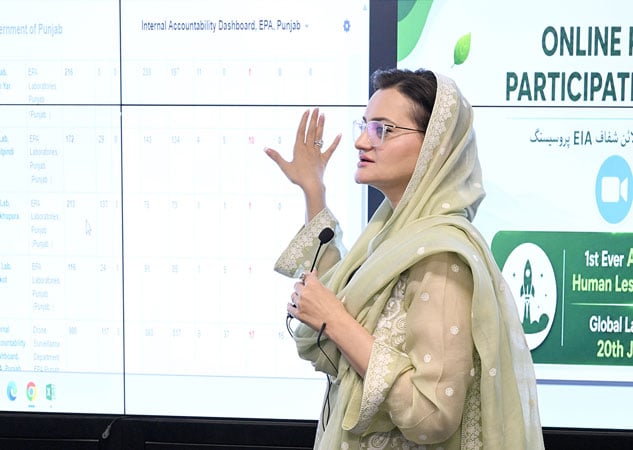
 Senior Provincial Minister for Punjab, Marriyum Aurangzeb, gave a comprehensive briefing to senior journalists on the establishment and functioning of Climate Watch, Punjab’s smog mitigation strategy, and the Government of Punjab’s wide-ranging environmental protection initiatives.
She stated that, under the leadership of Chief Minister Maryam Nawaz Sharif, Punjab has, for the first time, established an effective environmental governance system based on scientific evidence, modern technology, digital monitoring, and data-driven decision-making.
She said that when the government initiated work on addressing the smog crisis, there was neither an integrated monitoring system nor any reliable environmental data available. In the past, smog was treated merely as a seasonal issue lasting three months. The present government, however, has recognized it as a year-round environmental challenge and adopted a comprehensive, sustainable, and long-term strategy.
The Senior Provincial Minister explained that the government first established a scientific baseline database and is now continuously monitoring the impact of every sector on the Air Quality Index (AQI). While some pollution sources are seasonal, others remain active throughout the year; therefore, each sector is being monitored and analyzed separately. Multiple initiatives are also underway to reduce greenhouse gas emissions across Punjab.
She noted that, in the past, local pollution compounded the effects of transboundary pollution, significantly worsening air quality. Through targeted interventions, however, the government has substantially reduced local sources of pollution. As a result, overall air pollution in Punjab has declined by approximately 33 percent, while local pollution has been reduced by 60 percent. These improvements have also been validated by NASA’s satellite data.
Marriyum Aurangzeb said that the Environment Protection Department has undergone comprehensive restructuring. For the first time, Punjab has established a 1,000-member, multi-sectoral, technology-enabled Environmental Protection Force (EPF), which is enforcing environmental laws across seven major sectors. A Smog War Room, digital enforcement ecosystem, quick response system, and live dashboard have been introduced to ensure real-time monitoring of all enforcement activities.
She further informed journalists that more than 13,000 industrial units and chimneys across Punjab have been integrated into a digital monitoring system through QR codes. Continuous monitoring of emissions from every chimney is now underway, and immediate action is taken if any monitoring device is tampered with or environmental violations occur. A dedicated 1373 helpline, WhatsApp chatbot, and other digital platforms have also been activated to facilitate public complaints and environmental reporting.
The Senior Provincial Minister said that all brick kilns across Punjab have successfully transitioned to zigzag technology. Every kiln now has a unique digital identity and QR code, and no kiln is emitting black smoke. Mechanization of brick kilns has also contributed to eliminating child labour and improving overall compliance with environmental regulations.
She stated that fat-melting units and pyrolysis plants have been removed from residential areas, while province-wide enforcement operations against illegal facilities continue. Comprehensive mapping has been completed for hospital incinerators, industrial units, fat-melting units, pyrolysis plants, drains, and wastewater discharge points to ensure effective environmental monitoring and prevent hazardous waste contamination.
Marriyum Aurangzeb said that the phased relocation of industries from residential areas in Lahore, Faisalabad, and Sialkot is progressing steadily. Drone surveillance is being used to monitor industrial zones, while fugitive dust control measures, water sprinklers at construction sites, road dust suppression, and wastewater treatment plants have been made mandatory. She added that one percent of the budget for every development project is now earmarked for tree plantation and environmental protection initiatives.
She said that 7,200 Super Seeders are currently operational across Punjab to prevent crop residue burning, and their number will be increased to 15,000 this year. The Government of Punjab is providing 60 percent subsidy on these machines, while their local manufacturing has also commenced. Special emphasis is also being placed on promoting modern harvesting technologies to eliminate stubble burning.
The Senior Provincial Minister stated that 1,500 electric green buses are currently operating across Punjab, and the fleet will be expanded to 3,000 buses. For the first time, a fuel quality monitoring system has been introduced at petrol stations, supported by open laboratories conducting fuel testing. A biogas plant has also been made operational at Gujjar Colony.
She said that approximately 600,000 kilograms of confiscated plastic waste is being recycled into furniture and public benches. More than 52 million trees have been planted across Punjab, covering over 600,000 acres, with complete GIS mapping of plantation sites. Ongoing initiatives include the Lahore Green Ring Project, Lungs of Lahore plantation campaign, restoration of the Hudiara Drain, deployment of a German forest fire detection system, establishment of a dedicated Forest Force, and several other forest conservation projects. She also highlighted that Punjab has formulated its first-ever Climate Change Policy.
Marriyum Aurangzeb announced that Punjab’s first Climate Observatory is being established. A total of 59 modern AQI monitoring stations have already been installed across the province, with the number set to increase to 100, including 10 advanced monitoring stations in Lahore. Through the AQI Punjab mobile application, citizens can access real-time air quality data, hourly AQI updates, six-day forecasts, and public health advisories.
She said that heatwave management has now been incorporated into the mandate of Climate Watch. Waste segregation bins are being installed in 50,000 schools, while the Green Schools Programme is promoting environmental awareness among students throughout the province.
The Senior Provincial Minister said that under the Green Credit Programme, citizens can earn up to Rs. 10,000 in Green Credits by depositing 10 kilograms of plastic waste, and hundreds of thousands of people are benefiting from the initiative. The Climate Leadership Internship Programme is also successfully building the capacity of young people to become future environmental leaders.
She further informed journalists that 15 smog guns are currently operational, and their number will be increased to 30. The successful mist operation conducted in Kahna has demonstrated the effectiveness of this technology in mitigating air pollution.
Marriyum Aurangzeb emphasized that the government’s primary focus remains on controlling local sources of pollution, which has already produced significant positive results. During the last smog season, there was no need to close educational institutions, while the number of hospital patients suffering from respiratory illnesses declined by approximately 1.4 million.
She said that 12 government departments are jointly implementing Punjab’s smog mitigation strategy. The Smog Mitigation Committee at the Planning and Development Board regularly reviews progress and coordinates implementation across departments. She described the media as a key partner in this effort, noting that daily air quality data is being shared with the public to promote environmental awareness and encourage responsible public participation.
Concluding the briefing, the Senior Provincial Minister said that under the leadership of Chief Minister Maryam Nawaz Sharif, the Government of Punjab has established a robust, scientific, transparent, and digitally enabled system to protect the environment, combat smog, and address the challenges of climate change. She said the positive impact of these reforms is already evident in improved public health, environmental quality, and the long-term sustainability of Punjab’s future.