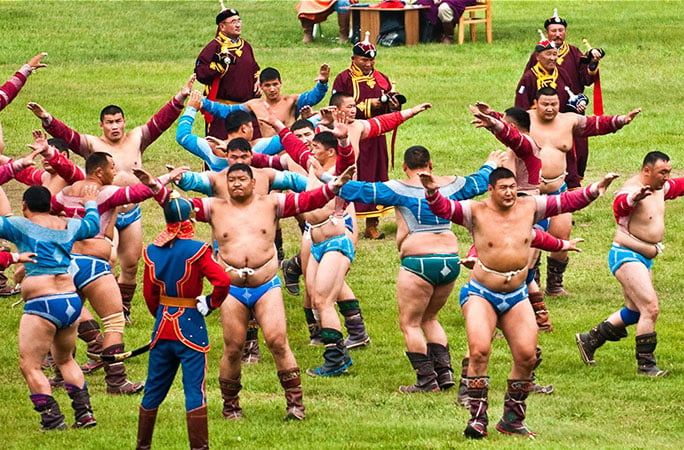
 The whistle blows, sending dozens of hulking wrestlers chasing a football in the Mongolian grasslands — a World Cup twist in their gruelling training for one of the country’s oldest sporting traditions.
“The World Cup is happening now, so we wanted to do something creative,” said four-time national champion Batsuuri “Basu” Namsraijav, who has founded his own training camp where wrestlers spend weeks preparing for the annual Naadam competition. The brief change of pace in the otherwise demanding programme “is still an intense workout”, Basu told AFP.
The cohort training at his newly built Basu Sports Complex are among more than 1,000 wrestlers from across the East Asian country hoping to emerge victorious from the two-day Naadam tournament in mid-July, known colloquially as the “Three Manly Games” — traditional wrestling, horse racing and archery. The wrestlers “have to prepare every part of themselves — their bodies, their food, their minds”, Basu said.
Access to the camp, located on the Mongolian steppe around 100 kilometres (62 miles) from the capital Ulaanbaatar, is heavily restricted, with few visitors allowed.
Training begins at dawn, followed by two sparring sessions, and a calorie-rich lunch of beef or mutton, vegetables and bowls of milk tea.
Wrestlers spend around a month living in traditional gers and wooden cabins, and training at the camp’s indoor arena and gym or outdoor practice field. As Naadam competitions take place outdoors, Basu believes training in the grasslands helps wrestlers prepare. “It used to be much simpler,” said 39-year-old Basu.
“Now we have a place where athletes can train properly while still staying close to nature.” Naadam is “our national Olympics”, Basu said, and victory brings honour to the winner’s family and province.
Unlike Olympic wrestling, Mongolia’s traditional style has no weight classes or time limits, and sometimes a single bout can last close to an hour. A wrestler loses only when any body part other than the soles of his feet touches the ground.
It is not uncommon for lightweight or young competitors — such as last year’s champion Batmagnai Enkhtuvshin, born in 2001 — to defeat much larger opponents.
The training camps, where older athletes pass on techniques to younger generations, remain one of the sport’s defining features.
They still draw many men — women are not allowed to wrestle — to the grasslands even as the country is rapidly urbanising.
Sumiyabazar Naranbaatar, a 22-year-old training at Basu’s camp, said he had decided to take up wrestling after Naadam was suspended during the Covid-19 pandemic.
“It felt very odd,” he told AFP. “It has such a long history, and suddenly, there was no wrestling.
“That was when I decided to pursue wrestling. I had always wanted to become a wrestler, so I thought, why not give it a shot?”
As the evening sun dipped behind the hills, Sumiyabazar and the other wrestlers drifted back to their lodgings. In the final days before Naadam, training will keep on intensifying — and there will be no more football.