ISLAMKOT: As the car speeds along gleaming blacktop highways in Pakistan’s southern desert of Tharparkar, it is clear the new roads were not built to serve the poor herders and nomads who live in cone-shaped straw homes and subsist on herding sheep and cattle.
Indeed, a few decades ago, the Tharparkar desert in Sindh province bordering India was accessible only by crab-shaped vehicles that crawled over sand dunes by day and under star-studded skies at night, to reach the people of a forgotten century.
That changed as international feasibility studies sanctioned by Islamabad found that nearly half the desert covered coal. The turning point came as China offered to excavate and convert the fuel to help Pakistan cover its electricity shortfall of 25,000 megawatts.
So, while the world turned away from coal to cleaner fuels, the Sindh Engro Coal Mining Company (SECMC) began digging a layered, rectangular trough near the town of Islamkot.
Coal mine area: From above, the mining area looks like Pakistan’s 5,000-year-old archaeological site, Mohenjo-daro. But with Pakistani and Chinese flags fluttering side by side – and the hustle-bustle of dump trucks – the excavation clearly looks to the future.
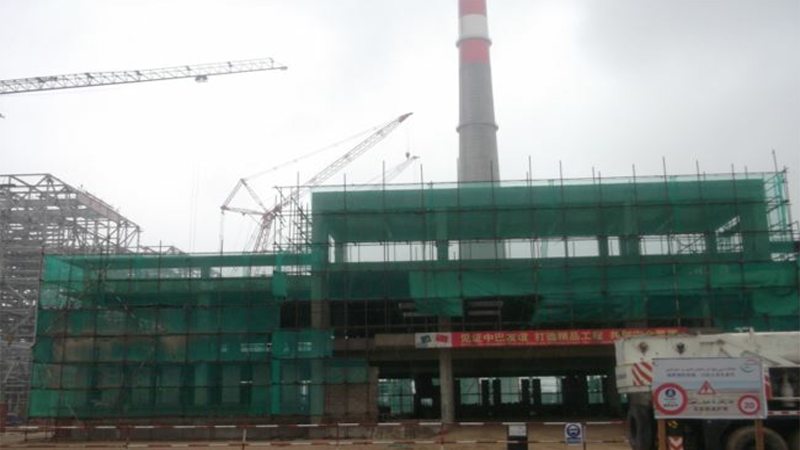
Across the barren hills, the State Power International Mendong (SPIM) and China Machinery Engineering Corporation’s power plants are poised to convert the coal to energy – reportedly 660 megawatts by the end of 2017.
Just outside the power plants sits a Chinese housing colony for the workers it has imported, a common practice for the country’s foreign projects. It’s a stark reminder of just how far Pakistan has allowed China’s entry into sensitive border territory.
In April 1965, Pakistan fought a territorial war with India to retake parts of the desert’s marshlands, called Rann of Kutch. Pakistan lost the claim, but it alarmed India sufficiently to fence its Gujarat border and install watch towers to prevent further incursions. New Delhi has so far not objected to the Thar project.
General Pervez Musharraf, the former army chief, gave a militaristic response to India’s enhanced border security. In 2000, his government constructed roads to Tharparkar, instituted border checks and intensified the scrutiny of visitors.
More recently, Washington’s embrace of India – and its rivalry with China – has fostered new regional alliances. As Pakistan’s friendship with China solidifies, including the multifaceted China-Pakistan Economic Corridor’s projects, power generation is a big part of China’s $62 billion investment. SECMC Director of Operations Syed Murtaza Azhar Rizvi said China would help extract 19 million tonnes of coal until 2030, using modern technology to counter the harmful effects of burning coal.
Partners in change: Meanwhile, Engro has a mandate from the Sindh government to ensure that the desert people, sitting atop the world’s seventh-largest coal reserves, become willing partners in the transformation of their habitat.
Already, Engro has created “Khushal Thar” (prosperous Thar), training 694 people on monthly stipends to be supplied to their Chinese partners.
Armed with a strategy for social change, Engro trains women as dump truck drivers. Recruiter Jehan Ara said the corporation, initially concerned about a backlash, first discussed the community’s response to inducting women into an all-male profession, and only then made the positions official. Interviewed in Islamkot, Marvi, 35, beamed at the prospect of driving dump trucks. Having six children was apparently no deterrent. Her husband, Ratan Lal, was on hand to cheer her, saying: “She is tough; she climbs trees to gather firewood and gets water from afar.”
But the community has concerns that water from the mining process, discharged into Gorano village 28 kilometres away, could pollute drinking water sources. In Mithi town, people have repeatedly demonstrated to sound the alarm, with the fears echoed by Sindh’s civil society.
Environmental
concerns: Attempting to assuage the community’s environmental fears, Engro has contracted with the Xinjiang Institute of Ecology and Geography to treat the mined water and use it for farming. A biosaline farm outside “coal alley” shows the treatment may be working. An oasis has sprouted amidst the desert, boasting grains and fruits.
For generations, the desert people have lived amid peacocks, sheep and camels. Engro plans to compensate and relocate them from their straw homes to model homes, fully equipped with schools and hospitals. Muslims and Hindus are to be resettled side by side, emblematic of the peaceful coexistence within the border community.
China’s coal reserves are declining, so it may get some of Thar’s production, and some of its out-of-work miners and engineers are putting their skills to use again. But with unemployment also rampant in Pakistan, SECMC maintains it constantly negotiates with the Chinese to hire cheaper Pakistani labour, which has been a sticking point on some projects.
Meanwhile, Pakistan’s sights are firmly set on the future. It expects that sustained coal excavation will eventually help get rid of deliberate power shutdowns aimed at preventing system failures, make electricity affordable and fire up its industries. The stated goal is to put young people to work – and the nation on the road to prosperity.
Published in Daily Times, December 3rd 2017.