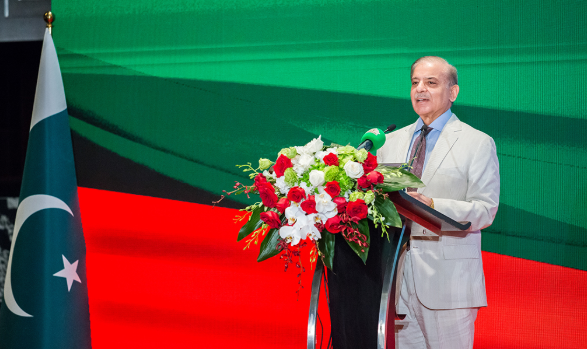
Prime Minister Shehbaz Sharif has invited Chinese companies to relocate industries to Pakistan under a “win-win model” aimed at boosting investment, trade, and industrial cooperation between the two countries. He made the remarks while addressing a Pakistan-China B2B Investment Conference in Hangzhou focused on IT, telecom, energy storage and agriculture sectors. Consequently, Pakistan positioned itself as a growing destination for foreign industrial expansion and joint ventures.
The prime minister said Pakistan seeks investment, expertise and technology instead of loans or financial aid, emphasizing long-term economic partnership with China. Meanwhile, he encouraged Chinese entrepreneurs to establish joint ventures with local firms and benefit from Pakistan’s investor-friendly policies. As a result, he said both countries could manufacture goods locally and export them to international markets.
Read more : Shehbaz Sharif praises Trump for advancing crucial Iran peace efforts
Shehbaz Sharif noted that rising labour costs in China are pushing some industries to explore more cost-effective production locations abroad. Therefore, he suggested that sectors where China is becoming less competitive could relocate to Pakistan for manufacturing and export purposes. In addition, he highlighted opportunities in textiles, leather and other industrial sectors for mutual benefit.
The prime minister also invited Chinese investors to explore Pakistan’s special economic zones, including a major 6,000-acre industrial zone in Karachi. He said the zone would provide modern infrastructure, one-window operations and long-term land leases to facilitate business ease. Furthermore, he assured investors of a secure and seamless business environment designed to attract large-scale industrial investment.
Read more : Pakistan, China ties enter new phase of people-centric cooperation
On agriculture, Shehbaz Sharif stressed Pakistan’s need to improve productivity through advanced seeds, modern techniques and mechanized farming with Chinese cooperation. He added that Pakistan had already sent 1,000 students to China for agricultural training, who were now contributing to national development. Consequently, he projected that agricultural trade with China could increase by 10 billion dollars within five to seven years.
The prime minister also highlighted progress in IT, artificial intelligence and mining sectors, calling them key areas for future collaboration between both countries. Meanwhile, he said multiple Memorandums of Understanding worth billions of dollars had been signed and several had already been converted into agreements. As a result, he reaffirmed Pakistan’s commitment to strengthening its long-standing strategic partnership with China under the historic Silk Road friendship.