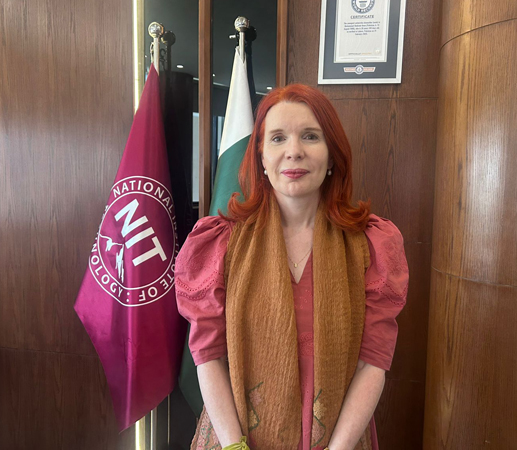
 Universities must not become part of political conflicts and should instead act as safe spaces for dialogue, learning and leadership, a leading global education expert said during a visit to Lahore, while also backing the revival of student unions in Pakistan under strict rules.
Dr Victoria C Fontan, an international scholar of peace and conflict studies, shared her views during an interaction at the National Institute of Technology (NIT) in Lahore. She spoke about higher education, student unions, regional tensions and the role of universities in shaping peaceful societies.
She said peace education is not only about teaching conflict resolution. It is about building people who can think, collaborate and solve problems in society. “Universities should create safe spaces. Students should be able to speak, debate and learn from each other,” she said.
Dr Victoria warned that when universities take sides in political conflicts, they lose their purpose. “If a university becomes part of a conflict, then where will people go to find solutions?” she asked. She said campuses should remain neutral and open to all views so that dialogue can take place.
Her remarks come at a time when debate over student unions has returned in Pakistan. Student unions were banned in many universities decades ago. Critics say the ban has limited political awareness and leadership training among students.
Dr Victoria supported the idea of student unions but with clear limits. She said unions can help students learn democracy, leadership and responsibility. However, she added that strong oversight by university administration is necessary.
“I have seen student unions work in difficult places like Afghanistan,” she said. “But there must be rules. There must be a constitution. And the administration must ensure that students do not misuse power.”
She recalled a case in Afghanistan where a student linked to a powerful political family tried to influence decisions through the union. The university leadership resisted the pressure and enforced rules. “If a university is not strong enough to handle such situations, then it should not allow unions,” she said.
Dr Victoria also spoke about the state of higher education in Pakistan. She praised the quality of academic debate in universities, especially in fields like international relations. She said Pakistani students and teachers show strong critical thinking.
However, she pointed out a key weakness. “Disciplines work in isolation. Departments do not collaborate. This is a lost opportunity,” she said. She added that modern education requires integration across fields and closer links with industry.
During her visit, she praised the approach of NIT Lahore. She said the institute is focusing on innovation and entrepreneurship, which prepares students for real-world challenges. “It is not just about knowledge. It is about building an ecosystem,” she said.
She said global university rankings now depend not only on academic work but also on innovation and real-world impact. “Universities must connect with society. They must solve problems. That is how they will improve their standing,” she said.
Dr Victoria said Pakistan is moving in the right direction and has strong potential. She described the country as an emerging economic and geopolitical player. She said its young population and growing education sector can drive change if managed well.