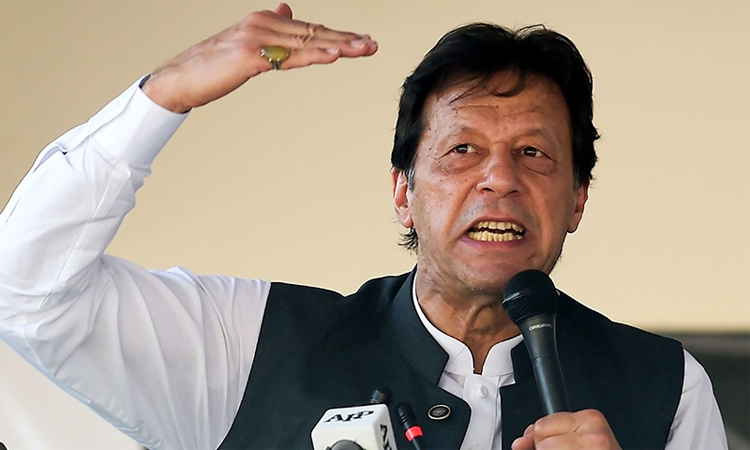
 Pakistan Tehreek-e-Insaf’s attempt to project political strength in Azad Jammu and Kashmir appeared to run into an awkward reality check on Saturday, as a rally addressed by Khyber Pakhtunkhwa Chief Minister Sohail Afridi drew a visibly thinner crowd than the scale of arrangements suggested.
The rally, held at Lal Chowk in Muzaffarabad, was organised as part of PTI’s public mobilisation campaign. Chief Minister Sohail Afridi was scheduled to address the gathering on Saturday, days after the party linked its latest street activity to instructions from PTI founder Imran Khan.
Party organisers had presented the event as a show of strength beyond Khyber Pakhtunkhwa, where PTI remains politically entrenched and where Afridi now heads the provincial government. Banners, media coverage and seating arrangements were put in place to create the impression of a major political gathering.
The crowd, however, did not appear to match the setup.
Local estimates placed attendance between 700 and 850 people, against seating arrangements said to be for more than 1,100. Several rows of chairs remained vacant during parts of the event, according to people present at the venue and footage circulated on social media.
Senior journalist Muzamal Suharwardy also commented on the turnout in a post on X, writing that PTI’s election campaign jalsa in Muzaffarabad had “empty chairs”. He claimed that 1,100 chairs had been placed, with 600 remaining vacant, and alleged that the KP chief minister had travelled to the event on an official helicopter.
The optics were damaging for a party that has long built its political identity around street power, large public gatherings and the ability to mobilise supporters at short notice. PTI went to Muzaffarabad to show strength. The chairs showed up. The people did not.
For a party that once filled venues such as Minar-e-Pakistan and turned public rallies into national political moments, the Muzaffarabad turnout has triggered questions over whether PTI’s ground organisation outside its core areas remains as strong as its online presence and electoral appeal.
PTI supporters described the gathering as part of a wider mobilisation drive and circulated live videos showing Afridi addressing the crowd. Several pro-PTI accounts presented the event as a successful power show. Critics, however, pointed to the empty chairs as evidence of weak local mobilisation.
One opposition supporter remarked online that the empty chairs appeared “more organised than the mobilisation effort”, a jibe that quickly spread across social media.
Yet Saturday’s rally showed the distance between political sympathy and physical mobilisation.
The Muzaffarabad event has raised questions inside and outside the party about the condition of PTI’s local structures in AJK. Political workers say successful rallies depend less on central speeches and more on ward-level organisation, transport planning, active office-bearers and personal contact with supporters.
PTI brought banners, chairs and a chief minister to the venue. The missing ingredient was the crowd.
Afridi’s presence gave the rally added significance. Since becoming chief minister of Khyber Pakhtunkhwa, he has sought to position himself as one of PTI’s more visible street-level faces. His speeches have focused on loyalty to Imran Khan, resistance to the federal government and the party’s plan to revive public pressure.
Muzaffarabad tested that claim on the ground.
Political observers said the turnout should push PTI to examine whether its support beyond KP is being translated into organisation, or whether the party has become too dependent on Imran Khan’s personal popularity, social media messaging and anti-government sentiment.
The challenge is not unique to PTI. Pakistan’s political parties have increasingly treated public rallies as television frames and social media content. Camera angles, drone shots and edited clips now often matter more than constituency work. A strong online campaign can shape perception, but it cannot fill chairs on its own.
For PTI, the warning is sharper because its political brand was built on the promise that it could bring people into the streets when other parties could not. A weak turnout in Muzaffarabad does not mean PTI has lost its vote bank. It does suggest that parts of its ground network may no longer be working with the discipline and urgency the party once claimed.
The party now faces uncomfortable questions. Is its local structure active in AJK? Are workers still willing to come out beyond PTI’s core areas? Has the pressure of recent years weakened its street machinery? Can online anger still be converted into physical presence?
PTI wanted a power show in AJK. It got a reality check instead.
The rally was meant to prove the party’s reach beyond Khyber Pakhtunkhwa; instead, it has opened a debate over whether PTI needs to reconnect with its workers before it can again claim unmatched street power.