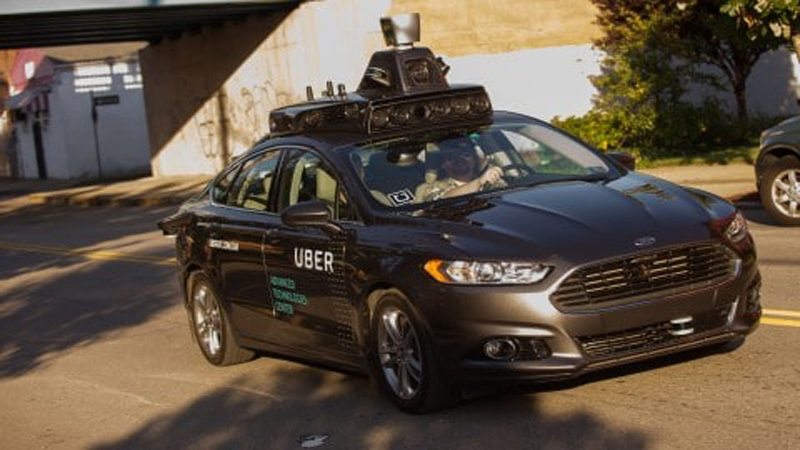
Driverless cars and trucks rule the road, while robots “man” the factories. Super-smartphones hail Uber helicopters or even planes to fly their owners across mushrooming urban areas. Machines use algorithms to teach themselves cognitive tasks that once required human intelligence, wiping out millions of managerial, as well as industrial, jobs.
These are visions of a world remade – for the most part, in the next five to 10 years – by technological advances that form a fourth industrial revolution. You catch glimpses of the same visions today not only in Silicon Valley but also in Paris think tanks, Chinese electric-car factories or even here at the edge of the Sahara.
Technological disruption in the 21st century is different. Societies had years to adapt to change driven by the steam engine, electricity and the computer. Today, change is instant and ubiquitous. It arrives digitally across the globe all at once.
Governments at all levels on all continents are suddenly waking up to how social media and other forms of algorithms and artificial intelligence have raced beyond their control or even awareness. (See the Trump campaign and Russia, 2016, for one example.)
This realization that American lives are on the cusp of technological disruptions even more sweeping than those of the past decade was driven home to me by being part of a research project on technology and governance at the Hoover Institution at Stanford University this year. “Autonomous” (i.e., driverless) cars, the cloud, and swarming drones that deliver goods to your doorstep or transform naval and ground war-fighting strategy are well-known concepts. But the reality that they are breathing down my – and your – neck came as something of a surprise.
So did the startling visions of change outlined in the cozy confines of Silicon Valley that were also on the agenda here on Africa’s Atlantic shoulder when France’s Institute of International Relations held its annual World Policy Conference this month.
The usual suspects – global balance-of-power politics, the European Union’s woes, President Trump’s foreign-policy brutishness, Brexit – shared pride of place with the Internet of Cars (the on-wheels version of the Internet of Things) and the vulnerability of the 5,000 military and civilian satellites now in orbit.
These were not abstract subjects for the conference’s host country. Morocco this month became the first African nation to launch a spy satellite into space. And the kingdom is a key player in U.N.-sponsored efforts to organize a global containment strategy for climate change.
China’s policies toward Taiwan and India were not dwelled upon here. Instead it was noted that China produces more electric-powered automobiles than the rest of the world combined in a determined campaign to reduce pollution. “China is becoming a global laboratory as well as a global factory,” said one speaker, pointing to Beijing’s surging development of artificial intelligence in all civilian and military forms.
The world’s major powers offer sharp contrasts in harnessing technological change to their national interests and histories. The result is a new bipolar world based on technology rather than nuclear arsenals. Today’s superpowers are the United States and China.
The U.S. government has kept out of the way and let market forces develop giant technology companies with global reach. China has chosen to compete head to head, keeping Facebook, Google and others out of its markets while capturing U.S. intellectual property for its national firms. Europe lets U.S. technology companies in and regulates them rather than competing. Russia has weaponized information technology, adding social media to its arsenal of troops, missiles and tanks.
Diplomats and strategists have begun to patrol this expanding intersection of technology and international affairs, hoping to find ways to adapt the Cold War rules of deterrence and arms-control agreements to threats from cyberspace. Some experts shudder at the thought of artificial intelligence being incorporated into national command-and-control systems, further reducing the time humans have to respond to hostile missiles- or laser beams.
There were also calls for governments to begin to grapple with urgent earth-bound problems created by the disruptive impact of technology on domestic labor markets and increasingly fragile political systems.
The jobs that artificial intelligence and automation create while destroying outmoded ones often require constant retraining and multiple career and location changes. U.S. employers report that 6.1 million jobs currently sit vacant largely because applicants lack either the skills or mobility needed.
And there was clear recognition from Palo Alto, Calif., to Marrakesh that the communication revolution embodied in social media has hollowed out the political parties in democracies, enabling demagogues to whip up mobs by remote control. The world turns, as always. But now it turns on a dime, or rather a computer chip.
Published in Daily Times, November 27th 2017.