
On 2 October 2017, the Parliament finally managed to enact the crucial 2017 Elections Bill. This was the result of an exceptionally positive parliament practice in Pakistan proposing several important reforms that would provide for considerably improved electoral processes and practices. The formation of a multi, cross-chamber party Parliamentary Committee on Electoral Reforms (PCER) has set precedence by developing a strong consensus among parliamentary parties.
This is unprecedented in Pakistan’s parliamentary history. The day of its passage should have been celebrated; however, this bill has also been made controversial by the political parties themselves.
Even though, the bill was unanimously submitted by PCER, easily passed by the National Assembly, concurrently admitted by the Senate’s Standing Committee on Law, Justice and Human Rights, it seems that it will also be dragged to the Supreme Court. Major opposition parties including the Pakistan Peoples’ Party (PPP) and Pakistan Tehreek-e-Insaf (PTI) were integral in the finalisation of the election law starting from the PCER to its re-passage in the National Assembly. However, serious concerns by these political players have emerged post panama-case verdict.
The controversial clause providing for a bar on holding party offices was introduced in an autocratic regime through the Political Parties Act of 1965. It was removed in 1975 when the late Zulfikar Ali Bhutto was in power. Later in 2002, it was re-inserted by General Pervez Musharraf to keep Benazir Bhutto away from the polls. It is quite startling that the PPP would now be so sympathetic towards such actions
With influential members from all parliamentary parties, the PCER submitted the draft elections bill for public deliberations on 20 December, 2016, which was later finalised on 19 July, 2017. Subsequent to Mian Muhammad Nawaz’s disqualification, the bill was introduced in the National Assembly on 7 August 2017 and transmitted to the Senate. Even though, the PCER took at least 38 months to fine tune the bill, it was sent to the Senate’s Committee for further deliberation. The committee submitted its report to the House on 26 September, 2017.
Upon its presentation in the Senate, Chaudhry Aitzaz Ahsan voiced his concerns by moving an amendment in Clause-203.
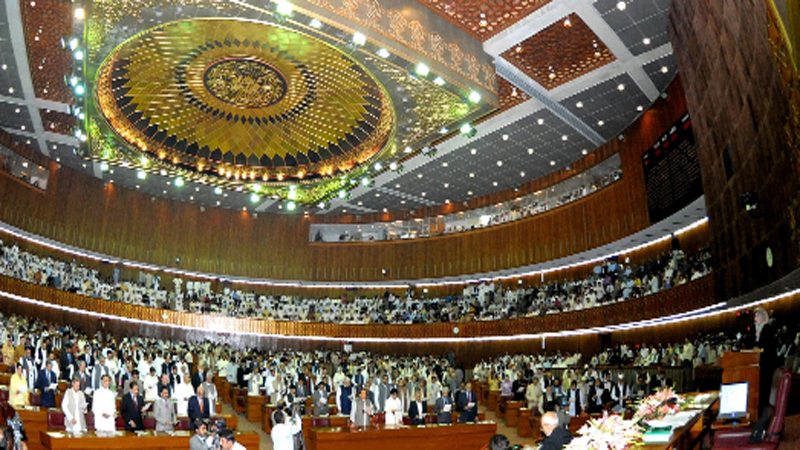 Ever since, the clause about ‘disqualified individual under Article 63 of the Constitution cannot be elected or chosen as a leader of any political party’ has been a bone of contention between political actors ultimately discrediting the hard work it took to unify nine election laws, five of which were ordered by military regimes.
The PPP did not raise amendments to sequester disqualified Nawaz Sharif from his political party at any other parliamentary forum, but Senator Ahsan’s actions have raised serious doubts over the entire legislative process. Even though the proposed amendment was clubbed by 38 votes against and 37 in favour, it has left us with yet another controversy. Very recently, the issue re-emerged as the PPP again submitted an amendment to the Election Act in the National Assembly. However, it was again disapproved by 163 votes against and 98 in favour.
Reinserting this amendment is supportive of dictatorial proclivities. This controversial clause providing for a bar on holding party offices was introduced in an autocratic regime through the Political Parties Act, 1965. It was removed in 1975 when the late Zulfikar Ali Bhutto was in power. Later in 2002, it was re-inserted by General Pervez Musharraf in 2002 to keep Benazir Bhutto away from the polls as well as PPP leadership. It is quite startling that the PPP would be sympathetic towards such actions. Citizens’ have the basic democratic right to elect their leaders.
The reinsertion of a bar on holding party offices is a reinforcement of dictatorial tendencies, which should be discouraged by political actors for the successful consolidation of democracy in Pakistan. The Elections Act is a positive reform to the electoral process. Even though critical improvements are still required in the law for future elections to be more inclusive, transparent and accountable; political parties need to work together for improving the system to build citizens’ trust and confidence.
The writer is Team Lead at Free and Fair Election Network (FAFEN), a researcher on parliamentary and electoral affairs, and a Chevening Scholar. He tweets as @dnananjum
Published in Daily Times, November 27th 2017.