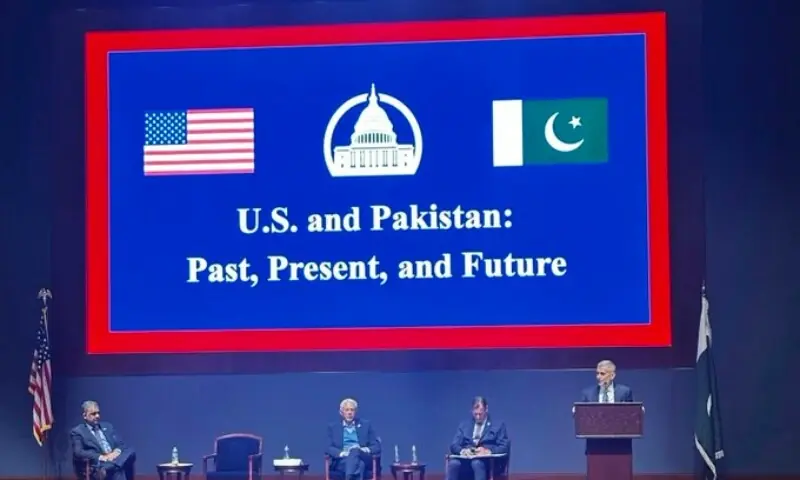
WASHINGTON — Speakers at a high-level symposium on Capitol Hill highlighted Pakistan’s growing diplomatic confidence, particularly its recent offer to mediate between the United States and Iran amid escalating tensions.
Read More: Seminar marks 65 years of diplomatic ties between Pakistan and Japan
The event, titled “US and Pakistan: Past, Present, and Future,” was organised by the Congressional Pakistan Caucus and brought together policymakers and experts to assess bilateral ties. Participants said Pakistan’s outreach during the recent US-Iran confrontation reflects its intent to play a stabilising role in a volatile region.
Speakers noted that Pakistan’s strategic location — bordering Afghanistan, Iran, India and close to the Gulf — continues to shape its foreign policy priorities. They emphasised that Islamabad should be viewed beyond a security lens, citing its large diaspora, growing middle class and economic potential.
Tom Suozzi and Jack Bergman co-chaired the session, while Rizwan Saeed Sheikh, Pakistan’s ambassador to Washington, underscored the country’s role in promoting regional peace and combating terrorism.
Today, we gathered experts from around the world to discuss the U.S.-Pakistani relationship, its history, current security and economic concerns, and how to build a better future. Thank you, Ambassador Rizwan Sheikh, Assistant Secretary of State Dr. Paul Kapur, and my Co-Chair of… pic.twitter.com/FHWgCNdhxN
— Tom Suozzi (@RepTomSuozzi) March 24, 2026
Great to join the Pakistan Caucus Symposium. Under @POTUS Trump’s leadership, a positive recalibration in the U.S.-Pakistan relationship is enabling mutually beneficial economic and commercial ties, including in the critical minerals sector. – SPK pic.twitter.com/wxEYvLrbKJ
— Bureau of South and Central Asian Affairs (SCA) (@State_SCA) March 24, 2026
Discussions acknowledged that US–Pakistan relations have historically fluctuated between cooperation and mistrust, often influenced by developments involving India, Afghanistan and China. Participants stressed the need to move beyond transactional engagement toward long-term economic and institutional cooperation.
Economic collaboration emerged as a key theme, with experts pointing to opportunities in minerals, renewable energy, and technology. However, concerns over regulatory instability, taxation and governance challenges continue to deter investors.
Read More: China-Pakistan education marks new phase of cooperation
Security discussions also highlighted evolving threats from militant groups and the importance of strengthening civilian law enforcement alongside military efforts.
Participants concluded that sustained dialogue, realistic expectations and structural reforms are essential to building a more stable and productive partnership between the two countries.