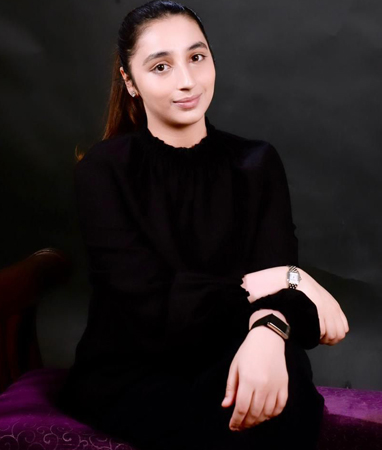
 You are a writer, a youth advocate and a social worker. Tell us, at such a tender age, how did you develop such deep and meaningful inclinations towards writing, advocacy and social work?
For me these interests developed very naturally because of the environment I grew up in. My mother has always been my biggest influence. I grew up watching her care deeply about people and about the community around her. Advocacy and social awareness weren’t things she preached but they were things she practiced. Seeing that from such a young age shaped the way I look at the world. I also grew up in Canada, where I attended public school and was surrounded by people from very different cultures, backgrounds and socioeconomic realities. Being in that kind of diverse environment taught me early on that everyone’s story is different. It made me curious about people and their experiences. When I moved back to Karachi and joined Karachi American School, I became more aware of how small our everyday circles can be. It made me realise that while many of us grow up in comfortable environments, they represent only a fraction of the country’s reality. Pakistan is a country with immense resilience but also immense inequality and being aware of that carries a responsibility. That awareness is what pushed me toward advocacy and social work. I began to feel that if we are fortunate enough to have access to education, resources and opportunity, then we should use those privileges to contribute to the communities around us. Writing, on the other hand, became my way of processing all of these thoughts. It’s my way of understanding the world and giving voice to things that often go unnoticed. So they grew out of the values I was raised with, the different worlds I’ve experienced and a growing awareness that being part of a society means paying attention to more than just your own life.
Tell us about your book The Crossing. What is it about and why did u choose this topic?
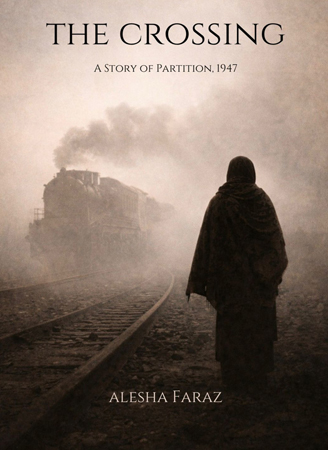
The Crossing is a historical novel set during the Partition of 1947. It follows the Ansari family, who live a quiet life in Triplicane, Madras, until rising tensions force them to leave everything behind and begin the difficult journey toward Pakistan. Although the story is set during a political moment in history, the book is really about the human experience of Partition, the fear, uncertainty, courage and resilience ordinary families carried with them during one of the largest migrations in history. Through the Ansari family’s journey, I wanted to show what it meant for people to leave their homes, their memories and the lives they had built. I chose this topic because I believe history should not only be remembered through dates and borders, but through the lives of the people who lived through it. The creation of Pakistan came with immense sacrifice and I think it is important, especially for younger generations, to understand that history. More than anything, the Partition teaches us about resilience and humanity. Even in moments of great loss and uncertainty, people still found ways to help one another and hold onto hope. I think that’s something we can learn from, that even in the hardest times, our values and compassion for others should remain. The Crossing is my attempt to remember a defining moment in our history while reminding readers that the lessons of the past can still guide how we move forward today.
Priced at Rs 1,500 in hardcopy, what is your target audience for your debut novel?
I think the audience for The Crossing is quite broad. While it is a historical novel, the story is ultimately about humanity and the experiences of ordinary people during extraordinary times. It’s for readers who want to understand the past a little more deeply and reflect on the resilience and compassion that people carried with them even in the most difficult moments. Because of that, I believe readers from many different age groups can connect with it. For younger readers, especially my generation, it offers a way to understand what Partition felt like on a human level. Many of us learn about 1947 only through textbooks or political discussions, but stories like these remind us that behind those historical events were real families, real fears and real sacrifices. Understanding that history can help us appreciate the country we live in today. At the same time, I think older readers may connect with the story in a very personal way. I also wanted to honour those memories and remind older generations that their sacrifices have not been forgotten.
What are you currently working on?
Alongside my writing, I am currently working on several research projects in the field of Early Childhood Development (ECD). I have been collaborating with Dr Shelina Bhamani at Aga Khan University on research papers and practical manuals focused on parenting, early learning and child development. The work focuses on helping parents and educators better understand how the early years of a child’s life shape their emotional, social and cognitive growth. Through this research, we are trying to develop resources that make these ideas more accessible and practical for families and communities.
Out of all the social issues plaguing our society, which is one the closest to your heart?
The social issue closest to my heart is education and a big reason for that is my dad. Growing up, he always had a very strong belief in education. From as early as I can remember, he constantly reminded my sibling, Shazir and I, how important it was to learn, to study and to value knowledge. His belief in education shaped the way I see the world today and I truly feel that I am the person I am because of the values he instilled in me. But that also made me realise something that is very difficult to ignore. The opportunities I have had are not the reality for millions of children in Pakistan. Today, around 25 million children between the ages of five and 16 are out of school, which means millions of young people are growing up without access to something that can completely shape their future. Education is so important. It is about giving a child the ability to think, to question, to dream and to imagine a different future for themselves. Education gives people dignity and the confidence to build their own path in life. If we truly want to move forward as a society, education has to be at the centre of that change.
Tell us about your university life.
My university life is definitely very busy. Most days start around 8am and often don’t end until the evening, so a huge part of my day and honestly my life revolves around university. It can be demanding and sometimes chaotic, but I genuinely love it. Every day feels different. There’s always something happening, something new to learn and something that challenges you. Some days are overwhelming, but they’re also exciting because you feel like you’re constantly growing. Studying at Aga Khan University is very meaningful to me, especially because the university is so closely connected to healthcare. Being in that environment teaches you a lot about gratitude. There are days when I wake up tired or stressed and don’t feel like coming in, but the moment I step onto campus and see patients and families walking in and out, it immediately puts things into perspective. It reminds me how fragile and valuable life really is, and how fortunate we are to simply wake up every day with the chance to live, learn and grow.
To be a good writer, one must be an avid reader. Who have been some of the writers you have grown up reading the most?
One of the first books that really made me fall in love with reading was Wonder by RJ Palacio. I remember reading it when I was younger and it stayed with me because of how simple but powerful its message was. It was one of the first times I realised how a story can make you see the world through someone else’s eyes and understand the importance of kindness. As I grew older, I found myself drawn to writers who tell very human stories. Khaled Hosseini is someone whose work has always resonated with me. The way he writes about family, sacrifice, identity and resilience is incredibly moving and his books remind you how deeply connected people’s stories are, no matter where they come from. I also really admire writers like Chimamanda Ngozi Adichie, because her writing explores identity and history in a very honest and powerful way. In general, the books that stay with me the most are the ones that teach you something about humanity. Stories that make you pause, reflect and understand people a little more deeply. Those are the kinds of books that made me fall in love with reading, and they definitely influenced the way I think about storytelling today.
Who are some contemporary social workers you greatly admire?
One social worker I have always deeply admired is Abdul Sattar Edhi. What inspires me most about him is the simplicity and sincerity with which he lived his life. He devoted his entire life to helping others out of a genuine love for humanity. What I find so powerful about his work is that he showed us that service to others doesn’t always have to be complicated or grand. Sometimes it simply comes down to caring deeply about people and being willing to help whenever you can. I think one of the biggest lessons from his life is that compassion can exist in the simplest actions. Making a difference in someone’s life doesn’t always require something extraordinary, sometimes it just requires sincerity and a willingness to care.