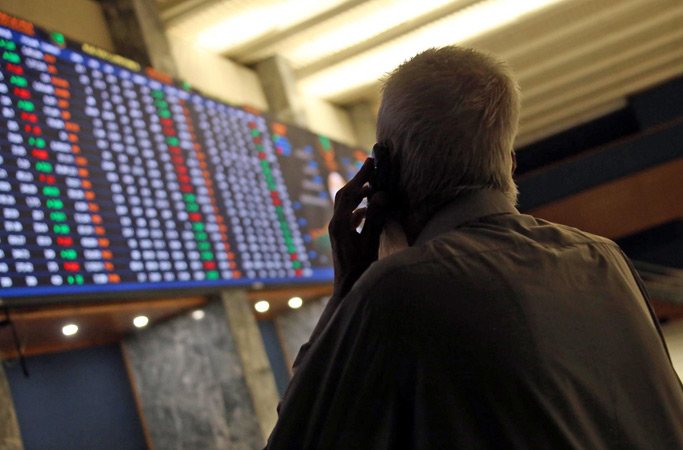
KARACHI – The Pakistan Stocks Exchange (PSX) remained rangebound on Friday as elevated oil prices and escalating tensions in the Middle East kept investors on edge, while uncertainty over a delayed staff-level agreement (SLA) with the International Monetary Fund (IMF) added to market caution.
Read More: Pakistan’s petroleum stock said to be at ‘comfortable levels’
The benchmark KSE-100 Index fluctuated between a high of 155,002.1 points, up 580.67 points (0.38%), and a low of 152,780.79 points, down 1,640.64 points (1.06%) compared to Thursday’s close of 154,421.43. Analysts noted that geopolitical concerns and rising fuel costs were driving the cautious sentiment.
“Oil prices, due to geopolitical tensions, are the prevalent reasons. Higher oil prices can cause another potential price hike in fuel prices, which will push inflation,” said Ahfaz Mustafa, CEO of Ismail Iqbal Securities. He added that the upcoming two-day weekend and SLA delays were prompting investors to adopt a “wait and watch” approach.
Independent analyst AAH Soomro echoed the sentiment, noting that investors are reluctant to take positions over the weekend amid market uncertainty.
Global oil prices remained elevated, with Brent futures for May rising 10 cents to $100.56 a barrel and WTI for April slipping 16 cents to $95.57, but still marking strong weekly gains of 9% and 7%, respectively. The US recently issued a 30-day licence allowing countries to buy stranded Russian oil in a bid to stabilise energy markets, though analysts warned that broader supply risks remain amid ongoing US-Israeli-Iran tensions.
Read More: Petroleum stocks at comfortable levels amid regional tensions
On Wednesday, Iran’s new supreme leader Mojtaba Khamenei vowed to keep the Strait of Hormuz closed, signaling a prolonged conflict and warning that oil prices could reach $200 per barrel. Market experts said the statement has further contributed to investor nervousness and volatility in domestic equities.
Overall, the PSX showed a cautious trading pattern, with investors closely monitoring both international energy developments and domestic financial policies ahead of the weekend.