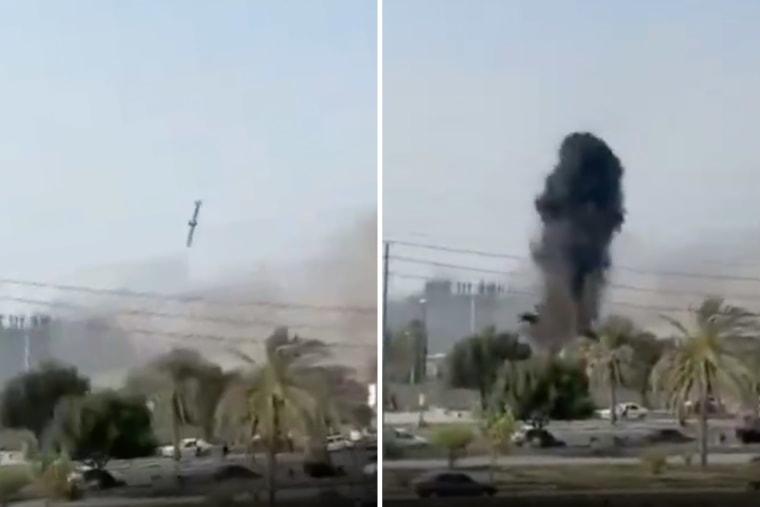
Newly circulated footage indicates that a Tomahawk cruise missile, likely fired by the United States, struck a compound in southern Iran near a school where a deadly unclaimed blast killed over 165 people at the start of the ongoing Middle East conflict.
Read More: US-Israeli missiles reportedly hit two schools in Iran’s Parand
Investigative group Bellingcat analyzed the video, geolocating it adjacent to the school in Minab, Hormozgan Province. Satellite imagery and visual identifiers in the footage, including a flat-roofed building, power lines, and vehicles, are consistent with the site. Trevor Ball, a Bellingcat researcher, identified the munition as a Tomahawk missile, which is exclusively possessed by the US in the current war.
Video footage published by investigative journalists at Bellingcat and verified by the New York Times appears to show a U.S. Tomahawk missile striking an Iranian Revolutionary Guard Corps compound adjacent to a school—adding to growing evidence the U.S. military was behind the… pic.twitter.com/aQTnhlQKbi
— NewsWire 🇱🇰 (@NewsWireLK) March 9, 2026
The US Central Command has acknowledged using Tomahawk missiles in the conflict and released a photo of the USS Spruance, part of the USS Abraham Lincoln carrier group, firing a missile on February 28. The footage appears to contradict claims by Donald Trump that Iran was responsible for the school blast. Trump suggested Iran could have Tomahawk missiles, despite no evidence of the country acquiring them.
A US official, speaking anonymously, told The Associated Press that the strike was likely American. Additional factors point to US involvement, including the US military launching an assessment of the incident and the school’s proximity to a Revolutionary Guard base and naval barracks — known targets of US operations in the province. Israel, which has denied responsibility, has focused attacks elsewhere, further suggesting US culpability.
Read More: Israel school strike kills 51 students in Iran
International law experts have raised concerns that even a misidentification of the target would constitute a serious violation. Janina Dill of Oxford University emphasized that attackers must take all feasible measures to verify targets. The Trump administration, however, has defended its operations as precise and decisive, with Defense Secretary Pete Hegseth dismissing constraints imposed by international norms.