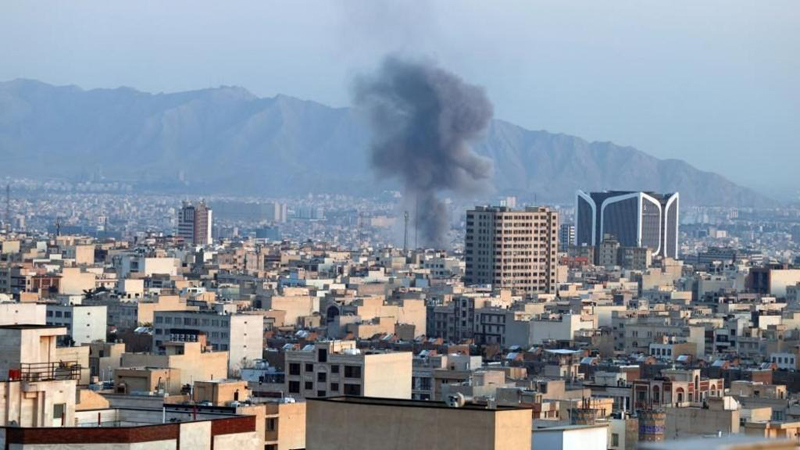
 United States President Donald Trump demanded Iran’s “unconditional surrender” on Friday and ruled out any deal, a dramatic escalation of his demands a week into the war he launched alongside Israel.
Trump made the remarks on social media just hours after Iran’s president announced that unspecified countries had begun mediation efforts in one of the first signals of any diplomatic initiative to end the conflict.
“After ?that, and the selection of a great and acceptable leader(s), we, and many of our wonderful and very brave allies and partners, will work tirelessly to bring Iran back from the brink of destruction, making it economically bigger, better, and stronger than ever before.”
On Thursday, Trump had told Reuters in a telephone interview that he was demanding the right to help select Iran’s new supreme leader, to replace Ayatollah Ali Khamenei, killed in the war’s first day.
Israel pounded the Lebanese capital Beirut on Friday after ordering an unprecedented evacuation of the entire southern suburbs of the city, in a major expansion of the war.
It carried out heavy air strikes on Hezbollah-controlled southern suburbs of Beirut and started a “broad-scale” wave of attacks against infrastructure in Tehran, while Iran said it targeted the heart of Tel Aviv with missiles.
Explosions and flashes lit up the night sky over Beirut’s southern suburbs. The Israeli military said it had carried out 26 waves of strikes overnight in the southern suburbs, saying targets included Iran-backed Hezbollah militia command centres and weapons storage facilities.
It also launched a new wave ?of attacks on Iran, saying 50 of its warplanes had struck a bunker beneath the destroyed Tehran compound of Khamenei, still being used by Iran’s leadership after he was killed.
Earlier, Iranian President Masoud Pezeshkian revealed that some countries had begun mediation efforts as the Islamic Republic continued its retaliatory strikes against Israel and US military bases in the Gulf region.
“Some countries have begun efforts at mediation,” Pezeshkian wrote in a post on his official X handle.
“Our response to them is clear: we are committed to lasting peace in the region, but we have not the slightest doubt in defending the dignity and sovereignty of our country,” he added. “The intended audience for mediation should be those who, by underestimating the Iranian people, have stoked the flames.”
Iran’s Islamic Revolutionary Guard Corps said Kheibar missiles were fired towards Tel Aviv as part of the 21st wave of its “Operation True Promise 4”. In a statement, the IRGC said the wave began with a combined missile and drone operation targeting sites in the heart of Tel Aviv.
Overnight, Iranian drones attacked the US Al Udied airbase in Qatar, the biggest US base in the Middle East, Qatari officials said. There were no reported casualties.
The IRGC said Iranian forces had targeted the Ramat David air base and a radar site in Israel, the Al-Adiri camp in Kuwait where US forces are stationed, and a drone attack on a base hosting US troops in Erbil, Iraq.
Hezbollah, in a message published in Hebrew on its Telegram channel early on Friday, warned Israelis to leave towns within five kilometres of the border.
“Your military’s aggression against Lebanese sovereignty and safe citizens, the destruction of civilian infrastructure and the expulsion campaign it is carrying out will not go unchallenged,” Hezbollah said. At least 1,230 people have been killed in Iran since the fighting began a week ago, according to the Iranian Red Crescent Society.
The Lebanese health ministry has reported 123 people have been killed and another 683 wounded as a result of Israeli attacks this week. Its figures do not distinguish between civilians and combatants. There have been no reported fatalities in Israel as a result of Hezbollah attacks.
United Nations Secretary-General Antonio Guterres has condemned “unlawful attacks” across the Middle East and warned that the situation could spiral out of control as the regional war raged across multiple countries, AFP reports.
“All the unlawful attacks in the Middle East and beyond are causing tremendous suffering and harm to civilians throughout the region – and pose a grave risk to the global economy, particularly to the most vulnerable people,” he said.