 Islamabad was never meant to be a frozen museum city. It was conceived as a living capital, designed to grow, adapt and respond to the needs of a rising population while preserving its natural character through planning, not paralysis. The challenge before policymakers today is not whether development should occur, but how it should be managed responsibly, scientifically and in balance with environmental protection.
In recent discourse, a familiar but misleading narrative has resurfaced: that infrastructure development itself is synonymous with environmental destruction. This framing is not only inaccurate; it is dangerously simplistic. No modern capital in the world functions without continuous investment in roads, drainage systems, utilities and mobility corridors. Cities that stop evolving do not become greener; they become dysfunctional.
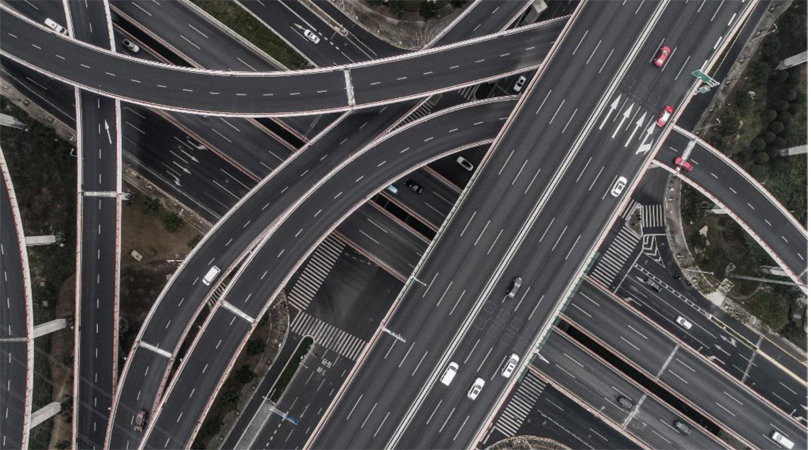
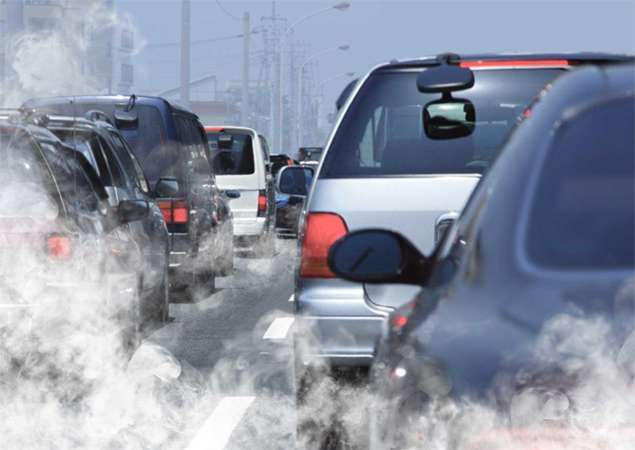
Improved road infrastructure is not a luxury project. It is a core environmental intervention. Vehicles stuck in congestion for extended periods emit far more carbon, particulate matter and toxic gases than those moving smoothly across upgraded corridors.
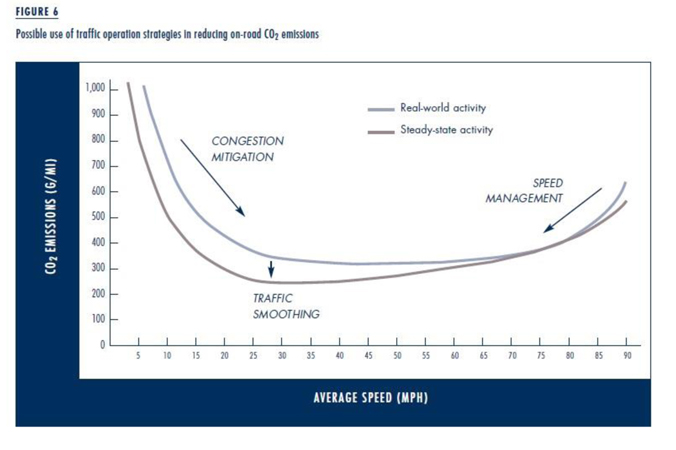
Reduced travel time translates directly into fuel savings, lower emissions, improved emergency response and economic efficiency. This is precisely why global cities – from London and Berlin to Seoul, Istanbul and Singapore – have invested heavily in signal-free corridors and controlled-access routes, while simultaneously strengthening pedestrian infrastructure through underpasses, footbridges and zoning reforms. Walkability is not achieved by rejecting roads; it is achieved by designing cities intelligently.
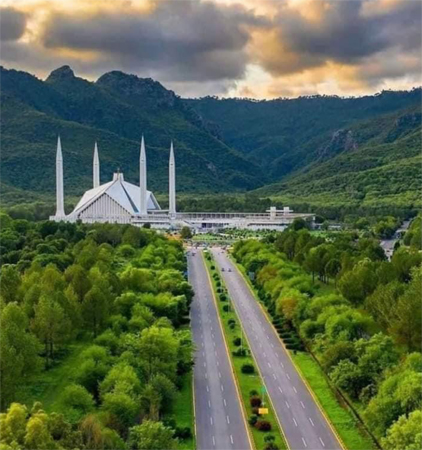
Assertions that Islamabad’s green character is being erased fail to withstand scrutiny. Satellite based vegetation analysis and historical land data confirm that the capital’s overall green cover has expanded significantly since its founding. From approximately 18,000 acres of forest cover inherited in 1960, Islamabad today hosts nearly 39,000 acres of green space. This growth is measurable, verifiable and documented. Selective images of localized cutting cannot override citywide environmental data.
Much of the recent tree removal debate also ignores a critical scientific distinction: not all trees contribute equally to environmental health. The targeted removal of Paper Mulberry, an invasive and non-native species introduced decades ago as a planning error, was not an act of deforestation but ecological correction. This species produces extremely high pollen loads, contributing to one of the most severe urban allergy crises in the region. At its peak, pollen counts in Islamabad reached between 35,000 and 55,000 grains per cubic meter – levels considered hazardous by global standards.
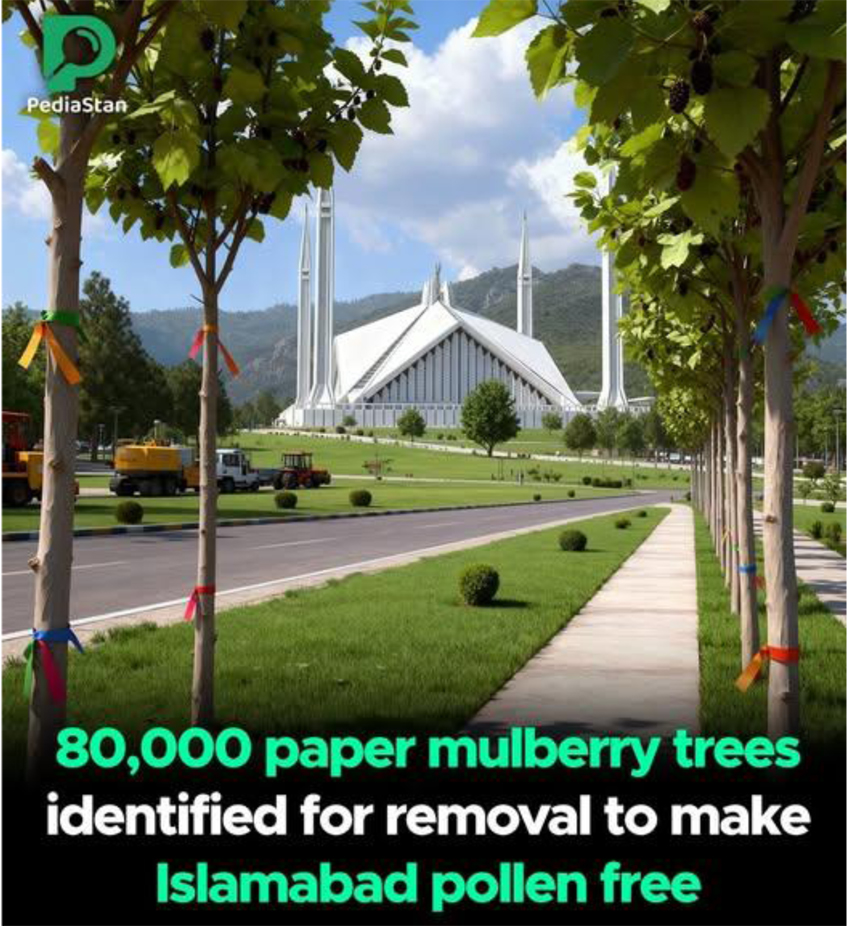
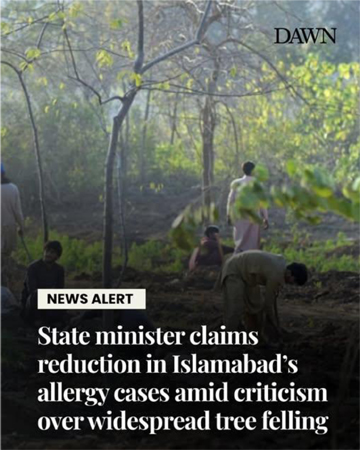
Nearly half the city’s population suffered seasonal respiratory distress, overwhelming hospitals every spring. Following scientifically guided removal and replacement with indigenous, low pollen species, reported allergy cases declined by 23 percent between 2023 and 2025. Public health is not an expendable side effect of environmental policy; it is a central objective of it.
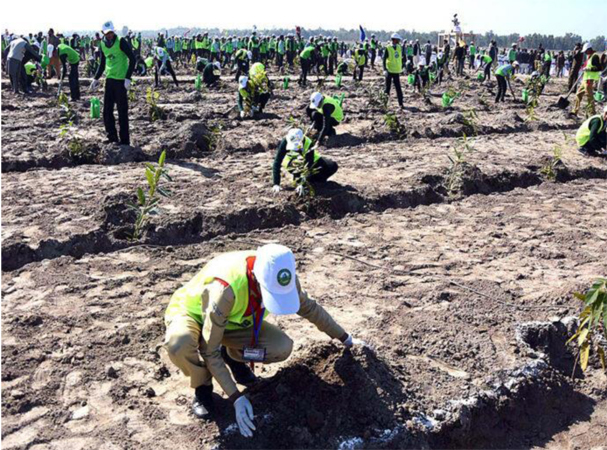
Equally important is what followed removal. Current policy mandates the plantation of three trees for every single tree removed. This is not symbolic rhetoric but an enforceable planning condition. Over 40,000 indigenous trees have already been planted under this framework, alongside more than 191,000 trees planted in 2025 alone and the dispersal of over two million seed balls across the Margalla landscape. These measures reflect expansion, not depletion.
Urban flooding, another frequently cited concern, also deserves clarity. Flood events in Islamabad have largely resulted from illegal encroachments, blocked natural waterways and unauthorized construction along nullahs – issues that predate recent infrastructure projects. Properly engineered roads and corridors restore drainage paths, incorporate slope management and reduce runoff pressure. It is unplanned sprawl, not regulated development, that creates water disasters.
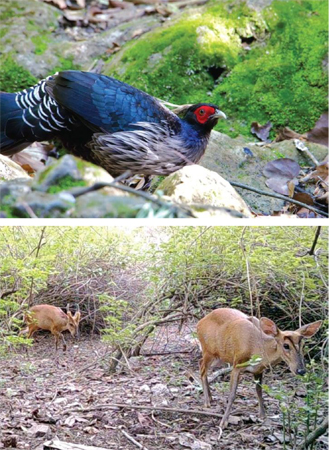
Similarly, concerns regarding wildlife must be addressed with realism rather than rhetoric. Capitals across the world coexist with adjacent national parks and protected zones through buffer areas, habitat restoration and controlled access. Wildlife conservation does not require halting all civic activity; it requires managing human expansion responsibly. Islamabad is no exception.
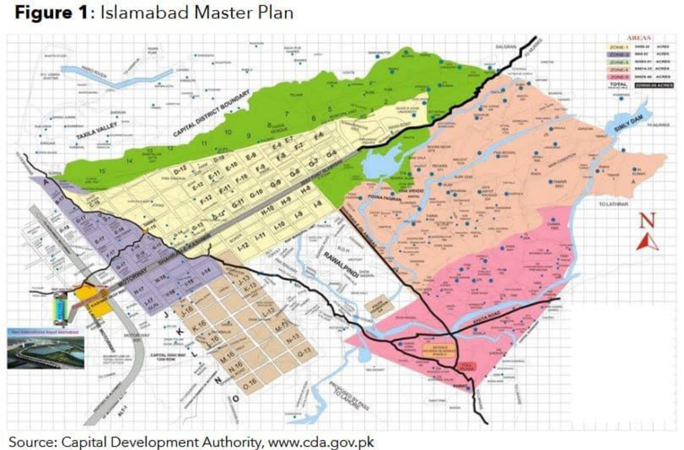
At the core of the city’s development approach remains strict adherence to the Islamabad Master Plan, which clearly distinguishes green zones from grey infrastructure areas. Development is confined to designated corridors, brownfield zones and previously disturbed land. Green belts are not being erased; they are being preserved through structured zoning and ecological redesign.
Environmental stewardship is not served by resisting every road, opposing every upgrade or romanticizing stagnation. It is served by evidence, balance and long-term planning. A city of nearly three million people and more so a capital city cannot be governed by sentiment alone. It must be guided by data, public health imperatives and sustainable design.
Hence, the real siege is not planned infrastructure, but “frozen minds”, “inertia to change”, “unfounded mindset rhetoric” and misinformation. Islamabad’s future lies not in denying growth, but in shaping it wisely. Protecting the environment does not mean freezing the city in the past; it means ensuring that progress today does not compromise life tomorrow. True sustainability is not the absence of development – it is development done right.