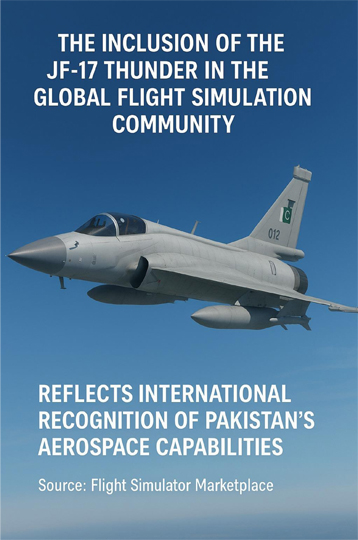
 For decades, the Microsoft Flight Simulator (MSFS) has served as the ultimate digital tapestry for aviation. It is a place where the world’s most sophisticated aerospace engineering is immortalized. To fly in this airspace is to join an elite club of airframes that define modern history. While the simulator has long hosted staples like the F-16 and F-35, the emergence of the JF-17 Thunder marks a transformative shift in the virtual skies.
This inclusion is more than a simple software update; it is a signal that the “Thunder,” born of a partnership between Pakistan and China, has officially graduated from a regional endeavor to a global aviation phenomenon. For the first time, millions of virtual pilots can experience the pride of the Pakistan Air Force (PAF) from the comfort of their cockpits.
A Digital Coming of Age

The JF-17’s presence in MSFS as a highly sought-after third-party add-on represents a moment of global recognition. This isn’t just an “extra aircraft”-it is a representation of a 4.5-generation multi-role fighter that has proven its worth in the most rigorous environments.

For Pakistan, the simulator serves as a global stage. While traditional defence narratives are often confined to specialized journals, MSFS brings the JF-17 to a mainstream, international audience. It allows users from Brazil to Belgium to engage with the aircraft’s unique systems, from its advanced glass cockpit to its specific flight laws. This organic interest from the simulation community acts as a “digital vindication,” confirming that the JF-17 has earned its place in the shared imagination of aviation enthusiasts.
JF-17 vs Tejas

A recurring theme in modern aviation discourse is the comparison between the JF-17 and its regional counterpart, the HAL Tejas. However, the world of flight simulation reveals a distinct trend. Despite its presence in its home market, the Tejas lacks a comparable footprint in the MSFS marketplace or among high-fidelity third-party developers.

The JF-17, by contrast, has seen a surge in community-driven content. From detailed operational aircraft liveries on ‘Flightsim.to’ to commercial packages available on the official MSFS Marketplace (such as the version by MScenery), the demand for the Thunder is palpable. This suggests that the JF-17 has more effectively “captured the flag” of global curiosity, motivating developers to recreate its performance with meticulous detail.
Technical Mastery & Operational Relevance

The JF-17 isn’t just about looks; it’s about a design philosophy rooted in modern combat reality. In the simulator, pilots can explore the very features that define the Block III variant which integrates modern radar and electronic warfare suites. Its capabilities involve long-range BVR (Beyond Visual Range) missiles like the PL-15. It has a philosophy of versatility that allows it to transition from air superiority to precision ground strike in a single mission.

This technical allure was first established in Digital Combat Simulator (DCS), where the JF-17 module by Deka Ironwork is frequently cited as one of the most “complete” and detailed modules available. Its migration to MSFS allows for a different kind of appreciation: the ability to fly the Thunder across the diverse landscapes of Earth.

The “Battle Proven” Prestige

What truly separates the JF-17 from many of its peers-both in reality and in simulation-is its status as a “battle-proven” aircraft. The events of 2019, and the more recent reports from May 2025 regarding the neutralization of advanced air defense systems like the S-400, have turned the JF-17 into a subject of intense study.
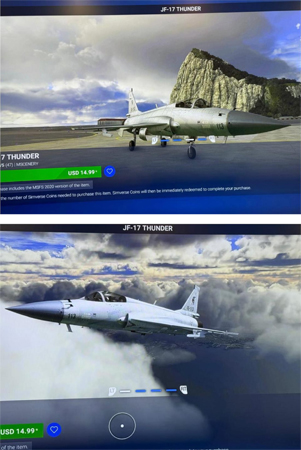
Aviation analysts and virtual pilots alike are drawn to aircraft with a story. In MSFS, the JF-17 isn’t just a collection of pixels; it is a digital surrogate for an airframe that has been tested in high-stakes environments. This real-world effectiveness translates into digital demand, as users seek to recreate the patrols and missions that have made the Thunder a household name in defense circles.
A Shared Aviation Reality
Ultimately, the JF-17’s journey into Microsoft Flight Simulator is a story of convergence. It represents the point where national pride, industrial ambition, and a global gaming community meet. Whether navigating the high-altitude peaks of the Karakoram or performing a low-level coastal run in the Mediterranean, the JF-17 flies with a confidence that mirrors its real-world trajectory.
It is no longer just “Pakistan’s fighter.” Through the lens of MSFS, the JF-17 Thunder has become a global aviation reality. It is a machine that stands as a testament to what can be achieved through strategic vision and technical persistence. As it continues to receive updates and new liveries from the community, the Thunder’s legacy in the digital realm is only just the beginning.