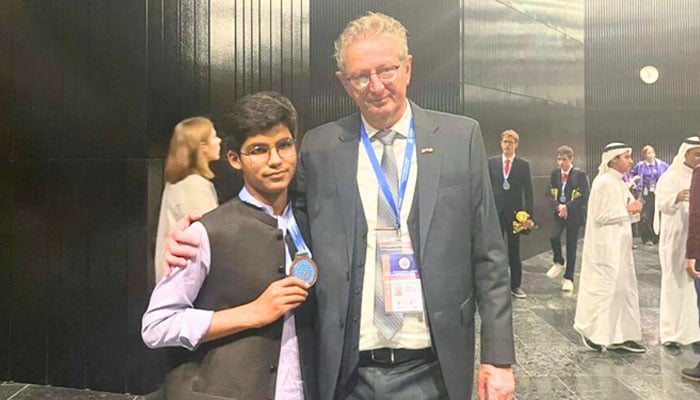
Muhammad Hashir, a student from Balochistan Residential College Loralai, has brought pride to Pakistan by securing a bronze medal at the International Junior Science Olympiad (IJSO) 2025. The competition, held from November 23 to December 2 in Sirius, Russia, gathered the brightest young minds from 80 countries to compete in Physics, Chemistry, and Biology.
Read More: PSF seeks applications from science students for participating in IJSO
Hashir’s performance stood out among hundreds of participants under the age of 16, earning recognition for his problem-solving skills and scientific knowledge. His achievement highlights the potential of Pakistan’s youth to excel on a global stage and serves as a source of national pride.
Pakistan’s delegation comprised six students selected through a competitive national process organised by the Pakistan Science Foundation and the Ministry of Science and Technology. Alongside Hashir, the team included Muhammad Zakariya from KP, Faisal Sattar from Balochistan, Mahendra Maheshwari from Sindh, Yasir Habib from Punjab, and Hamdan Ishaq representing the Federal region. They were accompanied by team leaders who guided them through both theoretical and experimental exams.
The International Junior Science Olympiad is a prestigious platform that nurtures young scientific talent and encourages students to demonstrate their capabilities internationally. Participation allows countries to showcase their commitment to science education and the development of STEM skills among youth.
The Pakistan Science Foundation and Ministry of Science and Technology congratulated all participants and mentors for their dedication. Hashir’s bronze medal is being celebrated as a testament to the efforts of educators and the perseverance of young scientists.
Read More: Pakistan grabs three bronze medals in World Fitness Championship
This achievement is expected to inspire students nationwide to pursue excellence in science and technology. It underscores that with proper guidance and opportunities, Pakistani youth can compete and succeed at the highest levels of international scientific competition.