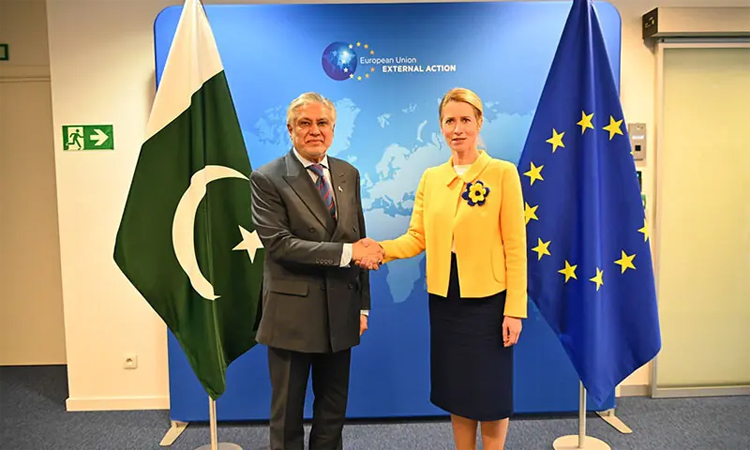
 In a joint statement shared on Sunday, Pakistan and the European Union (EU) called on Afghanistan to deal with terrorist organisations operating from its soil and to ensure the protection of human rights, especially those of women and girls.
The development came as the 7th Strategic Dialogue between Pakistan and the EU was convened in Brussels. The meeting was co-chaired by Deputy Prime Minister and Foreign Minister Ishaq Dar and the EU’s chief diplomat Kaja Kallas.
According to a joint statement shared by the Foreign Office (FO), Dar and Kallas discussed relations between Islamabad and Kabul amid cross-border tensions last month, with both top diplomats reaffirming their commitment to regional peace, stability, prosperity, and resolving issues with neighbours through dialogue.
“The two sides called on Afghanistan’s de facto authorities to play a constructive role in achieving the shared objective of rooting out terrorism from Afghan soil,” the statement read.
It added that Dar and Kallas expressed concern over Kabul’s deteriorating socioeconomic conditions and were in favour of a “peaceful, stable and self-reliant Afghanistan”.
They also hoped that Afghanistan would advocate for a “credible political process aligned with the UN-led ‘Doha process’, and in line with the commitments made by the Taliban de facto Authorities to the international community”, according to the statement.
It added that the EU appreciated Pakistan’s hosting millions of Afghan nationals for over four decades, but emphasised that any repatriation must be “safe, dignified and in line with international standards”.
“Both sides called upon the Afghan authorities to ensure protection of human rights, especially for women, girls and vulnerable communities,” the statement read.
Pakistan’s bilateral relations with Afghanistan have come under strain in recent times as the Tehreek-i-Taliban Pakistan (TTP) remains the main point of contention between the two countries.
Pakistan has demanded that the rulers in Kabul take action to stop cross-border terrorism, but the Afghan Taliban deny Islamabad’s allegations of terrorists being allowed to use Afghan soil to carry out attacks in Pakistan.
During a process of dialogue, which followed border clashes between the two countries in October, the two sides had met in an effort to work on mechanisms for lasting peace and stability between the two countries.
But the process ended in no result due to Afghan Taliban’s stubbornness.