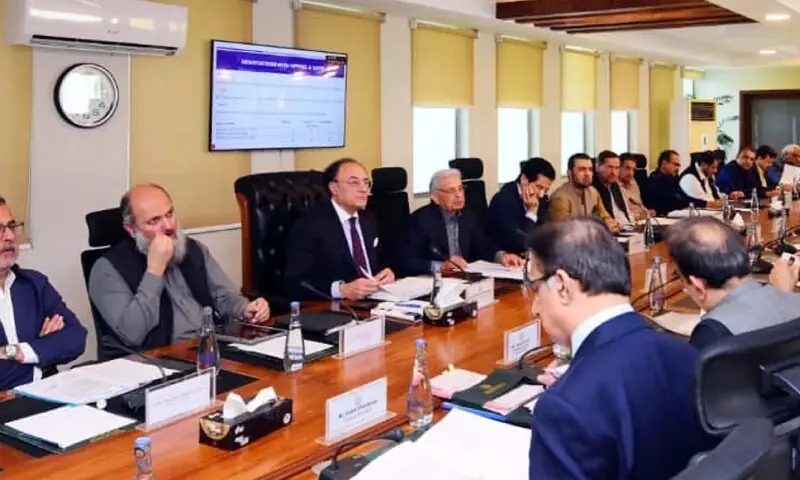
ISLAMABAD: The Economic Coordination Committee (ECC) of the Cabinet on Friday approved an inter-corporate circular debt settlement plan, including tariff rationalisation for all six operational nuclear power plants, aligning them with other power producers and paving the way for the eventual winding up of Power Holding Limited (PHL) — a company created to manage legacy power debt.
Chaired by Finance Minister Muhammad Aurangzeb, the ECC also approved sovereign guarantees worth Rs660 billion to back commercial loans of Rs1.225 trillion from local banks for circular debt settlement and the diversion of gas to fertiliser plants. The decision is part of a broader financial restructuring plan finalised by the military-led task force on power sector reforms.
Read More: Pakistan’s power sector circular debt rises to Rs1.69 trillion
The committee authorised the Central Power Purchasing Agency (CPPA) to finalise settlement agreements with the Pakistan Atomic Energy Commission (PAEC) covering six nuclear power plants — four in Chashma (C1–C4) and two in Karachi (K2–K3) — with a combined capacity of about 3,500MW. Under the new framework, the federal government will assume certain financial obligations, while PAEC will submit fresh tariff petitions reflecting the revised debt adjustments.
Additionally, the ECC approved repayment of Rs23.6 billion in PHL loans and a waiver of Rs119.5 billion in late-payment interest for LNG-based power plants at Bhikki, Balloki, and Haveli Bahadur Shah. It also sanctioned payments due to the Oil and Gas Development Company Limited (OGDCL) through the Uch power plants and directed the Power Division to prepare a closure timeline for PHL.
Read More: Govt plans hikes to tackle Rs 2800B gas debt
Further decisions included Rs960 million for the Interior Ministry to cover staff salaries, the reallocation of agricultural research funds, and approval for the diversion of 220 million cubic feet of gas from various fields to fertiliser plants to ensure stable and affordable fertiliser production. The Ministry of Maritime Affairs’ proposal for mineral exports via Port Qasim was deferred pending further stakeholder input.