BEIJING: A crew of three Chinese astronauts, including the country’s youngest-ever spacefarer, successfully docked with the Tiangong space station early Saturday, marking another milestone in China’s expanding space ambitions.
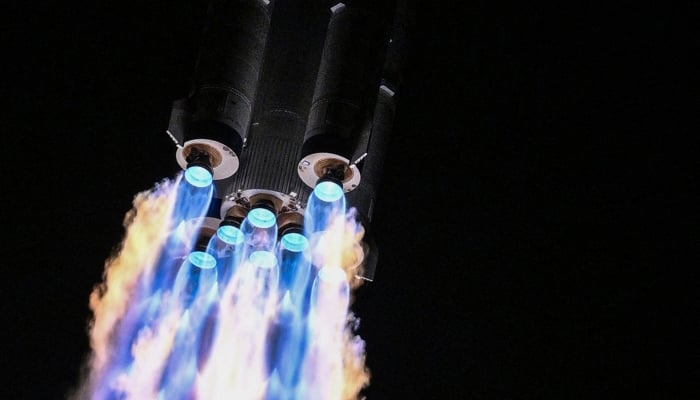
According to Xinhua News Agency, the Shenzhou-21 spacecraft docked with Tiangong at 3:22 a.m. (1922 GMT Friday) — about three and a half hours after lifting off from the Jiuquan Satellite Launch Centre in northwest China’s Gobi Desert, propelled by a Long March-2F rocket.
The mission’s commander Zhang Lu is joined by 32-year-old flight engineer Wu Fei, China’s youngest astronaut ever to enter orbit, and payload specialist Zhang Hongzhang, 39. In a historic first, the trio is accompanied by four lab mice — two male and two female — for China’s first in-orbit rodent experiments aimed at advancing biological research in microgravity.
Read More: China plans to have a Pakistani astronaut on short-term missions
Before liftoff, the astronauts waved goodbye to colleagues and family members as a band played a patriotic song. Zhang Lu expressed confidence that his team would “report back to our motherland and its people with complete success,” while first-time astronaut Wu Fei said he felt “incomparably lucky.”
The Tiangong space station, crewed by rotating teams every six months, stands as the crown jewel of China’s space program, into which billions have been invested to rival the United States and Russia. Beijing aims to send astronauts to the Moon by 2030 and eventually establish a lunar base.
The China Manned Space Agency (CMSA) said the Shenzhou-21 crew will conduct spacewalks, install anti-debris shields, and engage in educational outreach to inspire future generations. China, barred from the International Space Station (ISS) since 2011 due to U.S. restrictions, has since sought international cooperation, recently signing an agreement with Pakistan to train and recruit the first foreign “taikonauts.”
Read More: China to send Pakistan’s first astronaut on space mission by 2026