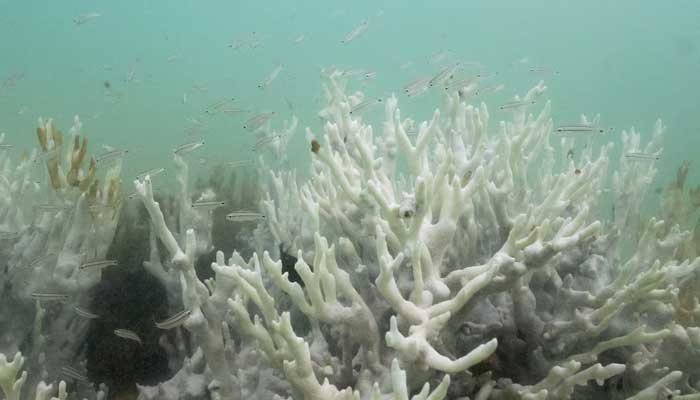
LONDON – The planet is edging past multiple climate “tipping points” faster than expected, with scientists warning that global coral reefs are now in an almost irreversible die-off, marking the first large-scale ecosystem collapse driven by human-induced warming.
The findings come from the Global Tipping Points Report, released Monday by a coalition of 160 researchers worldwide. The study synthesizes cutting-edge data on how climate systems are approaching — and in some cases, surpassing — critical thresholds.
Marine heatwaves in the last two years have stressed 84% of the world’s coral reefs, causing widespread bleaching and death. Scientists say the world’s reefs — vital for sustaining a quarter of all marine life — would only recover if temperatures were brought back down to 1°C above preindustrial levels, a goal now seen as almost unreachable. “Change is happening fast now, tragically, in parts of the climate, the biosphere,” said Tim Lenton of the University of Exeter, the report’s lead author.
Read More: Tragic Fire in Jaipur Hospital ICU Kills Eight
The study also revises downward the danger threshold for the Amazon rainforest, warning that even 1.5°C of warming — the benchmark set in the Paris Agreement — could trigger a collapse in the forest ecosystem due to deforestation and rising heat stress. This year’s COP30 summit, set to take place in Brazil’s Amazon region, is expected to face intense pressure to deliver a credible global action plan.
The report highlights growing instability in the Atlantic Meridional Overturning Circulation (AMOC) — a key ocean current that regulates Europe’s climate. A major disruption could drastically alter weather patterns, bringing colder winters and intensified storms across the northern hemisphere.
Read More: Mosque Demolitions Raise Fears for Muslims in India
Despite the grim outlook, researchers pointed to glimmers of progress. Renewable energy sources outpaced coal for electricity generation globally this year, according to data from the think tank Ember. “Nobody wants to be just traumatised and disempowered,” Lenton said. “We still have some agency.”
Average global temperatures are already 1.3–1.4°C higher than preindustrial levels, according to U.N. and EU science agencies. At the current pace, the planet is on track for about 3.1°C of warming this century — a level that would trigger multiple irreversible shifts in Earth’s systems. “Each year there is an increase in the scope and magnitude of the negative impacts of climate change,” said Pep Canadell, senior scientist at Australia’s CSIRO Climate Science Centre.
As nations prepare for COP30, scientists warn the next decade will decide whether humanity can still avoid cascading climate collapse — or merely manage its consequences.