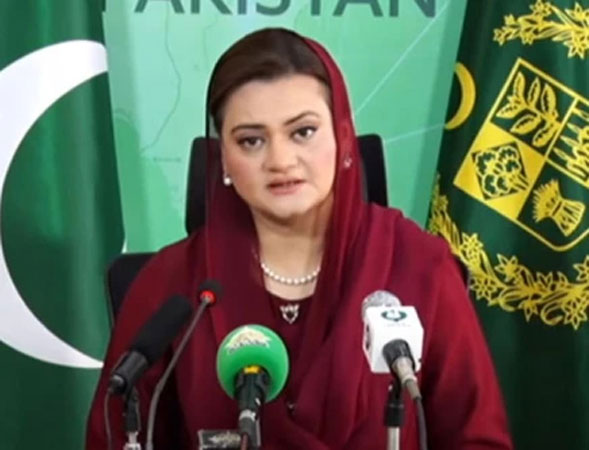
 Punjab Senior Minister Maryam Aurangzeb addressed the ceremony of the “Breathe Pakistan Programme”, emphasizing that the Punjab Government is taking effective and comprehensive measures to combat environmental pollution and smog.
The event was organized by Dawn Media Group, with participation from Federal Minister for Climate Change and Environmental Protection Dr. Musaddiq Masood Malik, UN Resident and Humanitarian Coordinator for Pakistan Mohammad Yahya, policymakers, stakeholders, environmental experts, and civil society representatives in large numbers.
Maryam Aurangzeb congratulated Dawn Media Group for organizing the important event and stated that, with the onset of the smog season, the Punjab Government has adopted a more advanced strategy this year.
She noted that, for the first time, a Climate Vision was approved in March, while the Climate Change Policy, data and AI-based monitoring systems, and a multi-sectoral plan have all become fully operational.
The Minister stated that continuous air quality monitoring is underway across all districts of Punjab, with 41 Air Quality Monitoring Stations currently functioning in Lahore.
She added that drones and Safe City cameras are being used to detect sources of toxic emissions.
To prevent crop residue burning, 5,000 super seeders have been activated, and 67 stubble burning zones have been established.
Maryam Aurangzeb remarked: “We now have political will, data, technology, and legislative reforms. The future of our environment-whether better or worse-depends on the choices we make as a society.”
She further stated that over 2,000 brick kilns violating environmental regulations have been demolished, while 900 non-compliant factories have been shut down.
Each chimney is now linked to the control room via cameras for real-time monitoring.
Regarding transport, she shared that vehicle testing is ongoing, and under a $300 million buyback policy, old vehicles are being retired. The EPA fuel testing process has also commenced.
In addition, 1,100 electric buses are currently operating across Punjab as part of the Green Transport Vision.
In line with global environmental goals, the National Carbon Credit Programme has been activated, while cooperation is ongoing on the East Wind Corridor for sustainable initiatives.
Maryam Aurangzeb stated that through the Breathe Pakistan Programme, the province is not only mitigating the impacts of climate change but also reducing the risks of floods and environmental disasters.
Under the Plastic Zero Punjab Programme, 360 tons of plastic waste have been seized and repurposed into furniture for children’s parks and schools.
The EPA has been certified as Smart Waste Compliant, and by October 30, segregated dustbins will be mandatory in all public schools.
She added that under the Clean Punjab Programme, over 100,000 workers are engaged daily in street cleaning operations.
“The government is providing policies, regulations, and incentives,” she said, “but public and media cooperation is essential.”
Maryam Aurangzeb concluded: “Under the leadership of Chief Minister Maryam Nawaz Sharif, we have implemented environmental policy at the grassroots level. The true strength of this effort lies in the participation of the public, the media, and the education of our children.”
At the end of the ceremony, Federal Minister for Climate Change Dr. Musaddiq Masood Malik and UN Resident and Humanitarian Coordinator Mohammad Yahya appreciated Chief Minister Maryam Nawaz Sharif and the Punjab Government’s environmental initiatives, stating that:
“The Punjab Government has taken practical and sustainable measures to combat smog and environmental pollution, setting an example for other provinces to follow.”